
Sudoku looks like a maths puzzle and contains no maths at all. Nikoli, the Japanese publisher that named it, describes it as a puzzle that "requires no calculations", only brains and concentration. The digits are labels. You could swap them for nine colours, nine animals or nine letters and every puzzle would work exactly the same way.
That one fact changes how to teach sudoku for kids. A child who freezes at the sight of numbers can still be very good at it, and a child who is quick at sums has no head start. What Sudoku does train is deduction: ruling things out until only one answer is left. This guide covers which grid size suits which age, the four solving techniques in the order children can actually absorb them, and three printable puzzles (4x4, 6x6 and 9x9) that we checked by computer to make sure each one has exactly one solution.
Key Takeaways
- Start small. A 4x4 grid has 16 cells and four symbols, and most children can finish one in their first sitting.
- Sudoku needs no arithmetic. The publisher that named it says so, and any nine symbols work in place of the digits.
- Teach the techniques in order: scanning, naked singles, hidden singles, then pencil marks. Pencil marks come last, not first.
- The fewest clues a standard 9x9 can have and still have one answer is 17, proved by an exhaustive computer search published in 2012.
- Sudoku makes children better at Sudoku. Claims that it raises general intelligence are not supported by the research reviews.
Which Sudoku grid size suits which age?
Match the grid to the child's patience for checking, not to their school year. The rule is identical on every size (each row, each column and each box holds every symbol exactly once), so a child who outgrows one grid already knows how to play the next. Here is the progression we use with younger learners. Treat the ages as a starting guide from teaching experience, not a developmental standard.
| Age | Grid | Cells | Box shape | Symbols | What a good first session looks like |
|---|---|---|---|---|---|
| 4 to 6 | 4x4 | 16 | 2 by 2 | 1 to 4, or four pictures | Finishes a 6-clue grid with a parent pointing at one row at a time |
| 6 to 8 | 6x6 | 36 | 2 rows by 3 columns | 1 to 6 | Finishes a 14-clue grid alone, using scanning only |
| 8 and up | 9x9 | 81 | 3 by 3 | 1 to 9 | Finishes an easy 30-clue grid in one or two sittings, starting to use naked singles |
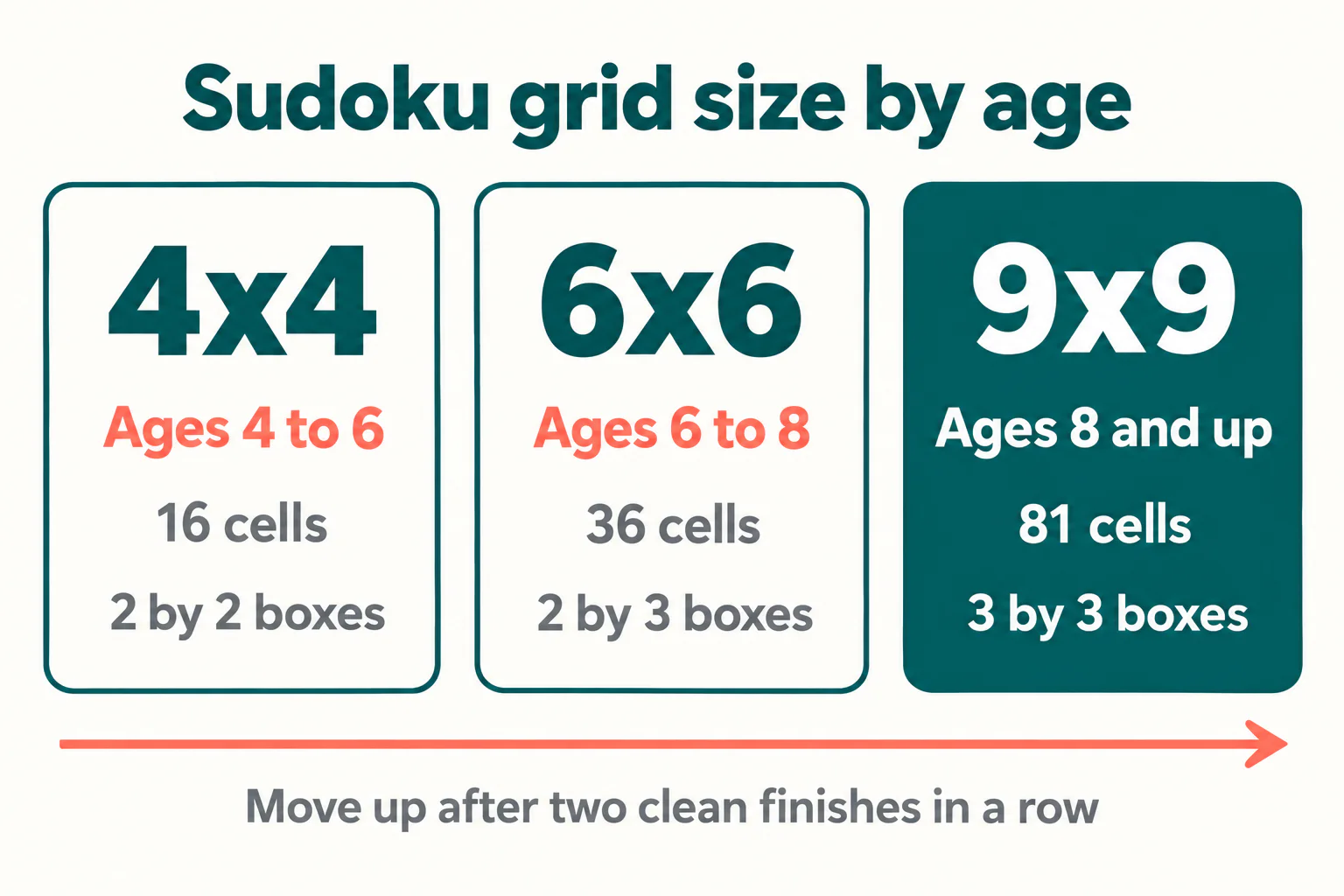
The 6x6 stage is the one most families skip, and it is the one that matters most. Going straight from 4x4 to 9x9 multiplies the number of cells by five. A 6x6 grid introduces rectangular boxes and a second technique without that cliff. A sensible signal to move up a size: two puzzles in a row finished without help and without erasing.
For the youngest group, pictures beat numbers. Four stickers (a cat, a sun, a tree, a boat) on a 4x4 grid teach exactly the same logic, and they remove any suggestion that the puzzle is about counting.
Is Sudoku maths? What it does and does not train
No. Sudoku is a logic puzzle that happens to use digits as symbols. You never add, compare or order them. The number 7 is not "bigger" than 3 inside a Sudoku; it is simply a different label. When Nikoli found the puzzle in an American magazine and brought it to Japan in 1984, its title was Number Place, and Nikoli's own rules still talk only about placing each number once per row, column and block.
That makes Sudoku unusually useful for children who have decided they are "bad at maths". It offers a win in a format that looks mathematical, without a single calculation to trip over. If that describes your child, our guide to maths anxiety in kids explains why low-stakes wins of this kind matter.
What Sudoku does exercise is a narrow but real set of habits:
- Elimination. Finding an answer by crossing out everything it cannot be.
- Holding constraints in mind. A cell sits in one row, one column and one box at once, and all three have to agree.
- Checking before committing. A wrong digit placed early does not announce itself until much later, which teaches children to verify.
- Persistence without guessing. A well-made puzzle never requires a guess, so "I'll just try a 5" is always the wrong move.
Those same habits show up in proof-style reasoning in later maths and in debugging code, where the job is also to rule out what cannot be wrong. That is a plausible link, not a proven one, and the honest version of the claim is in the section on whether Sudoku makes children smarter.
The four Sudoku techniques for kids, in teaching order
Every easy and medium puzzle can be solved with four ideas. Teach them one at a time, and do not introduce the next until the current one is automatic. The worked examples below use the 9x9 puzzle further down this page. Rows are counted from the top and columns from the left.
1. Scanning (cross-hatching)
Pick one number and one box. Look along every row and column that passes through the box and cross out the cells where that number cannot go, because it already appears in that row or column. If only one empty cell is left, the number goes there.
In the 9x9 puzzle, try the number 3 in the top-left box. Row 1 already has a 3 (at the far right), so the top row of the box is out. Column 1 already has a 3 (in row 4), so the left column of the box is out. The only empty cell left for 3 is row 2, column 3. Scanning is the right first technique because a child only has to track one number at a time.
2. Naked singles (the last number left in a cell)
Now flip the question. Instead of "where does this number go?", ask "what can go in this cell?" List every number already present in the cell's row, column and box. If eight of the nine are taken, the ninth is the answer.
Look at row 2, column 9. Row 2 contains 1, 4, 5, 7 and 8. Column 9 adds 3 and 9. The top-right box adds 2. That accounts for every number except 6, so the cell must be 6. Children usually find this harder than scanning, because they have to combine three lists in their head. Writing the three lists on paper the first few times helps.
3. Hidden singles (the only place left for a number)
This is scanning applied to a whole row or column instead of a box. Take a row, pick a number it is missing, and check every empty cell in that row. If the number is blocked from all but one cell, it goes in that cell, even if the cell itself still has other possibilities.
Row 3 is missing a 3. Its empty cells are in columns 1, 4, 5, 6, 7 and 9. Column 1 already has a 3, so do columns 5 and 6, and the top-right box (which covers columns 7 and 9) has one too. Only column 4 is left, so row 3, column 4 is a 3. The "hidden" part is the reason it comes third: the cell does not look solved until you think from the number's point of view.
4. Pencil marks (candidates)
When scanning and singles stop producing answers, write the possible numbers for each empty cell in small digits in its corner. These are called candidates or pencil marks. Every time a number is placed, erase it from the pencil marks in its row, column and box. A cell that drops to one candidate is a naked single you would otherwise have missed.
Pencil marks are bookkeeping, not a strategy, which is why they come last. A child who has the first three techniques automatic uses pencil marks to stay organised on harder puzzles. A child who starts with them spends twenty minutes writing tiny numbers and never learns to see the cell that is already decided. None of the three puzzles on this page needs pencil marks, though a 9x9 solver will find them useful for keeping track.
Notice your child enjoys the "rule it out" part more than the arithmetic? That is a reasoning strength worth building on. A free trial maths class with a Codeyoung teacher shows you where your child is and what they are ready for next, before you commit to anything.
Book a Free Trial →Printable Sudoku puzzles for kids, with answers
Three puzzles, one per stage. Each was generated and then checked with a computer solver that counts every possible completion: all three have exactly one solution, and all three can be finished with scanning and singles alone, no guessing required. Print this page or copy the grids onto squared paper. Thick lines mark the boxes.
Puzzle 1: 4x4 (ages 4 to 6, 6 clues)
Use the numbers 1 to 4. Each row, each column and each 2 by 2 box needs all four.
| 1 | |||
| 2 | 3 | 1 | |
| 4 | 2 |
Where to start: the third row is already missing only one number. After that, look at the bottom row, which needs a 1 and a 3, and check which column already has a 1.
Puzzle 2: 6x6 (ages 6 to 8, 14 clues)
Use the numbers 1 to 6. The boxes are 2 rows tall and 3 columns wide.
| 6 | 2 | 4 | 5 | ||
| 2 | 6 | ||||
| 5 | |||||
| 6 | 2 | ||||
| 2 | 1 | 5 | 6 | ||
| 1 |
Where to start: scan for the 5 in the top-left box. The top row already has a 5, and so does the second column, which leaves only one cell in the box where a 5 can go.
Puzzle 3: 9x9 (ages 8 and up, 30 clues)
Use the numbers 1 to 9. This is the grid used in the technique examples above, so the first three moves are already explained.
| 6 | 8 | 2 | 3 | |||||
| 1 | 5 | 4 | 7 | 8 | ||||
| 8 | 2 | 1 | ||||||
| 3 | 5 | 9 | ||||||
| 8 | 2 | |||||||
| 6 | 1 | 3 | 8 | |||||
| 4 | 3 | 6 | 9 | |||||
| 5 | ||||||||
| 6 | 1 | 9 | 5 |
Answers
Given clues are in bold. Cover these until the puzzle is finished.
4x4 answer
| 4 | 1 | 2 | 3 |
| 3 | 2 | 4 | 1 |
| 2 | 3 | 1 | 4 |
| 1 | 4 | 3 | 2 |
6x6 answer
| 3 | 1 | 6 | 2 | 4 | 5 |
| 5 | 4 | 2 | 6 | 1 | 3 |
| 2 | 5 | 3 | 1 | 6 | 4 |
| 1 | 6 | 4 | 3 | 5 | 2 |
| 4 | 2 | 1 | 5 | 3 | 6 |
| 6 | 3 | 5 | 4 | 2 | 1 |
9x9 answer
| 4 | 9 | 6 | 8 | 7 | 1 | 5 | 2 | 3 |
| 1 | 5 | 3 | 2 | 9 | 4 | 7 | 8 | 6 |
| 7 | 8 | 2 | 3 | 5 | 6 | 9 | 1 | 4 |
| 3 | 4 | 7 | 5 | 2 | 8 | 1 | 6 | 9 |
| 8 | 2 | 1 | 6 | 4 | 9 | 3 | 5 | 7 |
| 9 | 6 | 5 | 1 | 3 | 7 | 2 | 4 | 8 |
| 2 | 7 | 8 | 4 | 1 | 3 | 6 | 9 | 5 |
| 5 | 3 | 4 | 9 | 6 | 2 | 8 | 7 | 1 |
| 6 | 1 | 9 | 7 | 8 | 5 | 4 | 3 | 2 |
When your child finishes a grid, have them check it rather than you. Running a finger along each row, then each column, then each box, and confirming no symbol repeats is the same verification habit that makes a good maths student.
Why 17 clues is the floor, and why kids' puzzles give many more
Here is the fact most Sudoku articles get vague about. A proper Sudoku must have exactly one solution, and the fewest clues a standard 9x9 can give while still doing that is 17. Not "about 17" or "experts believe 17". It is proved.
Puzzles with 17 clues had been known for years, and nobody had found one with 16. In January 2012 three researchers, Gary McGuire of University College Dublin, Bastian Tugemann, and Gilles Civario of the Irish Centre for High-End Computing, posted a paper titled "There is no 16-Clue Sudoku". They checked every essentially different completed grid, all 5,472,730,538 of them, for a 16-clue puzzle hiding inside. The search took about 7.1 million core hours on a supercomputer cluster and found none. So 17 is the minimum.
The same paper lists the minimums for smaller grids, which is useful when you are picking puzzles for a younger child:
| Grid | Box | Fewest clues for one solution | Possible completed grids |
|---|---|---|---|
| 4x4 | 2 by 2 | 4 | 288 |
| 6x6 | 2 by 3 | 8 | 28,200,960 |
| 9x9 | 3 by 3 | 17 | 6,670,903,752,021,072,936,960 |

Two things follow for parents. First, fewer clues does not automatically mean harder. Difficulty comes from which techniques the puzzle forces, so two grids with the same number of clues can feel completely different. Second, a puzzle with fewer clues than these floors cannot have a single answer, and not every printable or homemade grid has been checked for one. A child who works for twenty minutes on a puzzle with two valid answers will eventually be "wrong" through no fault of their own, so use sources that state each puzzle has one solution. According to the McGuire paper, Nikoli has a rule that none of its puzzles uses more than 32 clues, which gives a sense of how many a well-built easy puzzle carries.
Does Sudoku make children smarter?
It makes them better at Sudoku. Whether it does more than that is a question researchers have tested directly, and the answer so far is disappointing for anyone hoping for a shortcut.
In 2016 a team led by Daniel Simons at the University of Illinois reviewed the evidence behind commercial brain-training programmes, including all 132 journal articles cited by a group of brain-training proponents. Their finding, as the University of Illinois summarised it: people improve on the specific tasks they practise, there is little evidence of broad transfer to other tasks, and little evidence of real-world benefits. That review was about computerised training games rather than paper Sudoku specifically, but it is the best evidence on the "puzzles make you cleverer" question, and it does not support the claim.
So why bother? Because the specific habits are worth having for their own sake. A child who learns to eliminate options, check their work and refuse to guess is practising things a maths teacher spends years asking for. Sudoku is a pleasant, low-pressure place to practise them, not a cognitive vitamin. If your child enjoys this kind of thinking, mix it with other formats: our IQ-style thinking questions for kids stretch pattern-spotting in a different direction, and these maths games for kids add the arithmetic that Sudoku leaves out. For the broader picture, see our guide on building logical thinking.
Where children get stuck, and what fixes it
They guess. The most common habit, and the most damaging, because a guessed digit can sit unnoticed for ten moves before it causes a clash. The fix is a house rule: every number placed must come with a reason the child can say out loud ("it's the only place left for a 3 in this box").
They stare at the whole grid. Eighty-one cells is too much to look at at once. Give a narrower instruction: "pick the number that appears most often and scan every box for it". Numbers already placed six or seven times are the easiest to finish.
They erase in frustration. When a clash appears, a child often wipes the whole grid. Teach them to find the two clashing numbers first and work backwards from there. Writing in pencil, with placed numbers slightly larger than pencil marks, makes this possible.
They lose interest at 9x9. Usually a sign the jump came too early. Go back to 6x6 for a week. There is no prize for reaching the big grid quickly, and a child who finishes three 6x6 puzzles happily is learning more than one who abandons a 9x9 halfway.
Getting started with Sudoku for kids
Start with a 4x4, move to 6x6 once two puzzles in a row go cleanly, and save 9x9 for when scanning is automatic. Teach scanning first, then naked singles, then hidden singles, and leave pencil marks until the first three are second nature. Use puzzles with exactly one solution, and remember the clue count says little about difficulty. Above all, treat Sudoku as practice in reasoning rather than arithmetic, because that is what it is: the puzzle's own publisher says it requires no calculations.
Codeyoung runs 1:1 live online maths classes for children aged 6 to 17, with a teacher who builds reasoning and the "why" before formal methods, and adapts the pace to your child rather than a fixed syllabus. The first class is free, so you can see how they respond before deciding.
Book a Free TrialExplore our online maths classes for kids.
Sources checked 18 November 2026: Nikoli's own Sudoku rules and history page (nikoli.co.jp); McGuire, Tugemann and Civario, "There is no 16-Clue Sudoku: Solving the Sudoku Minimum Number of Clues Problem via Hitting Set Enumeration", arXiv:1201.0749 (v2, 2013), for the 17-clue proof, the computation, the minimum-clue and grid-count table and the Nikoli 32-clue rule; Simons et al., "Do 'Brain-Training' Programs Work?", Psychological Science in the Public Interest (2016), via the University of Illinois news release; Andrew Stuart's SudokuWiki for technique names. The three puzzles were verified with our own solver to have exactly one solution each.