
Search for spelling words by grade and you will find hundreds of lists headed "4th grade spelling words" or "Year 4 statutory spellings". Most look official. In the United States none of them can be, because Common Core contains no spelling word list at all. Its entire spelling standard for Grade 4 is one line: "Spell grade-appropriate words correctly, consulting references as needed." It never says which words are grade-appropriate.
England does publish official word lists, and they are statutory. But there are only two, and each covers two school years at once, so there is no government Year 3 list or Year 4 list, only a single list for both. What follows is what each system actually requires at each age, the example words that come straight from the official documents, and how to practise them in a way that carries over into your child's own writing.
Key Takeaways
- Common Core lists spelling skills, not spelling words. Any US grade list is a publisher's or school's choice.
- England has two statutory lists of 100 words each, one for Years 3 and 4 and one for Years 5 and 6. The Year 1 and Year 2 words in the official appendix are non-statutory examples.
- The order is the same in both countries: sounds to letters first, then common patterns, then prefixes and suffixes, then word origins.
- The US spelling standard gets shorter as children get older. Grade 3 has three spelling lines; Grade 6 has two words: "Spell correctly."
- Teaching the rule beats teaching the list, because one suffix rule covers hundreds of words and a list covers twelve.
Spelling words by grade: the age-banded table
England's spelling appendix is organised into four stages: Year 1, Year 2, Years 3 and 4, and Years 5 and 6. US Common Core runs grade by grade. Lined up by age, they map onto each other closely, and the table below uses England's four stages because that is how the official word examples are grouped.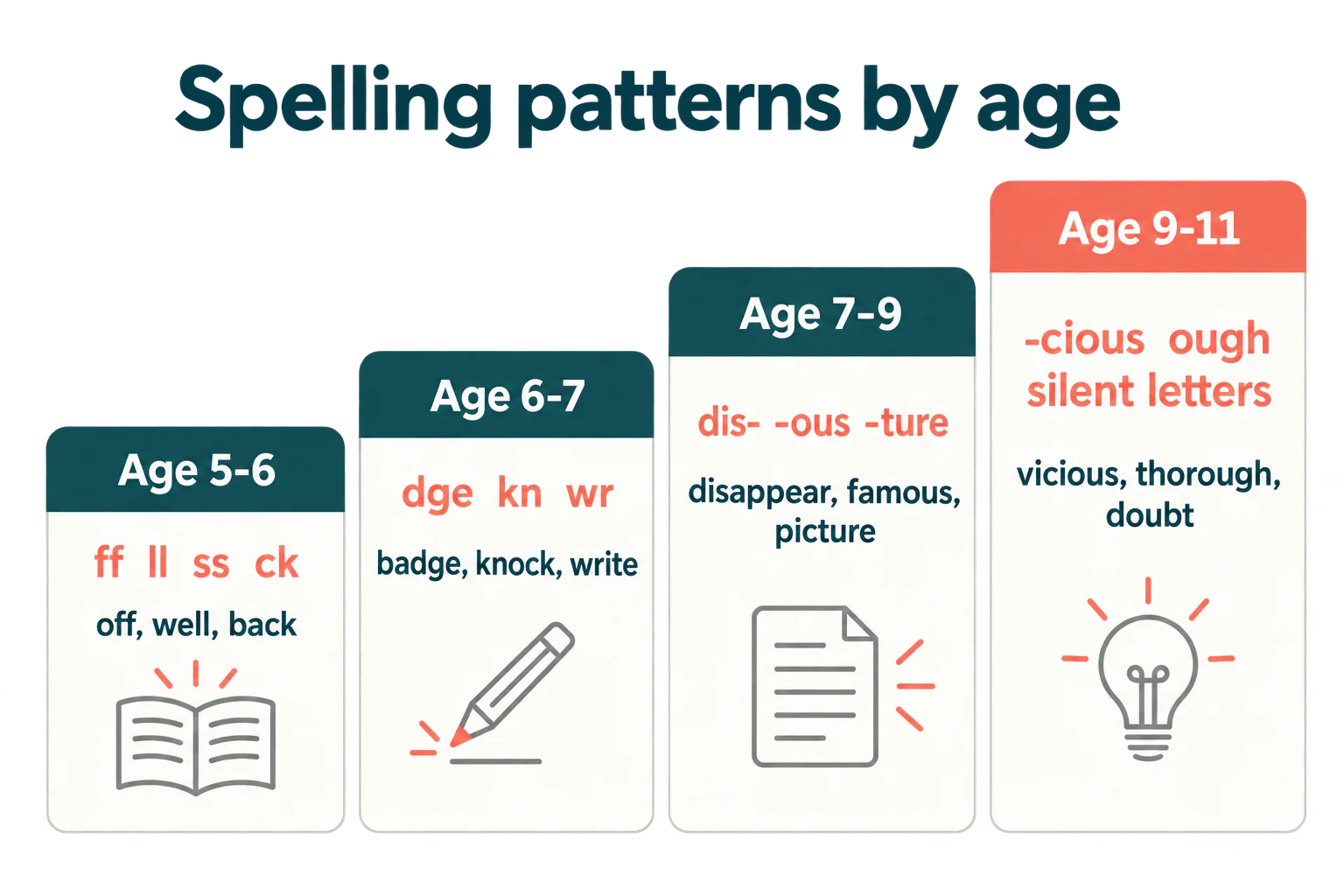
| Age | England | US | Patterns expected | Example words from the official documents |
|---|---|---|---|---|
| 5–6 | Year 1 | Kindergarten | One letter or pair per sound; ff, ll, ss, zz, ck; plurals with -s and -es; the prefix un- | off, well, miss, back, think, catch, cats, catches, unfair |
| 6–7 | Year 2 | Grade 1 | -dge and -ge; kn, gn and wr; -le, -el, -al; y changing to i; doubling before -ing; -tion; contractions | badge, huge, knock, write, table, camel, copied, patting, station, can't |
| 7–9 | Years 3–4 | Grades 2–3 | Prefixes dis-, mis-, in-, il-, im-, ir-, re-, sub-; suffixes -ation, -ly, -ous, -sure, -ture, -sion; plural possessive apostrophe | disappear, illegal, impossible, sadly, famous, treasure, picture, decision, girls' |
| 9–11 | Years 5–6 | Grades 4–5 | -cious and -tious; -cial and -tial; -ant against -ent; -able against -ible; ei after c; ough; silent letters | vicious, essential, tolerance, obedient, adorable, sensible, receive, thorough, doubt |
The age ranges are the typical ages for each year group or grade. Read the table as a sequence rather than a deadline. A child who has not yet secured the Year 2 rule for dropping the e before -ing (hike, hiking) will struggle with every suffix after it, whatever their age.
Ages 5 to 6: Kindergarten and Year 1
Common Core asks kindergarteners to "write a letter or letters for most consonant and short-vowel sounds" and to "spell simple words phonetically, drawing on knowledge of sound-letter relationships." England's Year 1 is more specific, and its rules are worth teaching to a five-year-old because they are short and nearly always true. After a single short vowel, /k/ is usually spelt ck and /ch/ is usually tch: back, pocket, catch, kitchen. English words almost never end in v, so have, live and give take an e.
Year 1 also includes the days of the week and a short set of common exception words such as said, says, was, were, school, friend, once and our. The appendix adds "and/or others, according to the programme used", which is why your child's school list may not match the one you found online. For how to teach these tricky words without memorising whole shapes, our guide to phonics against sight words sets out the heart-word method.
Ages 6 to 7: Grade 1 and Year 2
This is the year spelling rules arrive in quantity. Common Core Grade 1 asks for "conventional spelling for words with common spelling patterns and for frequently occurring irregular words", while untaught words can still be spelt phonetically. England's Year 2 adds the suffix rules that every later year depends on: y changes to i before -es and -ed but not before -ing (cried but crying), the final e drops before a vowel suffix (hiking), and the last consonant doubles to keep a vowel short (patting, sadder, runner). Homophones start here too: there, their, they're and to, too, two.
Ages 7 to 9: Grades 2 to 3 and Years 3 to 4
Common Core Grade 2 asks children to "generalize learned spelling patterns when writing words", and gives its own example pairs: cage to badge, boy to boil. Grade 3 names the suffix work directly, with sitting, smiled, cries and happiness as examples, and lists the tools: word families, position-based spellings, syllable patterns, ending rules and meaningful word parts. England's Years 3 and 4 go further into word structure, with prefixes that change form (in- becomes il- in illegal, im- in impossible, ir- in irregular) and endings that sound alike but are spelt differently: measure and picture, invention and discussion.
Ages 9 to 11: Grades 4 to 5 and Years 5 to 6
Here the two systems separate sharply in how much they say. England's Years 5 and 6 cover endings that trip up adults, such as -able against -ible and -ant against -ent, with a clue for each: use -able if there is a related word ending in -ation (adorable, adoration), and use -ent after a soft c or soft g (innocent, decent). Common Core's Grades 4 and 5 say only "spell grade-appropriate words correctly, consulting references as needed", word for word identical in both grades.
What Common Core actually says about spelling, grade by grade
Every Common Core Language standard numbered L.x.2 opens with the same sentence: "Demonstrate command of the conventions of standard English capitalization, punctuation, and spelling when writing." The spelling detail sits in the lettered items underneath, and the striking thing is how quickly it thins out.
| Grade | Spelling items (verbatim, abridged where marked) |
|---|---|
| Kindergarten | L.K.2.c "Write a letter or letters for most consonant and short-vowel sounds (phonemes)." L.K.2.d "Spell simple words phonetically, drawing on knowledge of sound-letter relationships." |
| Grade 1 | L.1.2.d "Use conventional spelling for words with common spelling patterns and for frequently occurring irregular words." L.1.2.e "Spell untaught words phonetically, drawing on phonemic awareness and spelling conventions." |
| Grade 2 | L.2.2.d "Generalize learned spelling patterns when writing words (e.g., cage → badge; boy → boil)." L.2.2.e consult reference materials, including beginning dictionaries, to check spellings. |
| Grade 3 | L.3.2.e conventional spelling for high-frequency and studied words and for adding suffixes (sitting, smiled, cries, happiness). L.3.2.f spelling patterns and generalizations. L.3.2.g consult reference materials. |
| Grade 4 | L.4.2.d "Spell grade-appropriate words correctly, consulting references as needed." |
| Grade 5 | L.5.2.e "Spell grade-appropriate words correctly, consulting references as needed." |
| Grade 6 | L.6.2.b "Spell correctly." |
Two more Common Core items sit in the grammar standard rather than the spelling one but matter for spelling lists. Grade 2 asks for irregular plurals (feet, children, teeth, mice, fish) and irregular past tenses (sat, hid, told). Grade 4 asks children to "correctly use frequently confused words (e.g., to, too, two; there, their)", which England introduces in Year 2, at six to seven, about three years earlier.
The practical meaning for a US parent is this. When a school sends home a Grade 4 list, it is the school's interpretation of "grade-appropriate", usually taken from a published spelling or reading programme. That is fine, and often good, but it is not a national standard, and a child who moves district can meet a completely different list in the same grade. Ask the teacher which programme the list comes from, and you will know what the next list will contain.
Not sure whether your child's spelling is on track for their age? A free trial class with a Codeyoung English teacher shows you exactly where they are and which patterns to work on next, before you commit to anything.
Book a Free Trial →England's statutory spelling lists for Years 3 to 6
The appendix is explicit about which part is the law and which is advice. Only the left-hand column of rules is statutory, the example words beside them are guidance, and "the word-lists for years 3 and 4 and years 5 and 6 are statutory." It describes them as "a mixture of words pupils frequently use in their writing and those which they often misspell", and says the 100 words in each list "can easily be taught within the four years of key stage 2."
So a Year 3 child is not expected to know all of the first list by July. The list is a two-year target, and a school deciding to teach half of it in Year 3 and half in Year 4 is making its own split.
| Why it is hard | Years 3–4 list | Years 5–6 list |
|---|---|---|
| A sound with an unusual spelling | busy, women, heart, island | yacht, queue, rhythm, rhyme |
| An unstressed vowel you cannot hear | separate, library, February | definite, desperate, category, cemetery |
| Doubled or undoubled letters | address, different, possess(ion) | accommodate, embarrass, committee, harass |
| Pairs and families | breath and breathe, eight and eighth, woman and women | conscience and conscious, equip and equipped |
| British spellings | centre, favourite | programme, neighbour, recognise, criticise |
The last row matters if your child is following a US school with UK resources, or the other way round. The Years 5 and 6 list includes programme, neighbour, marvellous and recognise, and the Years 3 and 4 list includes centre and favourite. A US teacher will mark all six as errors, and an English one will mark the American forms as errors. Neither child is a weak speller.
Watch the doubled-letter row closely too. Embarrass doubles both the r and the s, while harass, on the same list, doubles only the s. A child who learns one by analogy with the other will get one of them wrong, which is exactly why both are on the list.
How to practise spelling words at home
Practise the pattern before the list. Both official documents point the same way here. England's appendix says pupils "increasingly" need to understand morphology and etymology, word parts and word origins, and Common Core Grade 3 names "meaningful word parts" as a spelling tool. A list of twelve words teaches twelve words. A rule teaches every word that follows it.
Five methods, roughly in order of how much they return for the time.
- Find the short word inside the long one. The appendix gives the examples itself. Medicine is spelt with a c because it is related to medical, where the c is a clear /k/. Opposite takes an o in the unclear middle syllable because it comes from oppose. Business is busy plus -ness, with the y turning to i by the Year 2 rule. Ask your child to find a shorter relative before they write a long word, and the hard letter usually becomes obvious.
- Sort by rule, not by list. Give your child ten words with endings that sound the same, and ask them to sort them by the root word. The appendix's rule for /shun/ endings is a good one at age eight or nine: -tion if the root ends in t or te (invent, invention), -ssion if it ends in ss or -mit (discuss, discussion; permit, permission), -sion if it ends in d or se (expand, expansion), and -cian if it ends in c (music, musician).
- Say the hidden syllable aloud, once. For words with a vowel you cannot hear, such as separate or definite, say them in an exaggerated way while spelling (sep-A-rate, def-I-nite), then switch back to normal speech. This is a private memory aid, so keep it out of reading aloud.
- Test in sentences, not lists. A word spelt correctly on Friday's test and wrongly in Monday's story is the most common complaint parents bring us, and we covered the reasons in why a child can pass the spelling test and misspell the words in writing. Dictated sentences are the fix, and England keeps dictation as a statutory requirement through Year 4: pupils should "write from memory simple sentences, dictated by the teacher". Our step-by-step method is in dictation practice at home.
- Look it up, on purpose. Common Core asks for dictionary checking from Grade 2, and England asks Years 3 and 4 to use the first two or three letters of a word to find it in a dictionary, rising to three or four letters in Years 5 and 6. Checking a spelling is a skill in its own right, and it is the one adults actually use.
For the earliest stage, where most practice is still reading and writing high-frequency words, our list of 250 sight words for first graders is the companion piece. Spelling and punctuation are taught side by side in both systems, so punctuation for kids by age follows the same two-curriculum format as this guide.
Which spelling list should your child follow?
Your child's own school's, and the age table above is the check on it. If your child is in a US school, the list comes from the school's programme, and Common Core gives you the skill to look for at each grade. If they are in England, the two statutory lists are fixed and you can print them straight from the Department for Education's appendix. If you are in Canada, Australia or an international school, neither document governs your child's class, but both are free, detailed and useful as a reference for what a typical child can do at each age.
Moving between systems is where the confusion shows. A child who moves from England to the United States at nine will have been taught the -able and -ible rule by name, which Common Core never mentions, and will spell colour with a u. A child moving the other way may never have been asked to learn a fixed list. Neither is behind. Compare your child against the stage table, not against a list from a different country.
Spelling and reading also develop at different speeds. England's appendix opens with the line "Most people read words more accurately than they spell them. The younger pupils are, the truer this is." A child reading two years above their grade can still be spelling at their grade, which is normal. Our guide to reading levels by grade covers the reading side.
The mistake that matters more than the list
Marking every misspelling as the same kind of error. A Year 1 child who writes nite for night has used the sounds correctly on a word that does not follow them, and England's notes for Year 1 say children "will be spelling some words in a phonically plausible way, even if sometimes incorrectly." That error is the system working. A child who writes nihgt has the letters but not the order, and needs different help.
The same applies at eleven. A child who writes independant has applied a real rule to a word that breaks it, which is a much smaller problem than a child who writes indipendent and cannot hear the syllables. Sort the errors before you correct them, and the list your child actually needs will usually turn out to be shorter than the one they were sent home with.
Spelling words by grade, in short
Spelling expectations follow the same sequence in England and the United States: sounds to letters at five, common patterns and suffix rules at six and seven, prefixes and word families from seven to nine, and word origins and tricky endings from nine to eleven. England backs this with two statutory lists of 100 words, each covering two years. Common Core backs it with skills alone and no words at all, so every US grade list is a local choice.
For parents, that changes the question. Rather than asking whether your child knows the Grade 4 list, ask whether they can spell a new word built on a rule they have been taught. That is what both documents are aiming at, and it is what turns spelling practice into better writing.
Codeyoung runs 1:1 live online classes for children aged 6 to 17, with a teacher who adapts the pace to your child rather than a fixed syllabus. The first class is free, so you can see how they respond before deciding.
Book a Free TrialSources checked 23 November 2026: English Appendix 1: Spelling, national curriculum in England, and the English programmes of study for key stages 1 and 2, Department for Education; Common Core State Standards, English Language Arts, Language strand, Kindergarten to Grade 6. Ages given are the typical ages for each year group or grade. For structured help with spelling and writing, our online English classes start with a free trial.