
Most parents go looking for the signs your child needs a math tutor after a specific bad evening: an hour of homework that should have taken fifteen minutes, tears, and a worksheet with four questions done. That evening is real information. It is just not enough on its own to tell you what kind of help to buy, or whether to buy any.
The national data explains why this feels so confusing. In the 2024 NAEP mathematics assessment, the average eighth-grade score did not significantly change from 2022. Underneath that flat average, scores rose for students at the 75th and 90th percentiles and fell for students at the 10th and 25th. The proportion reaching NAEP Proficient went up, and the proportion below NAEP Basic went up at the same time.
So a parent can be told that maths results are holding steady while their own child slides. Both statements are true. The average hid the split.
What This Article Gives You
- Six signs that genuinely predict a maths gap, and the ones that look alarming but do not.
- What "behind" looks like at each age, since it is a different thing at seven and at fifteen.
- The four separate causes these signs point to, only one of which tutoring fixes.
- When hiring a tutor will make the problem worse.
- A two-week check to run before paying anyone.
What the 2024 National Results Say About the Middle
The useful finding for parents is not the headline average. It is the divergence underneath it.
At fourth grade, 2024 scores improved compared with 2022, and the gains showed up at the 50th, 75th and 90th percentiles. They did not show up at the 10th and 25th. At eighth grade the pattern was sharper: gains at the top, declines at the bottom, and an average that barely moved. Both grades still sit below where they were in 2019.
Two things follow. First, if your child is in the lower part of the distribution, the recovery being reported nationally has mostly not reached them. Second, the gap between the top and bottom of a typical maths class is widening, which means a teacher working to the middle is further from both ends than they used to be. That is a structural reason for one-to-one help, not a judgement about any school.
Six Signs That Actually Predict a Maths Gap
These are the signals worth acting on, in rough order of how much they tell you.
- Homework takes two or three times longer than other subjects. A thirty-minute set stretching past ninety minutes is the single most reliable sign, because time is a direct measure of how much is automatic and how much is being reconstructed from scratch.
- The same mistake returns across weeks. Not varied errors, which are normal learning. One specific error reappearing in October that you also saw in September means the underlying idea was never corrected, only the answer.
- They can do the method but cannot explain it. Ask "why does that step work". A child who can execute a procedure with no account of why it works has memorised a sequence, and memorised sequences fail as soon as the question is phrased differently.
- Avoidance starts before the work does. Finding reasons not to begin, rather than giving up partway, points to an expectation of failure that has already formed.
- They count on fingers for sums well past the age their class has moved on. This matters less as a skill and more as a signal: it means working memory is being spent on arithmetic that should be automatic, leaving nothing for the actual problem.
- Marks are fine but confidence is not. The quiet one. A child holding a B while believing they are bad at maths will usually stop choosing maths at the first opportunity, and the decision gets made years before anyone notices the grade was never the issue.
Two things that are commonly treated as signs and are not. A single low test score tells you about one morning. And disliking maths, on its own, is so widespread that it predicts almost nothing about whether a child needs help.
What Falling Behind Looks Like at Each Age
The same label describes very different situations. What you are looking for changes with the stage, and so does the urgency.
| Age | What a real gap looks like | How urgent |
|---|---|---|
| 6–8 | Number bonds to 10 are not automatic. Counts up from one rather than on from a known fact. Cannot say which of two small numbers is larger without counting. | High. Everything later sits on this, and the gap is cheap to close now and expensive at twelve. |
| 9–11 | Times tables unreliable past five. Place value shaky, so decimals and column methods break. Struggles to decide which operation a word problem needs, even when they can perform it. | High. This is where most children quietly switch from understanding maths to copying procedures. |
| 12–14 | Fractions and negative numbers still cause errors. Cannot move between a fraction, a decimal and a percentage. Early algebra feels arbitrary because the arithmetic underneath is not secure. | Moderate to high. Usually a primary-school gap surfacing, not a new problem. |
| 15–17 | Can follow a worked example but cannot start an unfamiliar question. Revision consists of rereading rather than attempting. Marks swing widely by topic. | Targeted. Often one or two specific units rather than a general weakness, so diagnose narrowly before committing to a long programme. |
Notice the pattern down that column. At almost every stage, what presents as a problem with the current chapter turns out to be a gap from two or three years earlier. That is the main reason tutoring sometimes produces no visible change: the sessions are spent on this term's work while the actual break sits further back.
Not sure which level your child should start at? A free trial class with a Codeyoung teacher shows you exactly where they are and what they are ready for next, before you commit to anything.
Book a Free Trial →Four Causes, One of Which Tutoring Fixes
The signs above are symptoms, and four quite different things produce them. Telling them apart is the whole job, because the wrong fix costs months.
A pace problem. The child understands the material but not at the speed the class moves. They are fine on anything they get time with. Tutoring helps here, and often briefly, because nothing is actually missing.
A foundational gap. Something from an earlier year was never secured and everything built on it is unstable. This is the most common cause and the one tutoring is genuinely designed for, provided the teaching starts at the gap rather than at the current chapter.
Maths anxiety. The physical stress response arrives before the maths does, and working memory is consumed by the anxiety itself, so a child who knows a method cannot reach it under pressure. More instruction on its own does not treat this, and badly delivered tutoring reinforces it. We have written separately about what maths anxiety is and what helps, because it needs a different response.
Attention, processing or vision. Losing track mid-problem, skipping lines, copying numbers wrongly, or performing very differently out loud than on paper. None of these are maths problems and none are solved by maths teaching. They need the class teacher, and sometimes an optician or an educational assessment, first.
Here is the uncomfortable part. The six signs look nearly identical across all four causes. A parent cannot reliably distinguish them from the kitchen table, and neither can a tutor who starts teaching in the first session instead of diagnosing in it.
When a Maths Tutor Is the Wrong Answer
Three situations where hiring someone makes things worse, and they are common enough to be worth naming.
When the child is bored, not stuck. These present similarly and behave oppositely. Give a bored child easier work and they speed up and make careless slips; give a struggling child easier work and they slow down at a particular step. Extra tutoring aimed at a bored child adds repetition to a problem caused by repetition. The same confusion shows up in other subjects, which is why we wrote about telling boredom and difficulty apart.
When the real issue is untreated anxiety. Adding a second adult who asks maths questions, now in the evening as well as at school, extends the hours a child spends feeling exposed.
When nobody has checked the basics. Hearing, vision, sleep, and whether the child can actually see the board. Cheap to rule out, and genuinely responsible for some cases of sudden decline.
Being told that tutoring is not what your child needs should be an outcome a provider is willing to reach. If no assessment can produce that answer, it was not an assessment.
A Two-Week Check Before You Pay Anyone
Run this before committing to a programme. It costs nothing and it converts a worried feeling into something specific enough to act on.
- Time the homework for two weeks. Write down minutes per subject, not impressions. You are looking for the ratio of maths to everything else.
- Keep the papers. Do not correct them. At the end of the fortnight, sort the errors into groups. Repeated identical errors point to a foundational gap; scattered different errors point to pace or attention.
- Ask "why does that work" three times. Pick questions they got right. If a correct answer comes with no explanation, the understanding is thinner than the mark suggests.
- Give them something two years easier. Watch the speed. Faster and careless means boredom. Slower and stalling means a gap, and roughly where it sits.
- Email the class teacher one question: is this child behind the class, or behind their own earlier work? Those are different problems and the teacher already knows which.
- Then decide. If the answer is a foundational gap or a pace problem, tutoring is the right tool. If it is anxiety or attention, start elsewhere.
Parents who run this arrive at a first session able to say "fractions, since Year 5, and he can do the method but cannot tell me why". A teacher can work with that immediately. It is also worth knowing roughly what online maths tutoring costs before you start, so the decision is about fit rather than price alone.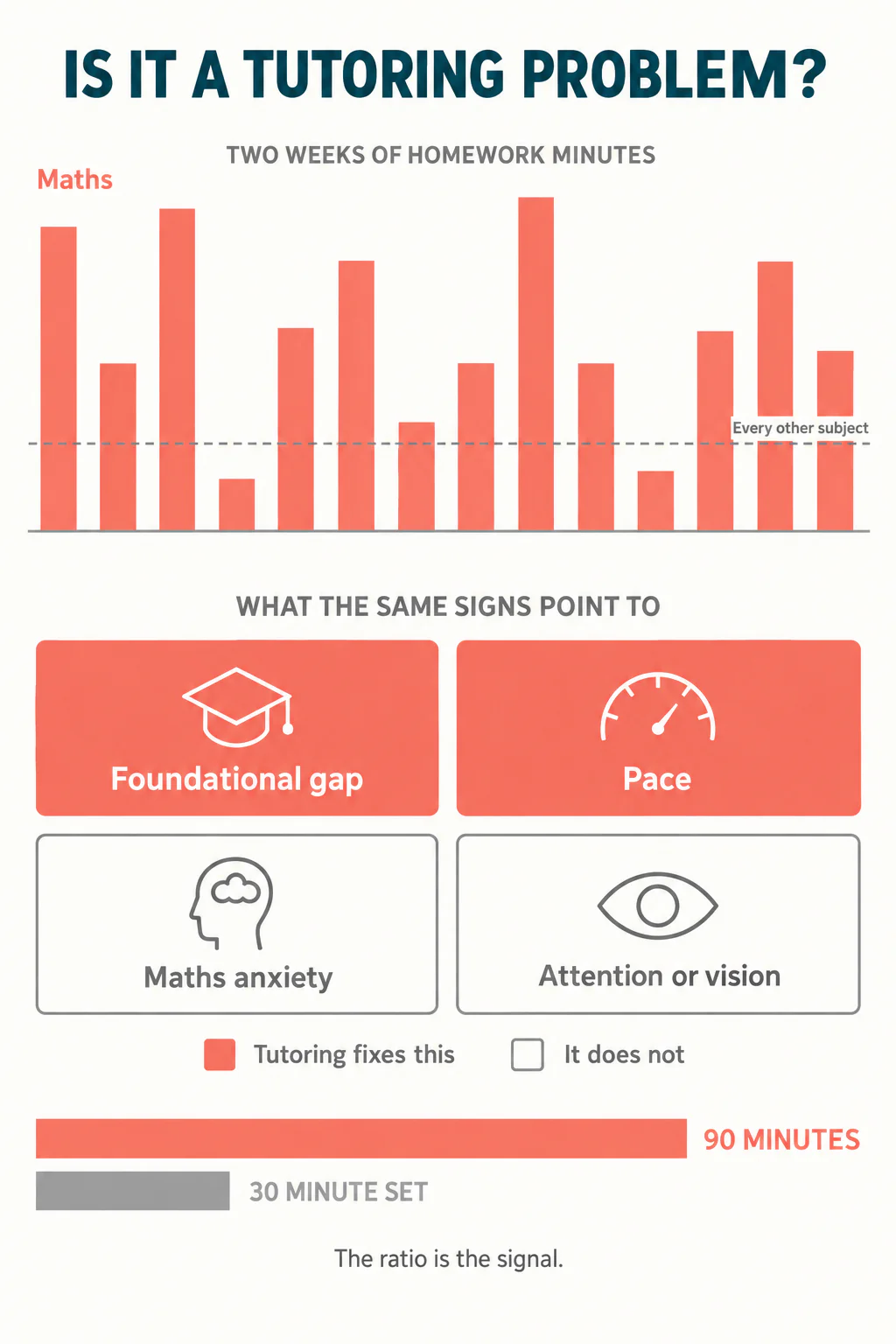
One last thing worth saying plainly, because it runs against how maths help is usually sold. The goal is not more maths. A child doing ninety minutes of homework for a thirty-minute set is already doing far more maths than their classmates and getting less from it. The aim is to make the earlier layer automatic so the current work stops costing so much, which is also the argument we make about teaching order of operations as reasoning rather than a rule to recite. Codeyoung's 1:1 online maths classes are built that way round, starting from where the reasoning stopped holding.
What to Do This Week
Start with the timing log, because it is the one piece of evidence that is hard to argue with and takes no expertise to collect. Two weeks of minutes per subject will tell you more than another evening of worrying about a worksheet.
Then sort the errors, ask why three times, and send the teacher that one question. By the end of the fortnight you will know which of the four causes you are dealing with, and tutoring will either be clearly the right tool or clearly the wrong one. Either answer is worth having.
Codeyoung runs 1:1 live online classes for children aged 6 to 17, with a teacher who adapts the pace to your child rather than a fixed syllabus. The first class is free, so you can see how they respond before deciding.
Book a Free Trial