
This is the question parents ask me most often now, and it usually arrives with a slight apology attached, as though it is an awkward thing to raise with someone who designs a coding curriculum.
It is a fair question and it deserves a direct answer. Yes, children should still learn to code, and the case for it is stronger than it was five years ago. But the reason has shifted, and so should the way it is taught. A programme that has not changed since 2020 is preparing children for a job that no longer exists in that form.
What follows is what actually changed, what the employment data shows rather than what the headlines suggest, and the specific ways coding education should adapt at each age. Some of this argues against how coding is commonly taught, including by people selling it.
The question is usually asked backwards
"Why learn to code if AI can do it?" contains a hidden assumption: that the point of learning to code is producing code.
That was never quite true, and it is clearly untrue now. Writing the syntax was always the smallest part of the work. The larger part is deciding what should be built, breaking it into pieces small enough to reason about, and working out why the result does not behave as expected.
Consider the equivalent in another subject. Calculators have handled arithmetic for fifty years, and we still teach children to multiply. Not because we expect them to do long multiplication at work, but because number sense is what lets someone notice that an answer is wrong by a factor of ten. Remove the underlying understanding and you get a person who cannot tell when the machine has produced nonsense.
That is the actual risk with AI-generated code. It is frequently correct, plausible-looking when incorrect, and confident either way.
What AI genuinely changed
I want to be careful here, because both the dismissive and the alarmist versions of this argument are wrong.
AI coding tools are genuinely capable. They write working functions, explain unfamiliar code, and remove much of the tedium that used to fill a junior programmer's week. Pretending otherwise to reassure parents would be dishonest.
What they have not changed is the part that was always difficult:
- Deciding what to build. A tool cannot tell you which problem is worth solving, or that the feature you requested will confuse the people using it.
- Judging correctness. Code that runs without errors can still be wrong. Recognising that requires knowing what the right answer looks like.
- Debugging the subtle failure. When something works in most cases and fails in one, the tool that wrote it often cannot find the problem either.
- Choosing between options. Two solutions can both work while one becomes unmaintainable within a year.
The shift is that the balance of work has moved further toward judgement and further away from production. Which means the thinking skills have become more valuable, not less, while pure typing speed has become close to worthless.
Will there even be jobs?
This is the part parents actually want answered, so here is the data rather than the vibe.
The US Bureau of Labor Statistics projects employment of software developers to grow by roughly 15.8 percent between 2024 and 2034, an increase of more than 267,000 jobs. That is substantially faster than the average across all occupations, and it is a projection made by an agency that is explicitly modelling the effect of AI on employment.
Three honest caveats belong with that figure.
Projections are models, not guarantees, and ten-year forecasts in a fast-moving field carry real uncertainty. The entry level is also changing shape, because the routine tasks traditionally given to juniors are exactly the tasks AI handles best. And the skills being hired for are drifting toward system design and judgement earlier in a career than they used to.
None of that says do not learn. It says the floor has risen. A graduate who can only produce code to specification is in a weaker position than they were. A graduate who can reason about systems is in a stronger one.
Not sure which level your child should start at? A free trial class with a Codeyoung teacher shows you exactly where they are and what they are ready for next, before you commit to anything.
Book a Free Trial →The case that has nothing to do with jobs
Most children who learn to code will not become programmers. That was true before AI and it is worth saying plainly, because the career argument is the weakest reason to start.
What coding does reliably is give a child a subject where being wrong is normal, visible and fixable.
This is unusual in school. In most subjects a mistake arrives days later as a mark on a page, and it feels like a verdict. In programming it arrives in three seconds, it is specific, and the child fixes it and moves on. Children who spend a few years in that loop develop a noticeably different relationship with being stuck. They stop treating it as evidence that they are bad at something.
The transferable skills are real and not mysterious: breaking a large problem into smaller ones, testing an assumption instead of arguing about it, and reading an error message carefully rather than panicking. Our guide to computational thinking for kids covers how those habits form.
These are the same skills that make someone good at directing an AI tool rather than being replaced by one. The child who can specify precisely what they want and recognise when the answer is wrong is the child who will get useful work out of these tools.
What should actually change in how kids learn to code
Here is where I disagree with a lot of current advice, including from people who sell coding classes.
The common response to AI has been to push children toward AI tools earlier. Teach eight-year-olds to prompt. Put assistants in beginner lessons. I think this is backwards, and I think it will produce a generation of children who can generate code and cannot read it.
A child who has never debugged anything has no way to evaluate what an assistant hands them. The tool does not support their learning, it substitutes for it. The result looks like progress and is not.
What genuinely needs to change is smaller and less exciting: more emphasis on reading code, more on explaining why something broke, less on typing speed and syntax memorisation.
| Age | Focus | Role of AI tools |
|---|---|---|
| 6 to 8 | Sequencing, loops and cause and effect through visual blocks | None. The child is learning that instructions have consequences. |
| 9 to 11 | Logic, conditionals, debugging their own projects | None. Finding your own mistake is the entire lesson. |
| 12 to 14 | Real syntax, usually Python. Reading code written by others. | Sparingly, to explain unfamiliar code rather than to produce it. |
| 15 to 17 | Building real projects, system design, code review | Actively, as a working tool. By now they can tell when it is wrong. |
The progression has not changed much, which is the point. The readiness markers were always about cognitive development rather than technology. If you want the detail on that, our age-by-age guide to when a child should start coding and our comparison of Scratch against Python for beginners both go deeper.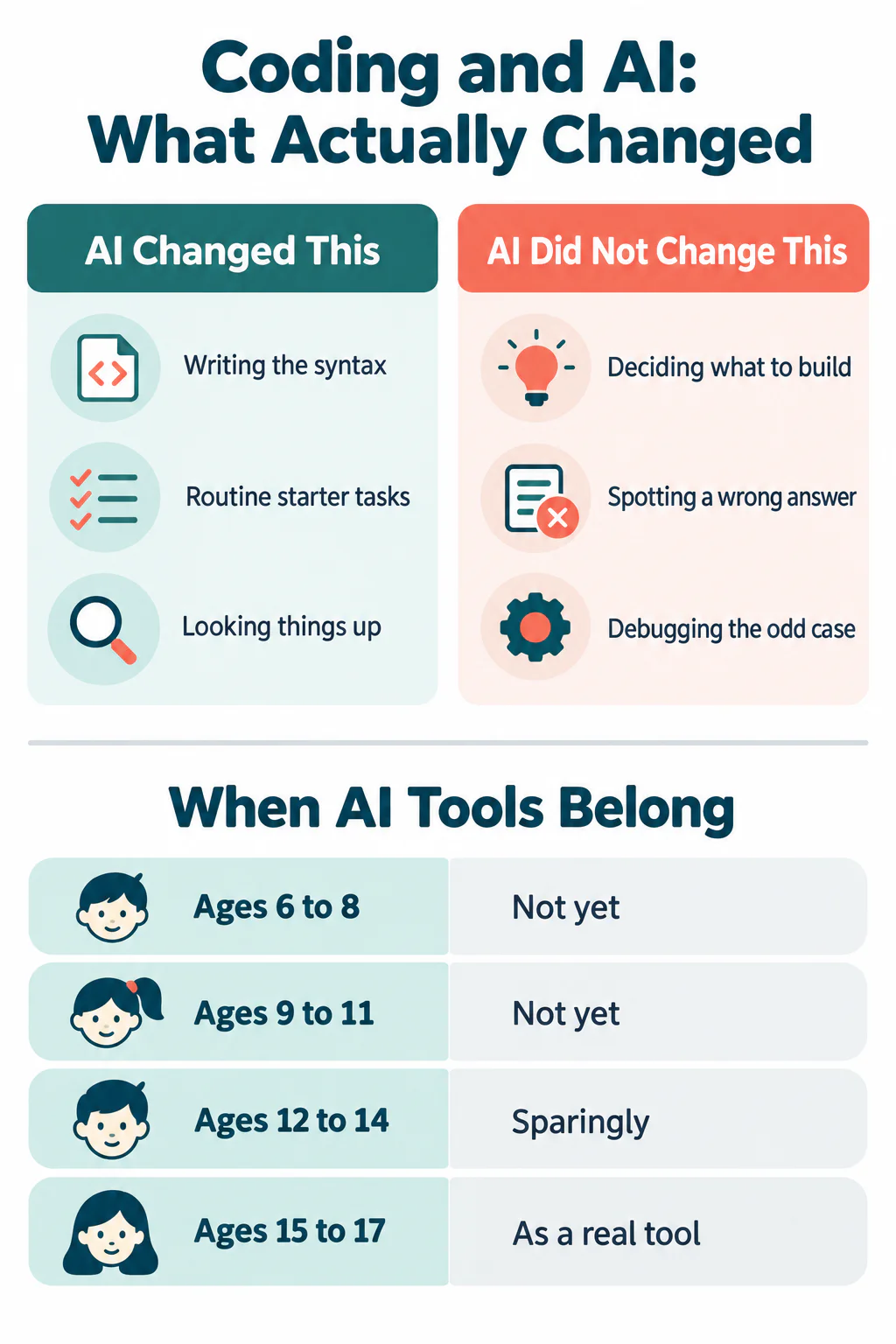
How do you teach AI use without outsourcing the thinking?
Once a child is old enough to use these tools, the difference between helpful and harmful comes down to a few habits.
- Attempt first, always. Write your own version before asking for help. Even a broken attempt means you understand the problem well enough to have an opinion about the answer.
- Explain it back. If a child cannot explain what the generated code does, line by line, they do not get to use it. This single rule prevents most of the damage.
- Assume it might be wrong. Treat output as a draft from a confident colleague who has not tested anything.
- Ask why, not just what. "Why is this approach better than mine?" teaches something. "Write this for me" does not.
These are the same habits that make AI genuinely useful for adults, and they are much easier to build at fourteen than to retrofit at twenty-four. Our guide on how kids can use AI for homework the right way applies the same principle across other subjects.
Frequently Asked Questions
Will there still be programming jobs when my child graduates?
The US Bureau of Labor Statistics projects software developer employment to grow about 15.8 percent between 2024 and 2034, adding more than 267,000 jobs. That is well above the average across all occupations. Projections are not promises, but the official forecast points to growth rather than collapse.
If AI writes the code, what is my child actually learning?
How to break a problem into steps, spot when an answer is wrong, and decide what is worth building. AI produces code quickly but cannot tell you whether the output is correct for your situation. Judging that requires understanding how the code works, which is what learning to program builds.
At what age should a child start coding now?
The same ages as before, because the fundamentals have not changed. Most children are ready for visual block coding around 6 or 7, for real syntax around 10 to 12, and for building projects with AI assistance in the mid-teens. Rushing a child into typing code early still backfires.
Should kids use AI coding assistants while learning?
Not at the beginning. A child who has never debugged anything cannot evaluate what an assistant produces, so the tool replaces the learning instead of supporting it. Once a child can read code and find their own mistakes, usually in the mid-teens, AI assistance becomes genuinely useful.
Is it too late for my teenager to start learning to code?
No. Teenagers often move faster than younger children because they already have the abstract reasoning that programming requires. They can usually skip block coding and start with Python directly. What they miss is years of low-stakes play, so the first projects should still be things they find genuinely interesting.
Does coding still help if my child does not want a tech career?
Yes, and this is increasingly the stronger argument. Coding teaches structured problem breakdown and debugging, which transfer to any field. Basic technical fluency is also becoming standard in marketing, finance, healthcare, design and law, where employees are expected to work alongside automated tools rather than build them.
Where this leaves you
The honest summary is that AI has made the syntax less important and the thinking more important, and most coding education was already weighted toward the wrong one of those.
So the question worth asking is no longer whether your child should learn to code. It is whether the programme you are considering teaches them to think or teaches them to type. Ask what happens in a lesson when a child's project does not work. If the teacher fixes it, look elsewhere. If the teacher helps the child find it, that is the thing worth paying for.
The children who will do well with these tools are the ones who understand what the tools are doing. That has not changed. It has just become more obvious.
Codeyoung runs 1:1 live online classes for children aged 6 to 17, with a teacher who adapts the pace to your child rather than a fixed syllabus. The first class is free, so you can see how they respond before deciding.
Book a Free TrialSource: US Bureau of Labor Statistics, Occupational Outlook Handbook: Software Developers.