
A child can read the word theory, spell it, use it in a sentence, and still get the science question wrong. Not because they did not study, but because they already knew the word. The science words that change meaning are a particular kind of trap: they look familiar, so nobody stops to check them, and the everyday meaning sits quietly underneath producing wrong answers for years. For parents this is useful news, because it means some of what looks like weak science is a language problem with a quick fix.
Why a familiar word is more dangerous than a new one
An unfamiliar word announces itself. A child meets photosynthesis, does not recognise it, and asks or looks it up. The system works.
A familiar word does the opposite. When a child meets theory in a science lesson, nothing signals a problem, because they have used that word since they were six. They supply the meaning they already have, the sentence still makes sense to them, and the misunderstanding survives undetected. Nobody can look up a word they do not know they are getting wrong.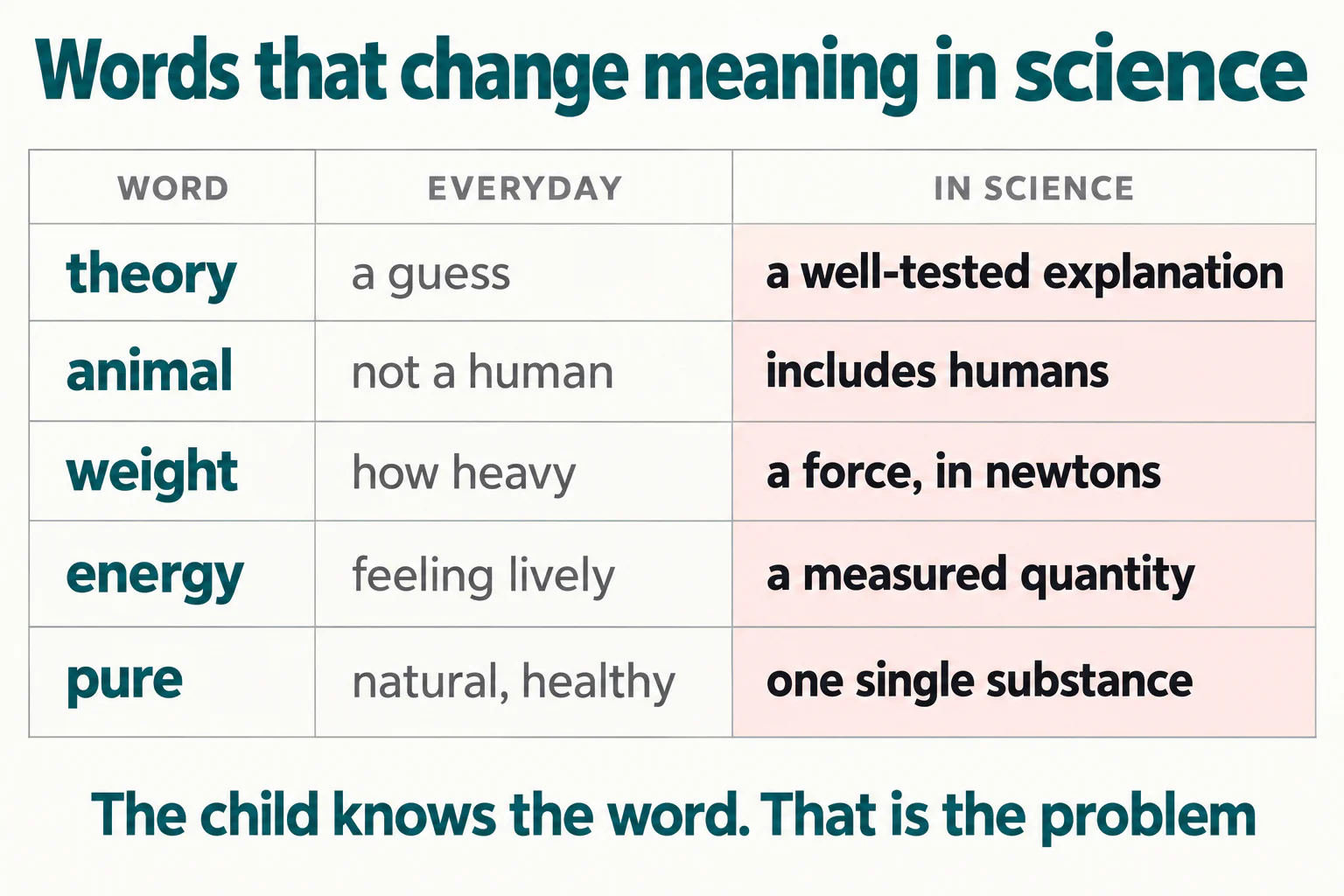
This is a different failure from not knowing the content. We have written separately about children who pass science tests without understanding, where technical vocabulary masks a missing model. This post is about the narrower, sharper case: words your child genuinely knows, where the meaning they hold is the wrong one for the room they are in. It is the science twin of the maths words that trip children up, and the mechanism is identical.
Theory, the worst offender
In everyday English a theory is a hunch. "I have a theory about why the cat keeps knocking things off the table" means a guess with no evidence behind it.
In science it means close to the opposite. The National Academies define a theory as "a plausible or scientifically acceptable, well-substantiated explanation of some aspect of the natural world; an organized system of accepted knowledge that applies in a variety of circumstances to explain a specific set of phenomena and predict the characteristics of as yet unobserved phenomena".
Read those two meanings next to each other. Everyday: unsupported. Scientific: well-substantiated, organised, predictive. A child carrying the first meaning into a lesson hears "it is only a theory" as "it is only a guess", and the entire structure of scientific knowledge lands upside down.
Two neighbouring words are worth giving your child at the same time, because they complete the set. A hypothesis is "a tentative explanation for an observation, phenomenon, or scientific problem that can be tested by further investigation", and the Academies add a condition children find genuinely interesting: scientific hypotheses "must be posed in a form that allows them to be rejected". A guess you cannot be wrong about does not qualify. A fact, meanwhile, is an observation or measurement that behaves the same way under the same circumstances.
So the everyday word closest to the schoolroom "theory" is not theory at all. It is hypothesis.
Are humans animals?
Yes, and most children will tell you no. In everyday English, animal means every living creature except us: it is the word on the zoo sign and in the phrase "animals and people". In biology, humans are animals, and specifically mammals.
This one matters more than it looks, because classification questions are built on it. A child who places humans outside the animal kingdom will mis-sort every question about vertebrates, mammals and warm-blooded creatures, and will do it consistently, which makes it look like a knowledge gap rather than a definition gap.
The fix takes a minute. Ask your child to draw three rings, one inside the next, and label them. Let them place humans themselves. Children who draw it remember it; children who are told it tend to revert within a week.
Not sure which level your child should start at? A free trial class with a Codeyoung teacher shows you exactly where they are and what they are ready for next, before you commit to anything.
Book a Free Trial →Weight, where the everyday word is simply wrong
This is the clash that produces marks lost on technicalities, and the one most parents get wrong alongside their children.
In everyday use, weight is how heavy something is, measured in kilograms. In physics those are two different quantities. Mass is how much matter an object contains, measured in kilograms, and it does not change with location. Weight is the gravitational force acting on that mass, and force is measured in newtons.
A one kilogram mass weighs about 9.8 newtons on Earth and about 1.7 newtons on the Moon. Its mass is one kilogram in both places. So the sentence "I weigh 40 kilograms", which every adult says, is using the wrong quantity and the wrong unit, and a child who repeats it in a physics answer loses the mark.
The useful thing to tell a child is that they are not being asked to stop saying it at home. They are being told that the word has a stricter job in science, the way a word can mean one thing on a football pitch and another in a courtroom.
Two more worth knowing
Energy. At home, energy is a feeling: having energy, running out of it. In science it is a measured quantity with units, something a system has a specific amount of and which moves between stores. Children who keep the everyday meaning treat energy as a kind of liveliness that things possess, which makes conservation of energy sound like a slogan rather than a rule.
Pure. On a food label, pure suggests natural, wholesome and good for you. In chemistry a pure substance is one made of a single substance with nothing else in it, which has no bearing on whether it is healthy. Pure water is chemistry. Pure orange juice is marketing. A child who merges the two will answer questions about mixtures and compounds using the advertising meaning.
What to do about it at home
The instinct is to correct the answer. Do the opposite: name the clash out loud and give both meanings at once.
The script is short. "That word has two jobs. At home it means a guess. In science it means an explanation that has been tested over and over. Which one is this question using?" Children handle two meanings without difficulty once they know there are two. What they cannot handle is a word they believe has one meaning when it has two, because there is nothing to alert them.
Three things that work, in rough order of value:
- Ask for the everyday meaning first. "What does theory mean when you use it with your friends?" You will hear the everyday meaning, which makes the clash visible to both of you before you say anything.
- Make them use the word in two sentences, one of each kind. Producing both is what separates them in memory.
- Watch for confident wrong answers. A hesitant wrong answer usually means missing knowledge. A fast, confident wrong answer on a familiar word is the signature of this problem.
If your child is reading the questions correctly but still losing marks for how an answer is phrased, the issue may be wider than vocabulary, and right answer, still loses marks covers that case. Our online science classes teach these clashes explicitly, because a teacher who names them is faster than a child discovering them by losing marks.
Conclusion
The science words that change meaning do their damage precisely because they are familiar. Theory means a tested explanation, not a guess. Animal includes humans. Weight is a force in newtons and mass is the kilograms. Energy is a quantity, not a mood, and pure means one substance, not a healthy one. None of this is difficult content, and none of it is usually taught as a language problem, which is why it survives for years in children who are otherwise doing fine. Name the two meanings, ask which one the question wants, and a surprising amount of apparent weakness in science turns out to have been a translation error.
Codeyoung runs 1:1 live online classes for children aged 6 to 17, with a teacher who adapts the pace to your child rather than a fixed syllabus. The first class is free, so you can see how they respond before deciding.
Book a Free TrialDefinitions checked against the National Academies' definitions of theory, fact and hypothesis and NASA's mass versus weight teaching materials, both checked 31 October 2026.