
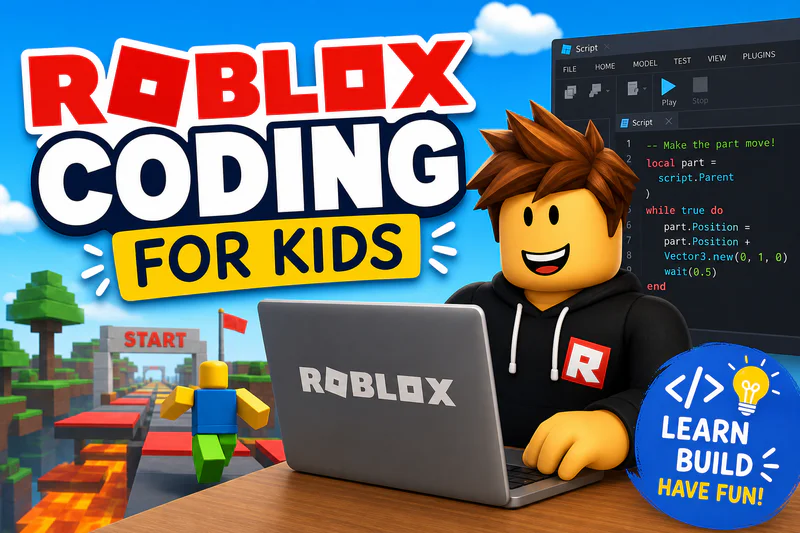
Most kids who play Roblox have no idea they're already thinking like programmers.
They're tweaking game mechanics, figuring out why something broke, building entire worlds from scratch, and iterating until it works. That's not just gaming — that's the core loop of coding.
The question isn't whether Roblox can teach kids to code. It's how to make the most of that interest before it fades into the next trend.
Here's what Roblox coding actually teaches, how it compares to other beginner languages, and where kids should go once they've outgrown the basics.
Why Roblox Is Actually a Coding Platform
Most parents see Roblox as a game. And it is. But underneath the surface, Roblox is built on Roblox Studio — a full game development environment that lets kids build, script, and publish their own games.
Roblox Studio uses Lua, a real, lightweight programming language used in game development and embedded systems. It's not a toy language or a simplified drag-and-drop tool. When a kid writes a script in Roblox Studio, they're writing actual code.
What makes this powerful is context. Kids aren't learning to code in the abstract — they're learning because they want their game to do something specific. That goal-driven learning tends to stick far better than worksheets or isolated coding exercises.
If your child is already spending hours exploring popular Roblox games, there's a good chance they've already started noticing how things are built — and wondering if they could build something themselves.
What Coding Skills Does Roblox Teach Kids?
When kids start scripting in Roblox Studio, they're picking up fundamental programming concepts without necessarily realising it:
Variables — storing and changing values (health points, score, speed)
Loops — repeating actions automatically (enemies that respawn, timers that count down)
Conditionals — if/then logic (if the player touches this, then that happens)
Functions — grouping reusable actions into named blocks
Debugging — figuring out why something isn't working and fixing it
These aren't Roblox-specific concepts. They're the same building blocks used in Python, JavaScript, Java, and virtually every other language. A kid who gets comfortable with these ideas in Roblox has a genuine head start when they move to more advanced coding.
Beyond the technical skills, Roblox coding builds problem-solving habits. Kids learn to break a big goal into smaller steps, test ideas quickly, and iterate when things don't work. Those habits transfer directly to real-world programming and engineering thinking.
Roblox Coding vs Other Beginner Languages

Roblox isn't the only on-ramp into coding for kids. Here's how it compares to the two most common alternatives:
Roblox (Lua) is best for kids who are already playing Roblox and motivated by game creation. It uses real syntax — no drag-and-drop — so the learning curve is steeper than Scratch, but the payoff is more substantial. Good for ages 8 and up.
Scratch is the gentlest starting point. It uses visual, block-based coding that removes the friction of syntax entirely. It's ideal for younger kids (5–8) or complete beginners who need to build confidence before touching text-based code. If your child hasn't started coding at all, Scratch programming for kids is often the better first step.
Python is where most kids land after they've outgrown Scratch or Roblox. It's clean, readable, and the most in-demand beginner language in schools and the industry. The jump from Lua to Python is smaller than most parents expect — the logic is the same, just different syntax. If you're wondering when to make that transition, this breakdown of Scratch vs Python covers the key differences.
The short version: Roblox sits in the middle of the beginner spectrum — more structured than Scratch, more accessible than Python. For kids who are game-obsessed, it's one of the best on-ramps available.
How Kids Can Start Learning Roblox Coding
There are two main paths:
Self-taught (free, slower): Roblox Studio is free to download. There are YouTube tutorials, the official Roblox Creator documentation, and community forums. A motivated kid can learn a lot this way — but progress tends to be inconsistent, and it's easy to get stuck or pick up bad habits without feedback.
Structured classes (faster, more reliable): A good coding class gives kids a clear progression, a teacher who can answer questions in real time, and a structure that keeps them moving forward even when things get hard. The gap between a self-taught kid who dabbles and one who's had proper instruction is significant — not just in what they know, but in how they think about problems.
When choosing a course, look for:
Age-appropriate pacing (not one-size-fits-all)
Live instruction, not just pre-recorded videos
Projects that build on each other rather than standalone exercises
A teacher who can explain why, not just what
Online coding courses for kids that combine structured curriculum with live, personalised teaching tend to produce the best results — especially for kids in the 7–14 age range where attention and motivation can be unpredictable.
What to Learn After Roblox Coding

Roblox is a great starting point — but it has a ceiling.
Once a kid gets comfortable with Lua and Roblox Studio, the natural question is: what's next? The good news is that everything they've learned transfers cleanly to other areas.
Game design is the most obvious next step for kids who love building in Roblox. Moving from Roblox's ecosystem into broader game design principles — level design, mechanics, player experience — opens up a much bigger creative world. Game design for teens is a natural extension that builds directly on what they already know.
Python is the most practical next step for kids who want to code beyond gaming. It's what schools teach, what universities expect, and what the job market rewards. The transition from Lua is smoother than it looks.
AI and machine learning is where things get genuinely exciting for older kids. Understanding how AI systems work — and being able to build simple ones — is quickly becoming one of the most valuable skills a young person can have. If your child is curious about this direction, exploring AI courses for kids is a worthwhile next move. The foundations built through Roblox coding make picking up these concepts significantly easier.
The key insight for parents: Roblox coding isn't a dead end. It's a gateway. The kids who start there and keep building are the ones who end up with genuinely marketable skills by their mid-teens.
Final Thoughts
Roblox coding is one of the most underrated entry points into programming for kids. It meets them where they already are — in a world they love — and teaches real skills through real projects.
The goal isn't to keep them in Roblox forever. It's to use that enthusiasm as fuel for something bigger.
If your child is ready to move from playing to building — or from building in Roblox to building in the real world — structured learning makes all the difference. Explore coding classes for kids and find the right next step for where they are now.