
A four-mark question comes back with one mark on it. The answer at the bottom of the page is correct. Your child is furious, you are sympathetic, and somewhere between you is the assumption that maths marks are awarded for being right. They mostly are not, which is why a child loses marks for a right answer more often than parents expect. On a multi-step question, the final figure is usually worth a single mark. The other three are sitting in the working that nobody wrote down.
This is not a teacher being pedantic. It is how published mark schemes are built, and once you can see the structure, the argument at the kitchen table changes shape entirely. It stops being about neatness and starts being about where the marks physically are.
Why a right answer can still lose marks
Marks are attached to stages of reasoning, not to outcomes. A question that asks a student to find the area of a compound shape is really asking them to do four things: split the shape sensibly, find each piece, add them, and state the result with units. Each of those is worth something, and only the last one is the answer.
So a child who writes "38 cm²" and nothing else has offered the marker one thing to assess out of four. The marker is not withholding credit out of strictness. There is nothing on the page to award it to. This is the part that changes the conversation at home: the missing marks were never lost, they were never claimed.
What the mark scheme is actually rewarding
Published mark schemes, including the GCSE mathematics schemes Pearson releases after each series, separate the two kinds of credit explicitly. There are marks for a correct method and marks for a correct answer, and they are awarded independently. Some marks stand alone for a particular correct statement, regardless of what came before.
One mechanism inside that structure is worth understanding, because it changes how much a mistake costs. If a student uses the right method and then makes a single arithmetic slip, the later steps can be credited using the value they actually produced rather than the correct one. The error is penalised once and not again. A student with visible working loses one mark for a slip. A student with no working loses all four for the same slip, because there is no way to tell the slip from a guess.
That asymmetry is the strongest practical argument for working, and it is one children find persuasive when it is put in those terms. A visible method is insurance.
Wrong answer, most of the marks
Take a concrete case. A question gives a rectangle 12 cm by 7 cm with a 3 cm square cut from one corner, and asks for the remaining area.
The intended route is 12 × 7 = 84, then 3 × 3 = 9, then 84 − 9 = 75 cm². Now suppose a child writes this instead:
- Area of rectangle = 12 × 7 = 84 cm²
- Area of square = 3 × 3 = 6 cm²
- Remaining = 84 − 6 = 78 cm²
The final answer is wrong. The multiplication in line two is wrong. And yet almost everything else is right: the shape was split correctly, the subtraction was the right operation, and the arithmetic in the third line is correct for the numbers in front of them. A scheme that credits method and follows the error through would award most of the available marks here.
Now suppose a different child writes only "78 cm²". Identical thinking, identical mistake, and almost nothing to award. Two students, the same understanding, very different scores. The difference is not ability. It is whether the reasoning was visible.
Not sure which level your child should start at? A free trial class with a Codeyoung teacher shows you exactly where they are and what they are ready for next, before you commit to anything.
Book a Free Trial →What "show your work" is usually taught as, and why that fails
Here is where I think most of us go wrong, teachers and parents alike. "Show your work" is delivered as a rule about recording. Do the maths, then write down what you did. Under that framing, working is admin: a transcription task added on to the thinking, with no benefit to the person doing it.
Children are quite right to resent that, and they are also right that it does not help them. Writing down a completed thought is not the same as thinking on paper.
The standards themselves ask for something different. The Common Core practice standard on mathematical argument expects students to "make conjectures and build a logical progression of statements", to "justify their conclusions, communicate them to others, and respond to the arguments of others", and, in the primary years, to "construct arguments using concrete referents such as objects, drawings, diagrams, and actions". Not one of those phrases is about recording. They are all about persuading. You can read the full standard on constructing viable arguments in a couple of minutes.
That is the reframe worth taking home. Working is not a record of the answer. It is the argument for the answer, and a child who understands it that way writes differently without being nagged.
What good working looks like at each age
The test is always the same: could a reader follow this without the child in the room. What satisfies that test changes as the maths gets harder. The table below reflects what we look for in 1:1 classes rather than a published standard.
| Age | What counts as working | The most common gap |
|---|---|---|
| 6 to 8 | A drawing, counters, a number line, a jotted partition of a number | Nothing on the page at all, because the sum was mental |
| 9 to 11 | One line per step, the operation written out, units carried through | Steps done in the right order but only the last one recorded |
| 12 to 14 | Formula stated before substituting, each line following from the last | Substituting straight into a calculator with no equation written |
| 15 to 17 | Method named, algebra shown line by line, reasoning for any non-obvious step | Skipping the rearrangement, which is usually where the marks are |
Two things show up in every row. Units are worth marks and are dropped constantly. And the step a child considers too obvious to write is very often the one being assessed.
Why your child refuses, and what actually changes it
A child who can do a problem in their head and will not write it down is not being difficult. They are making an accurate observation: at this level of difficulty, writing it out adds nothing for them. They can hold the whole thing in working memory, so the paper serves the marker rather than the mathematician.
Which means more reminders will not fix it, because the reminder does not change the underlying fact. Harder problems do. Writing becomes genuinely useful at the exact point where a problem exceeds what a child can hold in their head, and until they meet that point they are being asked to practise a habit with no visible purpose.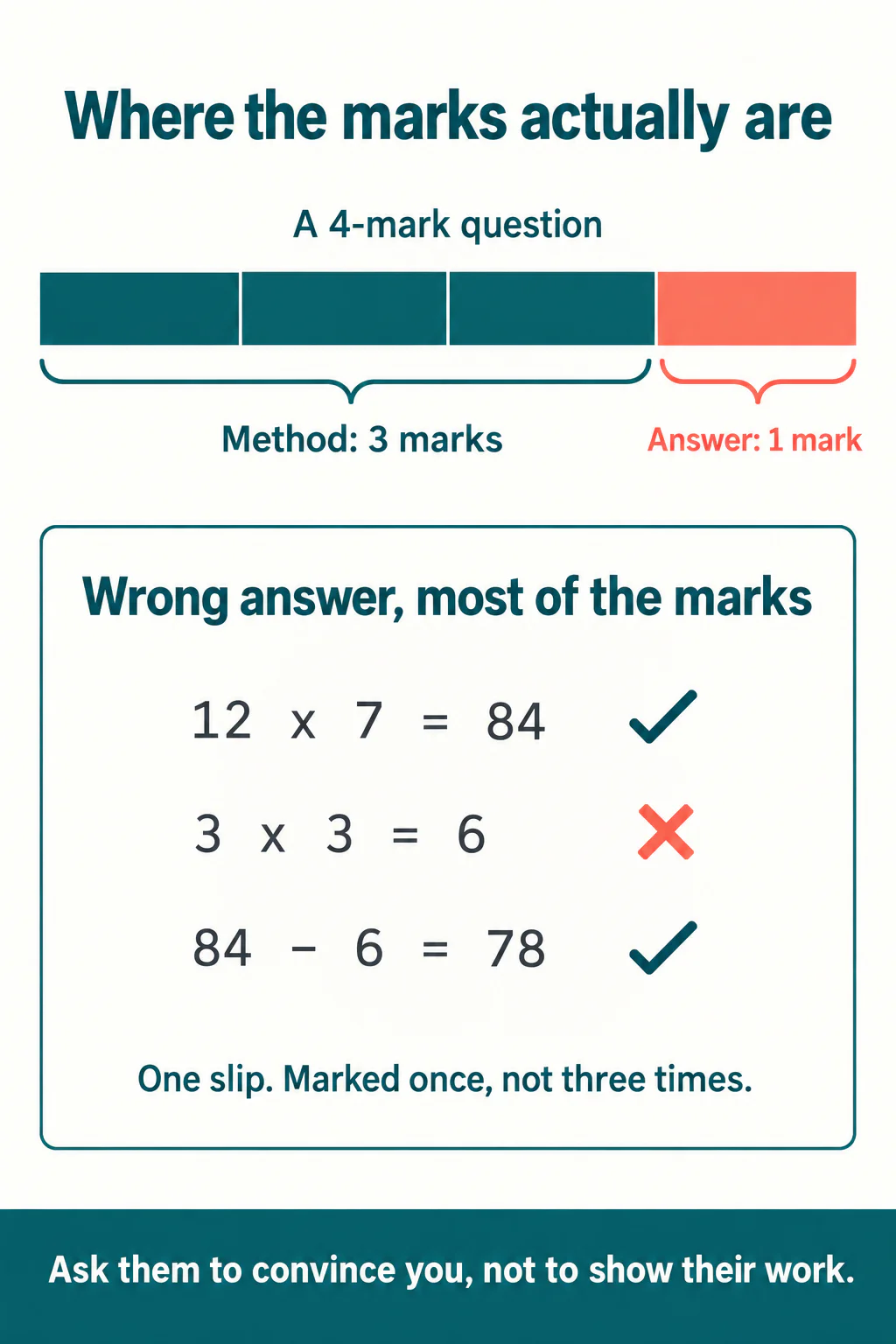
Three steps that work at home
- Replace the instruction. Stop saying "show your work" and say "convince me". Then be sceptical about one step and ask why it follows. This turns recording into arguing, which children will do willingly, and it matches what the standards ask for.
- Mark a piece of their work as a marker would. Take one multi-step question, decide together how the marks should split across the steps, then award them. Ten minutes of this teaches more than a term of reminders, because the child sees the marks sitting in the middle of the page rather than at the bottom.
- Give them one problem a week they cannot hold in their head. Not harder arithmetic, more steps. A three-stage word problem, a multi-part geometry question. The moment they lose track and have to start again is the moment writing stops being pointless.
Resist the urge to correct the layout while they are reasoning. Neatness is a separate lesson and it will crowd out this one. If maths homework is already a difficult hour in your house, our guide to helping with maths homework when you hated maths covers how to be useful without taking over, and strategies for solving word problems gives a structure for the multi-step questions that make working necessary.
When not to insist on it
There are times to let it go. Times-table practice and mental arithmetic drills are supposed to be mental, and demanding written working there defeats the purpose. A child in tears is not learning a habit, they are learning an association, and stopping is the better call. And when a child is deliberately estimating to check whether an answer is sensible, that is a skill worth protecting, not formalising.
Calculator work deserves a mention of its own, because it is where this problem concentrates. A calculator produces a number with no trace of how it arrived, so a student who works straight into one leaves the page blank by default. The equation still has to be written before the buttons are pressed, and we covered the wider question of when a child should use a calculator for homework separately. Where the resistance is really about confidence rather than effort, what to do when your child says they are bad at maths is the more useful starting point.
What to take from this
A child who loses marks for a right answer has usually not made a mathematical mistake. They have made a claiming mistake, and the marks were sitting in the middle of the page where nothing was written. Three marks for method, one for the answer, is the shape of most multi-step questions, and a visible method also limits the damage when something goes wrong.
The fix is not more reminders about neatness. It is to ask a different question. "Convince me" gets working out of a child that "show your work" never will, and a problem too long to hold in their head does the rest. If it would help to have a teacher build that habit deliberately, our 1:1 maths classes start from how a child reasons rather than from a worksheet.
Codeyoung runs 1:1 live online classes for children aged 6 to 17, with a teacher who adapts the pace to your child rather than a fixed syllabus. The first class is free, so you can see how they respond before deciding.
Book a Free Trial