
Your child gets their story back with comments on it. They read the comments, nod, take a fresh sheet, and copy the whole thing out again in their best handwriting with the spellings corrected. Forty minutes gone. The writing is exactly as good as it was.
This is what revising writing after feedback looks like for most children, and it is not their fault. We wrote the parent's half of this in how to give feedback on your child's writing. This is the child's half: what they are actually supposed to do with it once they have it.
Editing is not revising, and children only know one of them
Two different jobs, and school tends to name only the first.
Editing is surface work: spelling, punctuation, capital letters, handwriting. It is visible, it is markable, and it has right answers, which is why it dominates. Revising is structural: cutting something, moving something, saying more clearly who did what to whom. It has no right answers and it leaves the page messier before it leaves it better.
Ask a child what they changed in their second draft and you will hear about spellings. Ask what they cut and you will usually hear nothing, because cutting has not occurred to them as a thing a writer does. Words are hard-won at nine. Removing them feels like going backwards.
The English national curriculum actually asks for both. In years 3 and 4, pupils should be assessing the effectiveness of their own and others' writing and suggesting improvements, and proposing changes to grammar and vocabulary to improve consistency. Proofreading for spelling and punctuation is listed separately, as its own thing. The curriculum separates them cleanly. Most classroom time does not.
The three-pass order, and why it matters
Do the passes in the wrong order and the child does double work, then resents the whole exercise.
- Meaning. Does this say what I meant? Is anything confusing, missing, or in the wrong order?
- Structure. Does it move sensibly? Should this paragraph come first? Is there a bit that repeats?
- Surface. Spelling, punctuation, capitals.
The reason for that order is brutally practical. If a child proofreads first and then cuts the paragraph they proofread, they have thrown away their own careful work, and they will remember. Do that twice and they will quietly stop cutting anything, because cutting has become expensive. Surface work goes last because it is the only pass that is wasted by later changes.
Say the order out loud each time until it sticks. "Meaning, then shape, then spelling." Three words, and it saves a child from the most demoralising version of revision.
Not sure which level your child should start at? A free trial class with a Codeyoung teacher shows you exactly where they are and what they are ready for next, before you commit to anything.
Book a Free Trial →Read it aloud, because the ear is ahead of the eye
If you take one thing from this article, take this. A child can hear a bad sentence years before they can see one.
The national curriculum builds this in deliberately. Pupils in years 3 and 4 are expected to read their own writing aloud to a group or the whole class, using appropriate intonation and controlling tone and volume so that the meaning is clear. By years 5 and 6 they perform their own compositions. That is not a presentation skill exercise. Reading aloud is a diagnostic, and the instruction "so that the meaning is clear" is the giveaway: you cannot make unclear writing sound clear, and the child finds that out with their own mouth.
What actually happens when a nine-year-old reads their own work aloud:
- They stumble over a sentence that is too long. That stumble is the sentence asking to be split.
- They run out of breath. Same diagnosis.
- They say a word that is not on the page, usually the clearer one they meant. Write down what they said.
- They pause and explain something to the listener. That explanation belongs in the piece. It is missing.
That last one is the most valuable and the easiest to miss. When a child interrupts their own reading to say "she's the one from the beginning", they have just identified a gap in their writing and filled it verbally. Catch it, and say: put that in.
Read it to someone who was not there
Reading to a parent who already knows the story is weaker, because you fill in the gaps without noticing. A sibling, a grandparent on a call, or a patient dog works better. The listener does not have to give feedback. They only have to not already know what happens.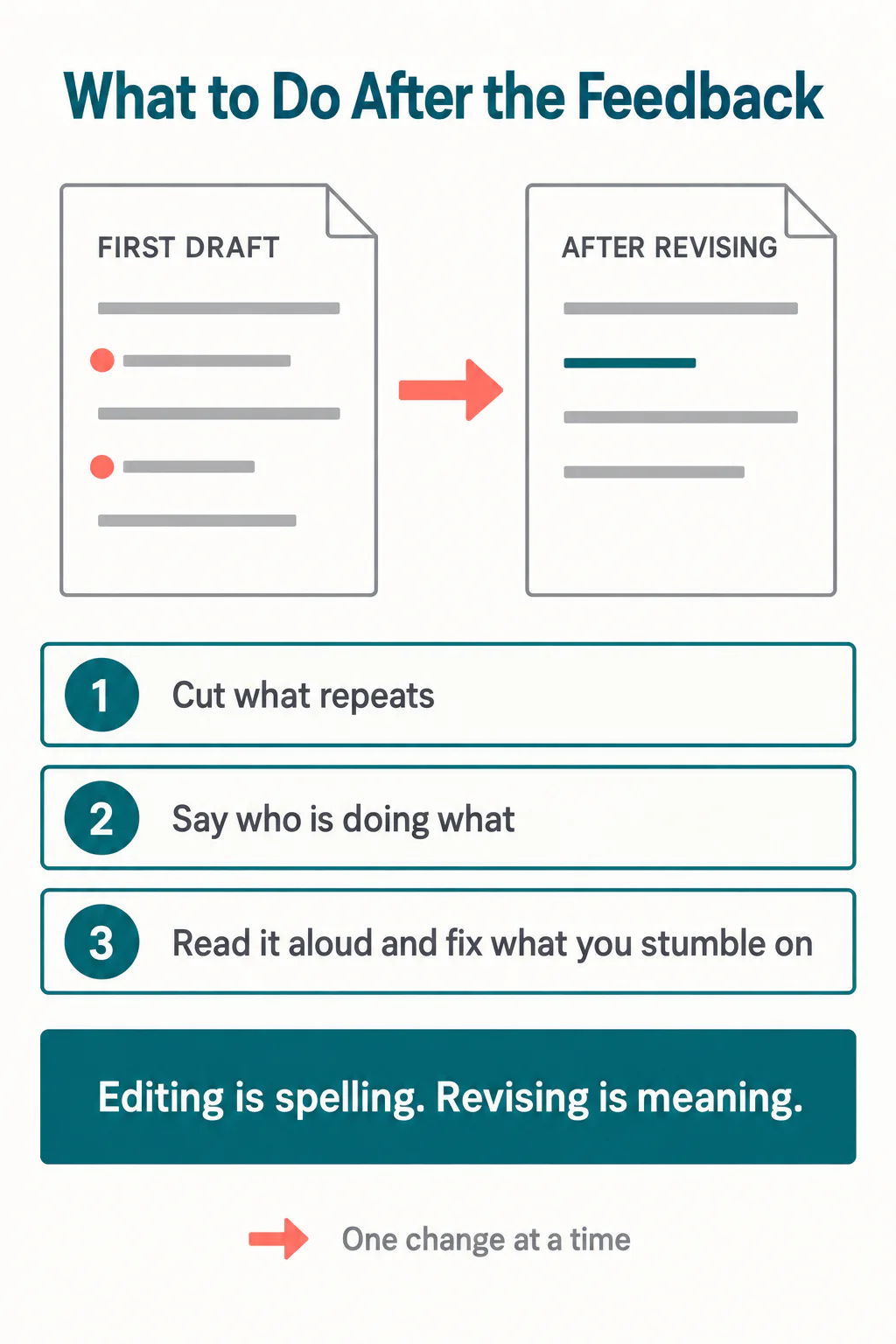
Three changes, chosen by the child
Do not ask for a better version. Ask for three changes.
"Make it better" is an instruction with no edge, and a child who does not know what better looks like will default to neater. "Find three things to change and tell me why" is finite, achievable and puts the judgement where it belongs. It also matches what the curriculum asks for at upper key stage 2, where pupils assess effectiveness and propose changes themselves rather than receiving them.
Three is the number for a reason. One is a token. Five feels like the whole thing was wrong. Three is enough that at least one of them has to be structural, because there usually are not three spellings worth the trouble.
Useful prompts, for a child who is stuck on what to change:
| Prompt | What it usually fixes |
|---|---|
| Which sentence is the most boring? | The flat opening line |
| Where do you say the same thing twice? | Repetition the child cannot see |
| Who is "he" in this sentence? | Unclear pronouns, which the curriculum names directly |
| What is the best bit? | Tells you what to keep, and often what to move to the front |
| Where would a reader stop understanding? | The real gap, if they can find it |
Ask one of these, not all five. A page of prompts is a worksheet, and worksheets get answered rather than used.
What to do with a comment the child disagrees with
Let them keep it, and make them say why.
This feels wrong to a lot of adults and it is the right call. A child who can say "I left the short sentences in because she is running and I wanted it fast" is doing something far more advanced than a child who changed it because the teacher said so. They have a reason. The reason is even correct.
Feedback is not an instruction list. Treating every comment as a command trains a writer to be compliant rather than deliberate, and compliance produces the neat, dead second draft this article started with. The rule worth teaching is simple: you may keep anything, as long as you can say why you kept it. Silence is not a reason.
The clean-copy trap
Writing it out neatly at the end is fine. Writing it out neatly instead is the problem, and the two are hard to tell apart from the outside.
A simple test: look at the two drafts side by side. If the second one contains the same sentences in the same order with better handwriting, no revision happened. If a sentence is gone, or two have swapped places, or one has been split into two, it did.
This is why the second draft should be allowed to look worse. Crossings out, arrows, a sentence written up the margin, a paragraph with a line through it. A messy second draft is evidence of thinking. Requiring neatness at the revision stage quietly forbids the very thing you asked for, and children read that requirement accurately: if it has to look tidy, do not change much.
Keep the neat copy for the third pass, once the decisions are made. By then the handwriting is a reward rather than a substitute.
What good looks like by age
Expectations matter here, because asking a seven-year-old to restructure a piece independently produces tears and nothing else.
- Ages 6 to 7. Revise out loud, together. You ask, they answer, you do the writing. The skill being built is noticing, not rewriting.
- Ages 8 to 9. Three changes, with you naming the target. "Find the most boring sentence and make it better." They can act on a specific instruction.
- Ages 10 to 11. They find the three changes themselves and explain each one. This matches what the curriculum expects: assessing effectiveness and proposing changes.
- Ages 12 and up. They can do the same for somebody else's writing, which is harder and more useful, and it is the point at which the skill becomes genuinely theirs.
The jump between eight and eleven is the big one, and it is where most of the teaching effort should go. Before it, revising is a conversation. After it, it is something a child does on their own with a pencil, and they will carry it into every subject that asks them to write anything. The groundwork for that sits in the sentence-level work we covered in helping a child write better sentences.
The short version
Revising is not copying out. It is meaning first, structure second, spelling last, and a second draft that does not look messier than the first probably is not a second draft at all.
Two moves carry most of the improvement: have the child read the piece aloud to someone who does not already know it, and ask for three changes they choose and can explain. Everything else is refinement. A child who can say why they kept something is already writing deliberately, which is the whole thing you are trying to build.
The expectations quoted above are from the English programmes of study in the national curriculum for England, and our online English classes for kids teach revising as its own skill rather than as an afterthought to a finished piece.
Codeyoung runs 1:1 live online classes for children aged 6 to 17, with a teacher who adapts the pace to your child rather than a fixed syllabus. The first class is free, so you can see how they respond before deciding.
Book a Free Trial