
Most punctuation for kids guides give you fourteen marks and a vague age range. The ranges are usually invented. The actual answer is published, in two different countries, and the two do not agree: a child in England is expected to use a semicolon correctly at ten or eleven, while US Common Core does not ask for one until Grades 9 to 10, at fourteen to sixteen.
That four-year gap on an identical skill is worth knowing if your child has moved between systems, is taught by an international school, or is simply being compared against a worksheet you found online. What follows is what each curriculum actually requires, at which age, and the three things that are worth practising at home at each stage.
Key Takeaways
- Both systems start in the same place: capital letters, full stops and question marks, at about five or six.
- The apostrophe arrives early. UK Year 2 and US Grade 2 both expect contractions and single ownership, so roughly six to eight.
- Plural possession is a separate, later skill, and the UK names it explicitly in Year 4 while Common Core does not isolate it at all.
- The semicolon is the biggest divergence: UK Year 6 against US Grades 9 to 10.
- Reading a child's own writing aloud finds more errors than any worksheet, because punctuation records how a sentence is spoken.
Which punctuation comes at which age
Here is the sequence both curriculums broadly share, with the ages at which each mark is formally expected. Where the two systems differ, the next section sets out exactly how.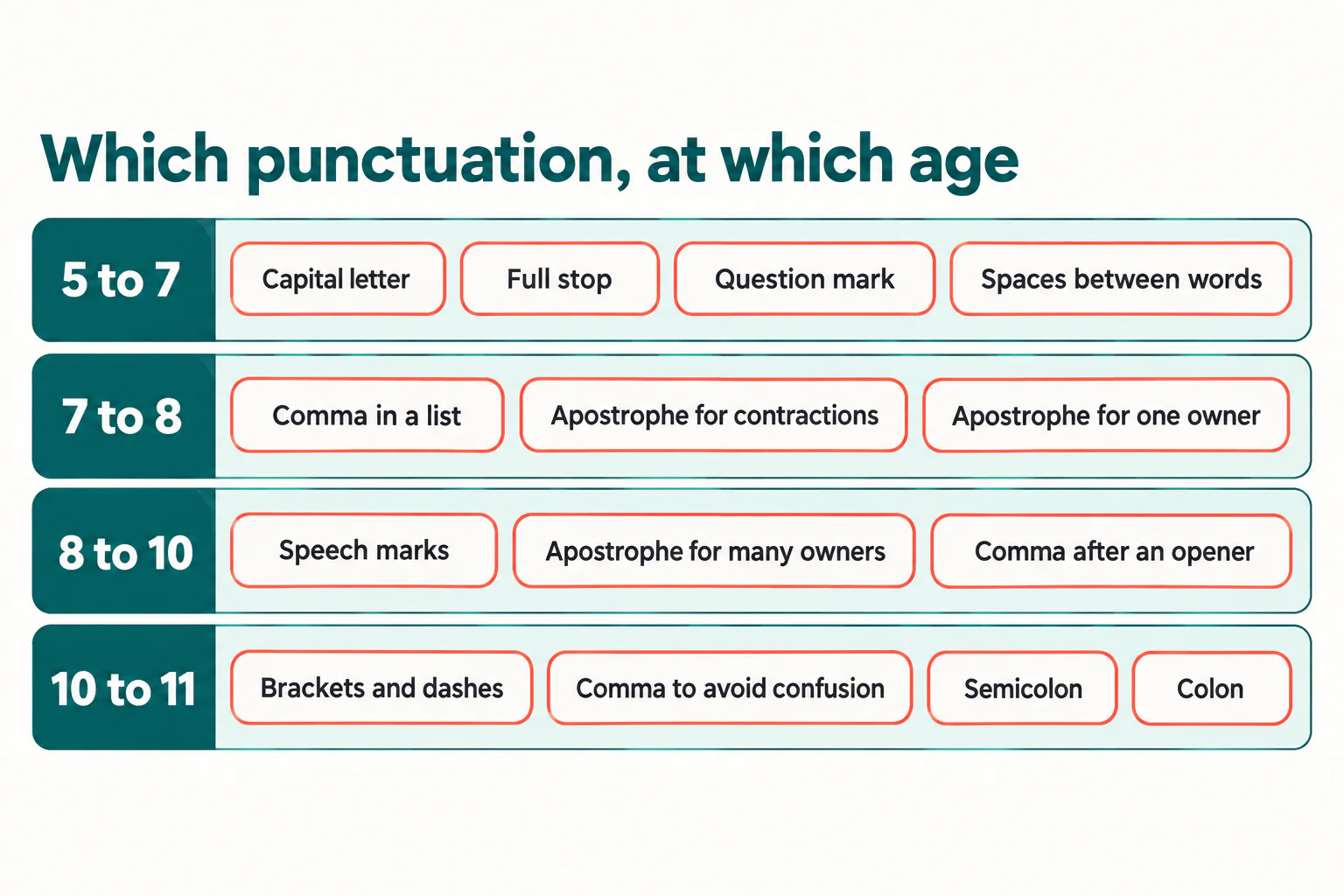
| Mark | UK | US Common Core |
|---|---|---|
| Capital letters, full stop, question mark | Year 1 (5–6) | Kindergarten to Grade 1 (5–7) |
| Commas to separate a list | Year 2 (6–7) | Grade 1 (6–7) |
| Apostrophe for contractions and one owner | Year 2 (6–7) | Grade 2 (7–8) |
| Speech marks for dialogue | Year 3 (7–8) | Grade 3 (8–9) |
| Apostrophe for more than one owner | Year 4 (8–9) | Not separately specified |
| Brackets, dashes or commas for parenthesis | Year 5 (9–10) | Grade 6 (11–12) |
| Semicolon and colon between clauses | Year 6 (10–11) | Grades 9–10 (14–16) |
Read the table as a sequence rather than a schedule. The order is almost identical in both systems, which is the useful part: end marks, then list commas, then the apostrophe, then speech, then the marks that organise longer sentences. A child who is shaky on full stops is not ready for semicolons in either country.
Why the two curriculums disagree about the semicolon
They disagree about when, not about what, and the wording makes that clear. The England national curriculum sets out for Year 6: "Use of the semi-colon, colon and dash to mark the boundary between independent clauses", with the worked example It's raining; I'm fed up. It also asks for the colon to introduce a list, semi-colons within lists, and bullet point punctuation in the same year.
US Common Core asks for almost exactly the same thing, four years later. Standard L.9-10.2.a reads: "Use a semicolon (and perhaps a conjunctive adverb) to link two or more closely related independent clauses", with the colon for lists and quotations alongside it. Between those two points, the word semicolon does not appear in the Grade 6, 7 or 8 standards at all.
Neither country is wrong, and this is not a league table. The UK curriculum front-loads punctuation terminology because it is formally assessed at the end of primary school. Common Core spreads the same ground across more years and spends the middle grades on different marks: Grade 6 takes commas, parentheses and dashes for parenthetical elements, Grade 7 takes the comma between coordinate adjectives, and Grade 8 takes the ellipsis.
What it means at home is simpler. If your child is in one system and you are using resources from the other, expect a mismatch of one to four years depending on the mark, and judge their writing against what their own school has actually taught.
Not sure which level your child should start at? A free trial class with a Codeyoung teacher shows you exactly where they are and what they are ready for next, before you commit to anything.
Book a Free Trial →The apostrophe does three different jobs

Children are usually taught the apostrophe as one rule, and it is three. Separating them is the single most useful thing a parent can do with this mark.
- A missing letter.It is becomes it's, and the apostrophe stands exactly where the i was. The UK curriculum phrases this as marking "where letters are missing in spelling".
- One owner.The girl's name, with the apostrophe before the s. Both curriculums introduce this alongside contractions.
- More than one owner.The girls' names, with the apostrophe after the s. This is a Year 4 item in England and Common Core never gives it a standard of its own, folding it into "form and use possessives" at Grade 3.
The confusion that outlives school is its against it's, and it is caused by the first two rules colliding. It's only ever means it is or it has. The possessive its takes no apostrophe at all, because it behaves like his and hers rather than like a noun. Telling a child that possessive pronouns never take an apostrophe settles it faster than any mnemonic.
What to practise at home, by stage
Three things per stage, and none of them is a worksheet.
Ages 5 to 7. Read what they wrote back to them aloud, exactly as punctuated, running the sentences together where the full stops are missing. The comedy does the teaching. Then ask them to point at where you should have stopped. Capital letters for names and for the word I can be checked in ten seconds on anything they write.
Ages 7 to 9. Hunt apostrophes in the wild, on packaging, shop signs and menus, and sort each one into contraction or ownership. Use a shopping list for list commas, because the items are theirs and the structure is obvious. When speech marks arrive, have them mark up a page of a book they are already reading rather than writing new dialogue.
Ages 9 to 11. This is where punctuation starts changing meaning rather than just marking it. Hyphens are the clearest demonstration, and the national curriculum uses the example itself: man eating shark against man-eating shark. Commas for parenthesis are best taught by removing the bracketed part and checking the sentence still stands up.
If handwriting or sentence structure is the real obstacle rather than the marks themselves, our guide to helping a child write better sentences covers sentence combining, which is the skill underneath this one. For the grammar vocabulary that punctuation rules assume, parts of speech and how they build sentences is the companion piece, and these grammar teaching strategies cover the wider subject.
The mistake that matters more than the marks
A missing full stop is almost never a punctuation problem. It is a sentence problem wearing a punctuation costume.
Children who cannot find where one sentence ends are usually still joining clauses with and, producing a single breathless sentence that genuinely has no natural stopping point to mark. Adding full stops to that sentence does not fix it, because there is nowhere correct to put them. The sentence has to be rebuilt first, which is a different lesson entirely and one this post deliberately does not try to teach.
So the order is: can they write two separate sentences, then can they punctuate them. Reversing those two is the most common way punctuation practice stops working, and it is why the marks-first worksheets that dominate this subject so often leave a child's writing unchanged.
Where this leaves you
Punctuation looks like a list of fourteen marks and behaves like a sequence of about six decisions, introduced in a consistent order in both countries. Capitals and full stops at five or six, list commas and the apostrophe by seven or eight, speech marks around eight, and the organising marks between nine and eleven in England or considerably later in the United States.
The practical test is not whether your child can name a semicolon. It is whether they can read their own writing aloud and hear where it needs to stop. That skill transfers to every mark on the chart, and it costs nothing but five minutes and a straight face.
Codeyoung runs 1:1 live online classes for children aged 6 to 17, with a teacher who adapts the pace to your child rather than a fixed syllabus. The first class is free, so you can see how they respond before deciding.
Book a Free TrialSources checked 4 November 2026: National curriculum in England, English programmes of study and Appendix 2; Common Core State Standards, English Language Arts, Language strand. Ages given are the typical ages for each year group or grade. If writing is the wider worry, our online English classes start with a free trial.