The phonics versus sight words argument rests on a claim that is simply not true: that sight words cannot be sounded out. Reading Universe, published by WETA Public Broadcasting, puts the figure plainly. About 85% of high-frequency words are fully decodable, and with thorough phonics teaching up to 99% of them can be read using established letter-sound patterns. The flashcard pile on your kitchen table is doing work that phonics would do faster, and your child would be able to read words that were never on any list.
That leaves two real questions for a parent, and this guide answers both. Which words genuinely have to be learned by heart, and which part of them. And what phonics actually delivers, because there is one thing parents are routinely promised that the evidence does not support.
What is the real difference between phonics and sight words?
Phonics is a teaching method. Sight words are a list. Comparing them is like comparing a recipe with a shopping list, and most of the confusion in this argument comes from treating them as two competing methods.
Phonics teaches a child the relationship between letters and sounds, so that an unfamiliar word can be worked out from its parts. A sight word list, usually a Dolch or Fry list, collects the words that appear most often in English text, because a child who reads those instantly reads everything else more smoothly.
The two overlap almost completely. The list exists because those words are frequent, not because they are irregular, and frequency and irregularity are different things. "And", "it", "but", "run" and "went" are all high-frequency and all perfectly decodable. They end up on flashcards anyway, purely because of how often they appear.
There is a third term worth knowing, because the research uses it constantly. Phonemic awareness is hearing and manipulating the individual sounds in spoken words, before letters are involved at all. The National Reading Panel found that "teaching children to manipulate phonemes in words was highly effective under a variety of teaching conditions with a variety of learners across a range of grade and age levels". It comes before phonics, and a child who cannot hear the three sounds in "cat" will not get far decoding it.
Most sight words are not actually sight words
Take any first-grade list and sort it honestly. The great majority of the words follow patterns a child has already been taught or is about to be. Of a hundred high-frequency words, roughly eighty-five are fully decodable, and only about fifteen contain something that genuinely breaks the rules.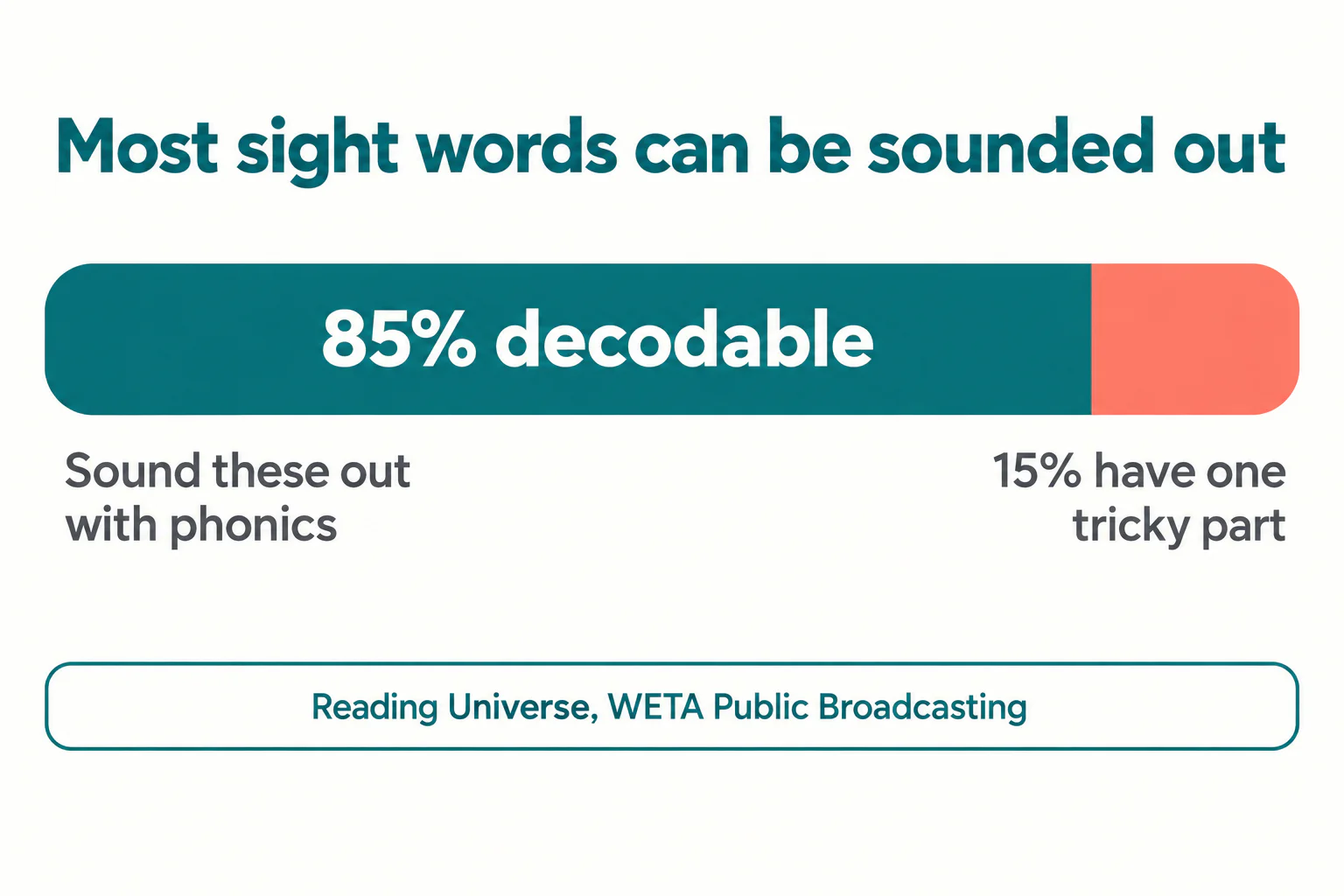
This matters for how an evening of practice goes. A child drilled on whole-word shapes learns one word per card and gains nothing transferable. A child taught that "ea" can say the sound in "bread" learns a pattern that opens up bread, head, dead, instead and spread, none of which were on the card. The first approach scales linearly with effort. The second compounds.
Reading Universe is blunt about the cost of the older approach: whole-word teaching "requires students to visually memorize hundreds of words, which can be overwhelming". Most children get through it anyway. The ones who do not are usually the children who most needed the pattern, not the picture.
Our own list of 250 essential sight words for first graders is still the right list to work from. Use it as a frequency list rather than a memorising list: work through it with phonics, and treat the small irregular group separately.
What is a heart word, and how do you teach one?
A heart word is a high-frequency word with one tricky part. Reading Universe describes these as words that "each have a tricky part of the word that students must memorize, or learn by heart", and notes that other programmes call the same thing red words, trick words or rule breakers. The method is the same whatever the label: decode the regular letters, memorise the one part that misbehaves, and never memorise the whole word.
Three examples show how small the memorised part really is.
So the practice script at home is three sentences long. Say the word. Ask your child which letters are doing what they expect, and mark those. Then point at the one part that does not, and say "this bit we just remember". A child who has done that with "said" can usually do it unprompted with "says" a week later, which is the whole point.
One diagnostic worth running. Ask your child to spell a heart word out loud without writing it. Children who memorised the shape produce a jumble with the right letters in roughly the right place. Children who learned it as a decodable word plus one heart part get it exactly right, because they are reconstructing rather than recalling. If spelling breaks down in writing but survives the weekly test, our piece on why a child passes the spelling test but not in writing covers what that gap actually means.
What phonics does for your child, and what it does not
This is the part most reading advice gets wrong, and the source is the most heavily cited reading report in existence. The National Reading Panel, published by the National Institute of Child Health and Human Development in April 2000, concluded that "systematic phonics instruction produces significant benefits for students in kindergarten through 6th grade and for children having difficulty learning to read", and that "systematic synthetic phonics instruction had a positive and significant effect on disabled readers' reading skills".
Then comes the sentence that nobody quotes. "Older children receiving phonics instruction were better able to decode and spell words and to read text orally, but their comprehension of text was not significantly improved."
Read that properly and it reframes the whole decision. Phonics is the right answer to a decoding problem and the wrong answer to a comprehension problem. A ten-year-old who reads a page aloud fluently and then cannot say what happened in it does not need more phonics, and more phonics is what they are usually given. That child needs vocabulary, background knowledge and a reason to hold meaning while reading, which is a different kind of teaching. We wrote about exactly that pattern in reading fluently but missing the meaning.
The panel was also honest about something the internet is not. On how much phonics is enough, it wrote that "usually the term intensive is not defined", asked "how much is required to be considered intensive" and "how long should single instruction sessions last", and left both as questions for future research. Any programme promising an exact number of minutes a day is going beyond the evidence it cites.
Not sure whether your child's reading problem is decoding or comprehension? A free trial class with a Codeyoung English teacher identifies which one it is in a single session, before you commit to anything.
Book a Free Trial →How to teach high-frequency words at home, in order
The order matters more than the materials. Each step assumes the one before it.
- Check the sounds come first. Before any letters, say a word slowly and ask your child to tap out its sounds: "ship" is three taps, not four. If this is shaky, stay here. Phonics built on weak phonemic awareness collapses later.
- Sort the week's words into two piles. Decodable in one, tricky in the other. Most weeks the decodable pile is much larger, which is itself reassuring for a child who thinks English is arbitrary.
- Sound out the decodable pile. Do not show the word as a whole first. Let them build it from parts, and let it be slow. Speed arrives on its own with repetition.
- Teach each tricky word as a heart word. Mark the regular letters, mark the one part to remember, and name the sound the tricky part makes in that word.
- Read the words inside sentences the same day. A word recognised on a card and not in a sentence has not been learned. This is the step most often skipped.
- Come back after three days, not three weeks. Short gaps with small amounts beat one long session, and the pattern taught in step 3 is what you are checking has stuck.
For older children who are past this stage but still slow, the method changes rather than the subject: our guide to reading strategies across grades covers what replaces decoding practice.
Why this argument keeps appearing in the news
You are hearing about this now because it has become a legislative question rather than a classroom one. The Albert Shanker Institute reviewed over 400 literacy laws enacted between 2019 and 2024 and found that 118 laws across 23 states and the District of Columbia use the expression "science of reading", and that at least 17 states include prohibitions on three-cueing, the practice of encouraging a child to guess an unknown word from pictures and context.
That is the policy version of the same argument. Guessing from context and memorising shapes both let a child appear to read without being able to decode, and both postpone the problem until the books get harder, which is usually around age nine. Teaching for patterns rather than pictures is the one choice in early reading where the research and the legislation now point the same way.
None of this requires a parent to buy a programme. It requires knowing which pile a word belongs in, and resisting the instinct to show a child the whole word first. If you want a teacher doing that systematically each week, Codeyoung's 1:1 online English classes work through it at the pace your child actually reads at.
Sort the pile, then teach it
Three things to take away. Most of the sight word list is decodable, so phonics does the bulk of the work and the flashcards are mostly redundant. The small irregular group needs one part memorised rather than a whole shape, which is what a heart word is. And phonics is the answer to a decoding problem only: the National Reading Panel did not find that it improves comprehension in older readers, so a fluent reader who misses the meaning needs something else entirely.
Sorting this week's words into two piles takes about two minutes, and it changes what the next twenty minutes of practice are worth.
Codeyoung runs 1:1 live online classes for children aged 6 to 17, with a teacher who adapts the pace to your child rather than a fixed syllabus. The first class is free, so you can see how they respond before deciding.
Book a Free TrialSources, all checked 12 October 2026: National Reading Panel findings and determinations, NICHD, April 2000; Reading Universe on irregularly spelled high-frequency words, WETA Public Broadcasting; Albert Shanker Institute analysis of state literacy legislation, June 2025.