
The moment most parents notice the problem is the same one. You ask a child to bring the washing in, and instead of moving they ask how much. Somewhere along the way helping out became a negotiation, and nobody meant for that to happen.
Whether you pay your child for chores turns out to matter less than a distinction underneath it: the difference between a household duty and an actual job. Get that line right and an allowance teaches planning. Get it wrong and it teaches a child that family contribution has a price attached.
The two things that get bundled together
Allowance and chores are usually treated as one system, with the money conditional on the work. That bundling creates the problem, because it applies a price to things that should not have one.
Separate them and the picture clears up:
- Duties. Things a child does because they live here and are part of the household. Making their bed. Clearing their plate. Tidying their own room. No payment, ever, because nobody pays anyone else in the house for these either.
- Jobs. Genuine extra work somebody would otherwise have done or paid for. Washing the car. Raking leaves. Sorting the recycling for the whole house. Payment is reasonable, because the work is real and optional.
- Allowance. A predictable sum on a predictable day, attached to neither. Its purpose is to give a child something to practise managing.
That third one surprises people. An allowance that has to be earned is not an allowance, it is wages, and wages do not teach planning because the amount varies with effort. A child learning to budget needs a fixed input, in the same way that learning to cook is easier when the ingredients are not a surprise every week.
What happens when you pay for everything
Helping becomes conditional. This is the practical failure, and it arrives faster than parents expect.
There is a well-documented effect behind it. A large meta-analysis by Deci, Koestner and Ryan, published in Psychological Bulletin in 1999 (volume 125, pages 627 to 668, doi 10.1037/0033-2909.125.6.627), found that tangible rewards offered for completing a task tended to reduce people's intrinsic motivation to do that task afterwards. The reward reframes the activity: something you did because it seemed worth doing becomes something you did for payment, and the willingness does not survive the payment stopping.
That research is about task motivation in general rather than about household chores specifically, and it is worth being honest about the gap. But the mechanism is recognisable to any parent who has watched a previously willing seven-year-old start asking what the rate is.
The version that goes wrong looks like this. Every task gets a price, because pricing works at first. The child becomes an efficient contractor, does the paid work well, and quietly stops doing anything unpriced. Requests for unpaid help now feel to them like being asked to work for nothing, which, given the system they were taught, is a fair reading.
Not sure which level your child should start at? A free trial class with a Codeyoung teacher shows you exactly where they are and what they are ready for next, before you commit to anything.
Book a Free Trial →Why age six to twelve is the window that matters
The United States Consumer Financial Protection Bureau maps children's financial development into three building blocks, each attached to an age band, and the middle one is where an allowance does its work.
| Ages | Building block | What is developing |
|---|---|---|
| 3 to 5 | Executive function | Self-control, working memory, planning ahead, waiting |
| 6 to 12 | Financial habits and norms | Habits, rules of thumb, a sense of what is normal with money |
| 13 to 21 | Financial knowledge and decision-making | Factual knowledge, research, comparing options |
Read the middle row carefully. The CFPB describes habits and norms as things children typically acquire through observation of parents and peers, developing a sense of what is normal or appropriate about spending and saving. Not through instruction. Through watching, and through doing.
That has a direct implication for how allowance works. A lecture about saving at age eight achieves very little, because the knowledge building block is not the one under construction yet. A small sum arriving every Saturday, which the child manages and occasionally mishandles, is exactly the kind of practice that stage is built for.
It also means the modelling matters more than the talking. A child who never sees a parent decide not to buy something learns that deciding not to buy is not a thing people do. We made a related argument about what children can and cannot observe in teaching kids about money when nobody uses cash.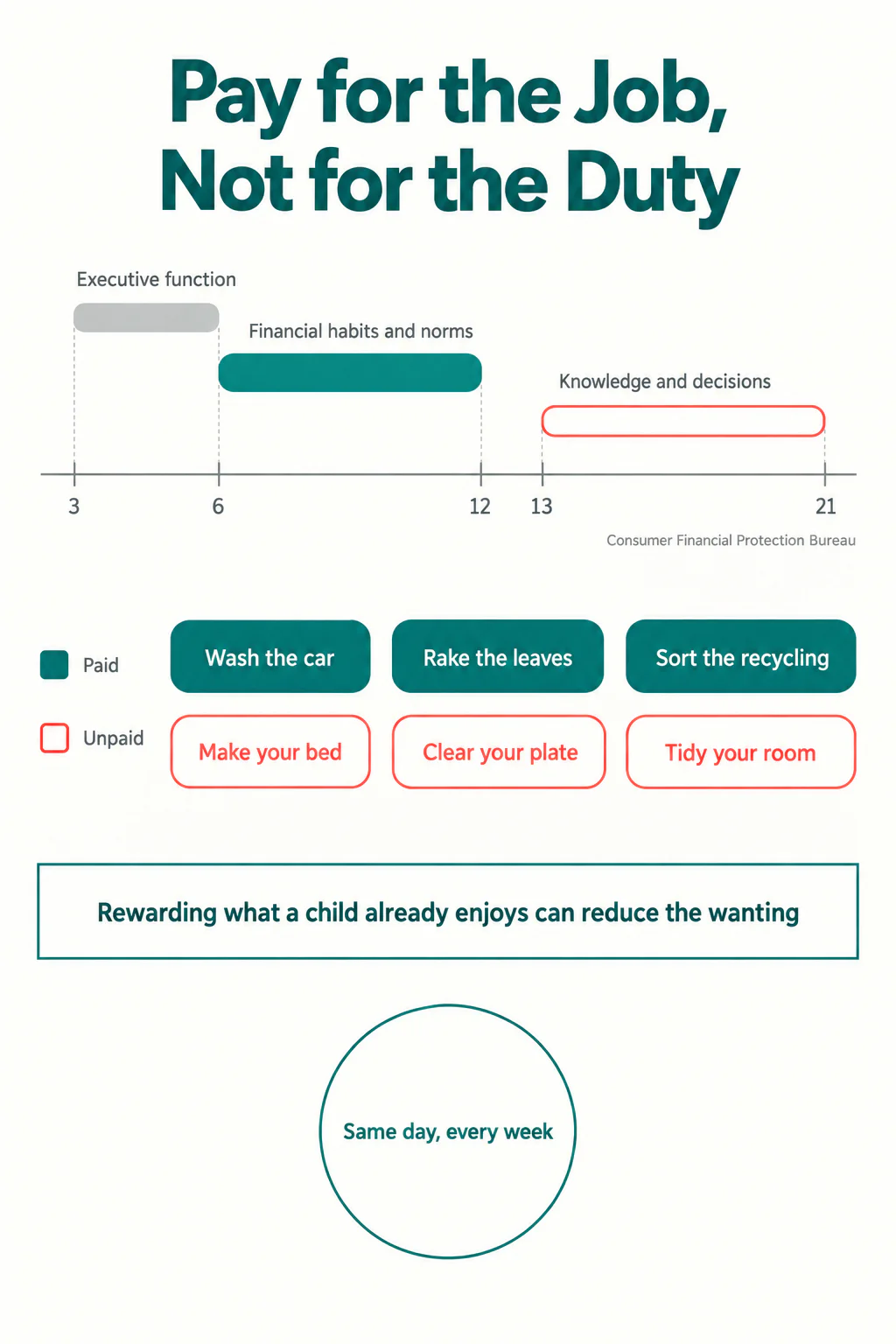
How much, and how often
The frequency matters considerably more than the amount, and parents generally have this the wrong way round.
A predictable small sum on a predictable day is a planning tool. A child knows what is arriving and when, so they can decide to wait for something. An unpredictable larger sum, handed over when asked and when the parent feels like it, teaches the child to ask well. Those are entirely different skills, and only one of them is financial.
Three rules that hold up in practice:
- Same day, every week. Sunday, or whatever suits. The reliability is the point.
- Paid without being requested. The moment a child has to ask, the lesson has changed.
- Not withheld for unrelated behaviour. Allowance used as a disciplinary lever stops being predictable, and predictability was the whole mechanism.
Point three is the one families break most often, usually in the heat of a difficult evening. It is understandable and it undoes the system, because a child cannot plan against an income that might be cancelled by an argument about bedtime. Damage caused through carelessness is different: contributing toward the repair of a broken thing is a real financial consequence, directly connected to the event.
Let the first mistake happen
A child who spends the whole lot on Saturday morning and has nothing left on Wednesday has learned something no conversation could have delivered.
The instinct to soften this is strong, and it is the single most common way the lesson gets cancelled. A parent who covers the shortfall has taught, accurately, that running out is not a real consequence. That lesson holds until the stakes are much higher.
Eight is a good age to run out of money. It costs almost nothing. The same discovery at nineteen, with a credit card, costs considerably more. Sitting through a Wednesday of mild regret is doing a child a service, provided nobody says anything resembling "I told you".
What helps instead is a short conversation the following Saturday, before the money arrives. "Last week it was gone by Wednesday. What do you want to do differently?" That asks the child to plan, which is the skill, rather than delivering a verdict about last week.
What a job should actually pay
Rates are a family matter, but the structure is not. Two principles keep it sane.
Price the job, not the hour. An agreed sum for washing the car avoids the situation where a child works slowly and earns more for it. It also produces a genuine negotiation about whether the price is fair, which is itself useful practice.
Let them turn it down. A job a child cannot decline is a duty in disguise, and the child will notice. The right to say no is what makes it a job, and it is also what makes accepting it mean something.
Worth noting that this sets up arithmetic worth doing. If washing the car pays a fixed sum and the thing they want costs six times that, the number of weekends involved is a real division problem with a real answer attached. Children who would resist a worksheet will happily work that out, which is the same principle behind our online maths classes starting from problems a child actually wants solved. Our piece on how maths is used in everyday life has more in the same vein.
The mistake that is easiest to make
Announcing a whole system on a Sunday evening. Chore chart, job rates, allowance day, savings rules, the lot.
It collapses within a fortnight, every time, because it requires the parent to administer it consistently and nobody sustains that alongside everything else. What survives is whatever was simplest.
Start with one thing: a fixed small amount on a fixed day, no conditions. Run it for a month. Add a single paid job after that if it is working. A system a family actually maintains beats a better system that stops in March, and the same logic applies to most things parents try to introduce at home, as we argued in teaching children about money, ten mistakes to avoid.
Where to start this weekend
Write two short lists. On one, the things your child does because they live in this house. On the other, the things that are genuinely extra work somebody would otherwise pay for. Say both lists out loud to them, and be clear that the first list is never going to be paid.
Then pick a day and a small fixed amount, and hand it over on that day without being asked. That is the whole system. It works because it is small enough to keep going, and because the lesson it teaches, that money arrives predictably and has to last, is the one that transfers to adult life almost unchanged.
Codeyoung runs 1:1 live online classes for children aged 6 to 17, with a teacher who adapts the pace to your child rather than a fixed syllabus. The first class is free, so you can see how they respond before deciding.
Book a Free Trial