
In 1987, a team from the Harvard-Smithsonian Center for Astrophysics stopped 23 Harvard seniors, alumni and faculty members on graduation day and asked them a question a nine-year-old is taught: what causes the seasons?
Twenty-one of them got it wrong. Most said the Earth must be closer to the Sun in summer. Several, asked about the phases of the Moon, said the Earth's shadow falls across it.
These were people who had passed every science test put in front of them for sixteen years. The film they made about it, A Private Universe, remains one of the most uncomfortable things in science education, because it shows something that applies directly to your child: passing science tests and understanding science are separable, and school assessment does not reliably tell them apart.
Why science is uniquely easy to fake
Every subject can be memorised. Science is unusually vulnerable, for three reasons that compound.
The questions ask for recall. Define photosynthesis. Label the parts of a cell. Name the three states of matter. These are retrieval tasks, and a child who has learned the words scores full marks whether or not any model sits behind them.
The vocabulary does the work. Science hands children impressive-sounding words, and a sentence containing "evaporation" and "condensation" in the right order reads as understanding. It often is not. I have heard children use "gravity" fluently in three sentences and then say heavier things fall faster.
The intuitive wrong answer is rarely challenged. A child arrives with an existing theory of how the world works, usually a sensible one. Closer means hotter is good reasoning. It is simply wrong about seasons, and unless something forces a collision between the intuition and the taught answer, the child files both away and uses whichever the situation calls for.
That last point is the one parents find hardest to believe. Children do not usually replace a wrong idea with a right one. They keep both.
What this looks like at home
A few patterns worth recognising.
Your child explains a topic using the exact phrasing from the textbook and cannot rephrase it. Ask them to say it differently and they repeat the same sentence more slowly.
They answer confidently inside the topic and go blank just outside it. Photosynthesis, fine. Why a plant in a dark cupboard dies, no idea, despite it being the same fact.
They ask whether something "will be in the test", which is a reasonable question from a child and a reliable sign that the material is being handled as a list rather than an explanation.
None of these mean your child is not clever. They mean the subject is being learned in a form that will not survive the summer.
Not sure which level your child should start at? A free trial class with a Codeyoung teacher shows you exactly where they are and what they are ready for next, before you commit to anything.
Book a Free Trial →Four questions that tell you the truth
These take five minutes and need no science knowledge of your own. The pattern is the same each time: ask them to apply the idea to something the textbook did not mention.
| Topic | Ask this | What understanding sounds like |
|---|---|---|
| Seasons | "Is it summer everywhere at once?" | Knows Australia is in winter, and can say why |
| States of matter | "Why does the bathroom mirror fog up?" | Connects warm damp air meeting a cold surface |
| Gravity | "If I drop a coin and a pebble together, which lands first?" | Says together, and is not put off by the weight difference |
| Plants | "Where does the wood in a tree actually come from?" | Gets to air and water rather than only soil |
The last one is the most revealing and almost everyone gets it wrong, adults included. Most people say the tree is made of soil. The bulk of a tree's mass comes from carbon dioxide in the air. A child who can get there has genuinely understood photosynthesis rather than recited it.
Do not treat a wrong answer as a failure. Nearly every child gets at least one of these wrong, and so do most adults. The information you want is which ones, and whether they can reason when they are unsure.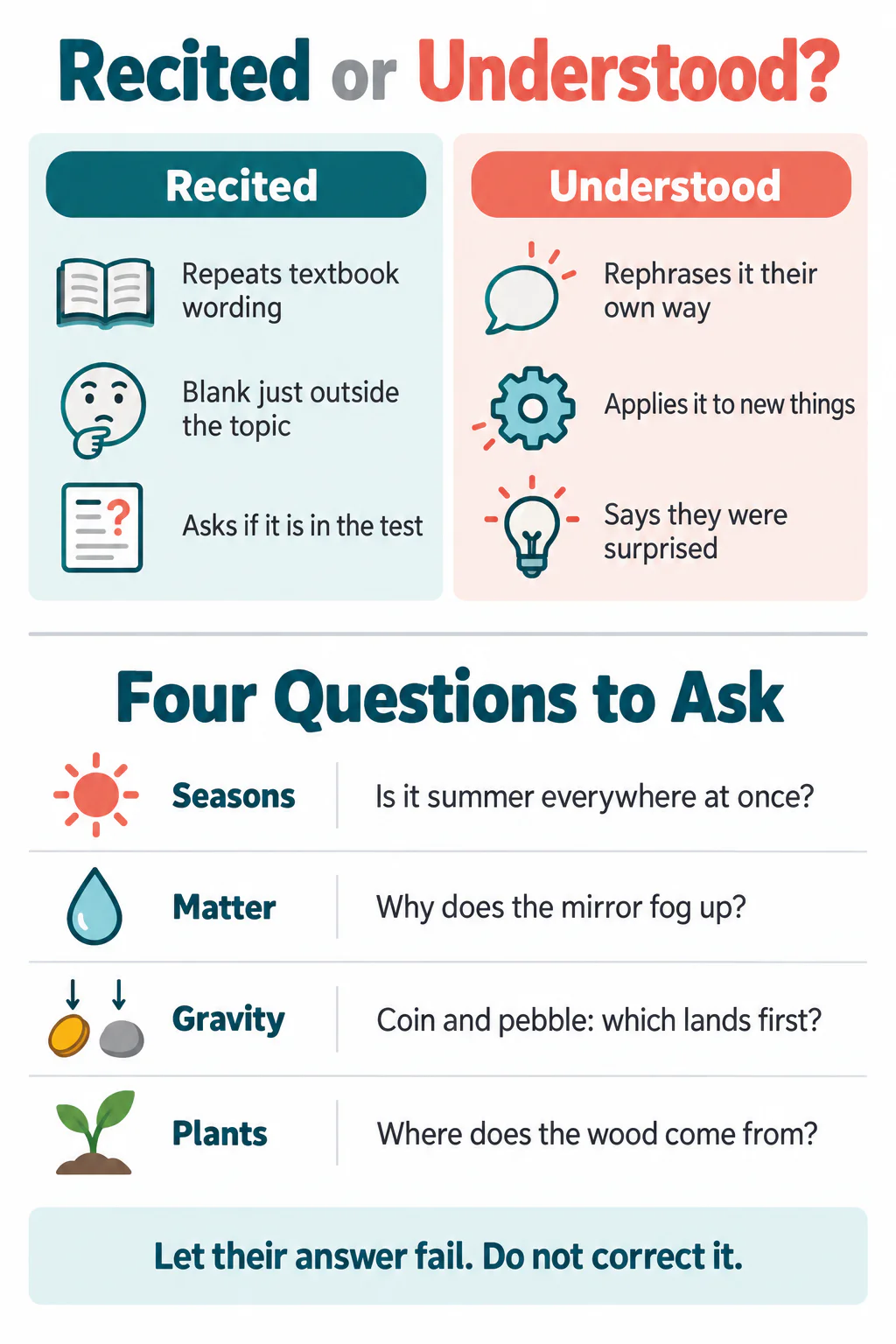
What to do when the answer is wrong
This is where most parents go wrong, and the instinct is a kind one.
The natural response is to correct it. Explain the axial tilt, draw a diagram, make sure they have the right version. It feels like teaching and it changes remarkably little, because it produces exactly the situation described above: the child now has the correct explanation stored next to the intuitive one, and the intuitive one still feels true.
What works better is letting the explanation fail on its own.
- Take their answer seriously. "Okay, so if we're closer to the Sun in summer, what's happening in Australia right now?"
- Wait. The silence is the useful part. This is the moment the model breaks, and it has to break for them rather than at them.
- Let them reach for something. Even a wrong new idea is progress, because it means they are rebuilding rather than filing.
- Only then offer the tilt. Arriving after the contradiction, it explains something they now want explained.
A misconception a child has argued themselves out of tends to stay gone. One they were simply corrected on tends to come back, which is precisely what happened to those Harvard graduates.
What good science teaching does differently
If you are choosing a class or judging one your child is already in, this is the thing to watch for.
Weak science teaching delivers explanations and then tests whether they were retained. Strong science teaching gets the child to predict first, then shows them what actually happens, and spends its time on the gap between the two.
That prediction step is the whole mechanism. A child who has committed to a guess is paying attention to the outcome in a way a child receiving an explanation never is. It is also why experiments taught as a procedure to follow teach so much less than experiments where the result is genuinely in question.
Practical signals: does your child ever say they were surprised by something? Do they mention getting a prediction wrong? Surprise means a model was updated, and it is the single best indicator that real science is happening. Our guide on telling whether your child's classes are actually working covers the broader version of that question, and knowing if your child needs science help deals with the case where they are genuinely behind rather than just memorising.
For building the habit at home, five-minute science ideas are useful mostly because they create small predictions with fast answers, and curiosity-led science teaching explains the approach in more detail.
Frequently Asked Questions
How can my child score well and still not understand science?
Because most school science questions ask for recall: define this, label that, state the three stages. A child who has memorised the words can answer correctly without holding the underlying model. The test measures what they can retrieve, which is not the same as what they understand.
What is the fastest way to check real understanding?
Ask them to explain a familiar everyday thing using what they learned, rather than reciting the topic. A child with a working model can apply it to a new situation. A child who memorised will either repeat the textbook phrasing or go quiet, and the difference shows within a minute.
Is memorising in science always bad?
No. Some things genuinely have to be learned by heart, including vocabulary, symbols and a handful of values. The problem is memorising instead of understanding rather than alongside it. Facts are useful hooks once a model exists and a poor substitute when it does not.
Why do misconceptions survive being taught the right answer?
Because children usually add the new explanation alongside the old one rather than replacing it. The intuitive version still feels right, so it resurfaces outside exam conditions. Changing that requires the child to notice their own explanation failing, which passive listening rarely produces.
What if my child gets the follow-up question wrong?
Treat it as useful rather than alarming, and resist correcting immediately. Ask what would happen if their explanation were true, and let them find the contradiction. A misconception a child has argued themselves out of stays gone. One they were simply corrected on usually does not.
Should I raise this with the teacher?
Yes, and frame it as a question rather than a complaint. Ask whether your child can explain ideas in their own words in class or mainly reproduces taught phrasing. A good science teacher already knows the difference and will usually have noticed which one your child does.
What to take from this
A science grade tells you what your child could retrieve on one morning. It does not tell you whether an explanation exists underneath, and those two things come apart more often than school reports suggest.
The check is quick. Pick something they studied this term and ask them to explain an ordinary thing with it, something the textbook never mentioned. Fogged mirrors, Australian winters, where a tree comes from. Then listen for whether they are reasoning or reciting.
If it turns out to be recitation, that is not bad news. It is early news, and it is far easier to fix at ten than at twenty-two on a Harvard lawn with a camera pointed at you.
Codeyoung runs 1:1 live online classes for children aged 6 to 17, with a teacher who adapts the pace to your child rather than a fixed syllabus. The first class is free, so you can see how they respond before deciding.
Book a Free TrialSources: Science in School on A Private Universe and SERC, Carleton College, on the study.