First-party parent survey · 2026
Codeyoung Research: We surveyed 364 parents across five countries - primarily the US, UK, and Canada - about raising kids in the age of AI. The results are clear, and a few of them are genuinely surprising.
The Short Version:
In a 2026 survey of 364 parents across five countries, 66% said AI skills will be critical to their child's future, yet only 11% of schools teach AI. Their biggest fear isn't job loss - it's loss of critical thinking (70%). And barely 1 in 10 want AI used for homework; most want kids who build with it.
If you're a parent, you've probably had a quiet moment of unease about this already. Maybe you watched your nine-year-old open a chatbot to "help with a worksheet." Maybe you typed a question into AI yourself and thought, I have no idea how I'd explain this to my kid.
You're not alone in that feeling. We wanted to know how widespread it is, so we asked the people closest to it: parents. What follows is what 364 of them told us - not opinions from a think tank, but answers from families who are living this in real time.
Here's the most important thing we learned, up front: most parents have already made their peace with AI being part of their kids' lives. They've decided it matters. What they're missing is a clear, trustworthy way to introduce it. Let's walk through the data.
The Big Gap: Almost every parent wants AI education. Almost no school provides it.
We started with the simplest question: how important will AI be to your child's future?
Two out of three parents (66%) said it will be critical - that AI will help define what their kid does for a living. Add in the parents who called it "moderately important," and 90% see AI as a real part of their child's future.
Then we asked the follow-up: does your child's school teach anything about AI? Only 11% said yes. Forty-four percent said no - and another 44% weren't sure, which, if you've ever tried to pin down what your kid is actually learning, usually means no.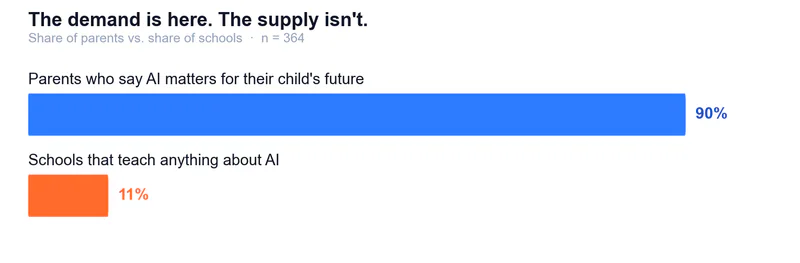
And here's a detail that surprised us. You might assume the urgency comes from tech-savvy parents who use AI all day. It doesn't. When we cross-checked, even parents who have never used an AI tool rated it "critical" at 69% - as high as the daily users do. Wanting this for your kid has nothing to do with whether you're "techie." It's nearly universal.
The Reality at Home: Your kid is probably already using AI. Most likely without you in the room.
Before parents decide what to do about AI, it helps to know what's already happening. So we asked whether kids are using AI today - and the answer is a loud yes.
61% of kids already use AI tools. Not "have heard of." Use. And of those, the largest group - 40% of all kids surveyed - are using it independently, with no adult supervision. Another 20% use it with a parent nearby. Only 28% don't use it at all.
Put those two findings together and the takeaway is uncomfortable but honest: by the time most parents decide to "do something" about AI, their kid has already been using it for months. The question was never whether your child will encounter AI. It's who teaches them to use it well - and right now, for 40% of kids, the answer is "nobody. They're figuring it out alone."
The Real Fear: Parents aren't scared of robots taking jobs. They're scared of a dull mind.
This is the finding that stopped us. We asked parents to choose their top three concerns about AI. Job loss, the headline everyone expects, came in fourth.
The runaway top concern, named by 70% of parents, was that their child won't learn to think critically. That's more than double the fear of job replacement (32%) and nearly three times the fear of cheating (24%). It was the single most agreed-upon answer in the whole survey.
Look closely at that top bar. The thing parents fear most isn't that AI will steal their child's future. It's that AI will steal their child's effort - the daily, ordinary work of figuring something out on your own. One parent put it to our team like this:
"I'm not worried about him not getting a job. I'm worried he'll stop trying to figure things out on his own."
And notice what these parents are not saying. They're not asking to ban AI or wall their kids off from it. They want their kids to grow up with AI but not behind it. That's a meaningful difference - and it points directly at what they want instead.
The Real Ask: What parents really want: a kid who builds with AI.
Here's where a lot of conventional ed-tech thinking falls apart. When we asked parents which AI skills they most want their child to learn, "use AI for schoolwork" finished dead last at 11%. What they want sits at the top:
We pushed further and asked what would make an AI course feel genuinely "worth it." If grade improvement were the secret driver, this is where it would show up. It didn't. "Grades improve" finished last again, at 19%. The top answer, at 57%, was a behavior change:
Read those two charts together and a clear picture emerges. Parents aren't buying AI education to nudge a B+ to an A. They've watched their child paste a homework prompt into a chatbot and copy the answer back, and somewhere in their gut they know that's the wrong relationship between a kid and a machine. They want someone to teach their child to be in charge of the AI - not the other way around. And the outcome they treasure most is a kid who can point at something and say, "I made that." Also important to point out that parents also feel the need for kids to use AI responsibly and be able to spot misinformation - seems naive but increasingly important with AI outputs becoming as realistic as ever.
The Parent Trap: They use AI every day. They still can't explain it.
This is the quietest, most relatable finding in the survey. 66% of parents use AI weekly or more; 42% use it daily. These aren't technophobes. They draft emails with it, plan trips with it, summarize documents at work with it.
And yet, when we asked how confident they feel explaining AI to their child, only 30% said "very confident."
This is a brand-new kind of parenting gap. With math, you can dust off enough to help with a fifth-grade worksheet. With reading, you model it just by being a reader. With AI, there's no muscle memory yet - no curriculum your school handed you, no version of this you did in your own childhood. Doing it doesn't teach you how to teach it.
Which leads somewhere reassuring, especially if you've felt out of your depth here. The parents who feel furthest behind - the ones who've never written a line of code - actually aren't. We split the sample almost evenly between tech and non-tech households (53/47), and they gave nearly identical answers across the board. Same fears. Same priorities. Same need for help. If this topic makes you feel unqualified, you're not behind. You're in the majority.
The Right Age: When should kids start? Most parents say: whatever age mine is now.
We asked parents the question we get more than any other: what's the right age to start learning about AI?
The most common answer was 11–13 (29%), closely followed by 6–8 (27%). More than four in five parents (82%) said start before age 13; half said by age 10.
But the averages hide the most revealing pattern: who picked what. Parents tend to name their own child's current age as the right age to start. We saw it clearly when we matched each parent's answer to their kid's actual age:
The "my kid is ready now" effect
Among parents of 6–8-year-olds, 54% picked 6–8 as the right starting age. Among parents of 11–13-year-olds, 77% picked 11–13. The trigger to act isn't a developmental milestone or a school recommendation - it's the moment a parent looks at their own child and thinks, they're ready, and I'm a little behind.
So if you've been waiting for some clear signal that it's time - that wondering is the signal. Statistically, the age your child is right now is the age the average parent decided was the right one to start.
The Verdict: Half of parents are sold. The other half just want proof.
Finally, we asked how interested parents are in an AI course for their child. The "not interested" camp barely exists.
The 51% who said "definitely" are straightforward - they've decided. The 3% who aren't interested are easy to set aside. It's the 46% in the middle that matter most, and they're widely misread.
These parents aren't unsure about AI. They've already concluded it matters for their kid. What they're evaluating is whether this specific course, this specific teacher, this specific approach will actually deliver. They don't need to be persuaded that AI is important. They need proof - a real class, a clear curriculum, a project another kid actually built. If that's you, your instinct is sound. You've already settled whether AI is worth learning; you're just weighing whether this particular version is. That's a fair question, and it's best answered by showing rather than telling.
What it means for you: Five things the data quietly tells every parent
We've taught kids 1:1 for years - 50,000+ families and a 4.5+ rating later - and this survey lined up with almost everything we hear on calls. If you're a parent trying to make a sensible decision, here's what we'd take from it.
Don't wait for school to cover it: 89% of parents say their kid's school teaches no AI, or they're not sure it does. That won't change in the next couple of years. If AI is going to enter your child's life with any intention behind it, the first move is yours.
Reset the relationship early, before the habit sets: 40% of kids already use AI on their own, and the default habit they pick up is "ask, copy, move on." The sooner a child learns to question and direct AI instead of just taking its first answer, the less that reflex hardens. Start with the relationship, not the tool.
Aim for a build, not a grade : A finished project - an app, a chatbot, a game, a generated story - is what flips AI from a vending machine into a workshop in a kid's mind. 57% of parents told us this mindset shift is the outcome they actually want. Trust that instinct.
Critical thinking is the prize - and AI can sharpen it: The thing 70% of parents fear losing is the very thing good AI education builds. A kid who learns to prompt an AI has to think clearly enough to say what they want. A kid who learns to check its answers is practicing skepticism. Done well, it sharpens the mind. Done lazily, it numbs it. The difference is the teacher.
You don't have to be the expert: Even among daily AI users, 69% don't feel "very confident" explaining it to their kid. You're not behind - you're with everyone else. The job isn't to teach your child AI yourself. It's to find them someone who can.
See what learning AI the right way looks like
Codeyoung's live, 1-on-1 AI & Coding classes for kids are built on exactly these findings - fundamentals first, real projects over toys, and responsible use woven through every step. No group Zoom rooms. No "use AI to do your homework." Just your child, a hand-picked mentor, and a clear path from "I've tried ChatGPT once" to "I built this myself."
Live 1-on-1 · Mentors from the top 1% of applicants · 4.5+ rated by 50,000+ parents
Quick answers: Parents' most common questions about kids and AI
At what age should kids start learning about AI?
In our survey of 364 parents, the most common answer was 11–13 (29%), with 82% saying kids should start by age 13 and half saying by age 10. In practice, parents tend to pick their own child's current age - 54% of parents of 6–8-year-olds and 77% of parents of 11–13-year-olds chose their own child's bracket. There's no single "right" age; what matters more is starting in a guided, age-appropriate way rather than leaving a child to explore AI alone.
Do schools teach AI?
Mostly not yet. Only 11% of the parents we surveyed said their child's school teaches anything about AI. 44% said it doesn't, and another 44% weren't sure. Meanwhile 90% of parents believe AI will matter to their child's future - a gap between demand and what schools currently deliver.
Is AI safe for kids?
AI can be safe for kids with guidance, but the data shows most kids aren't getting it: 40% of children already use AI tools with no adult supervision. Parents' top concerns are lost critical thinking (70%), safety and privacy (54%), and over-dependence (50%). The safest path isn't banning AI - it's teaching kids how to use it responsibly, verify its output, and stay in control of it.
Should my child learn AI?
97% of the parents we surveyed are open to AI education for their child, and 66% believe AI skills will be critical to their kid's future career. Most kids (61%) already use AI anyway. The question for most families isn't whether to learn AI, but whether to learn it intentionally, with fundamentals and responsible-use habits or by trial and error alone.
Should kids use AI for homework?
Parents are clearly cool on this. Only 11% want their child to use AI for schoolwork, and just 19% measure success by improved grades. The worry is that using AI as a homework shortcut weakens the effort and thinking that learning is supposed to build. Most parents (57%) would rather their child learn to use AI as a tool to build things than as a way to skip the work.
About this survey. Findings are based on 364 real responses to Codeyoung's "Help Shape AI Education for Your Child" survey, fielded April–May 2026 across parents in the United States (38%), United Kingdom (25%), Canada (21%), India, Australia, and other countries. The sample split almost evenly between tech (53%) and non-tech (47%) households. Per-question totals vary slightly due to partial responses; multi-select questions sum to more than 100%. Percentages are rounded. For methodology questions, contact the Codeyoung Research team at team@codeyoung.com