
Ask a class of eleven-year-olds to work out 8 ÷ 2 × 4 and you will get two answers, confidently. Half say 16. Half say 1. The half who say 1 are not careless: they are doing exactly what they were taught, because the mnemonic they were given for the order of operations in math quietly tells them to multiply before dividing.
The correct answer is 16. The acronym is not a slightly imperfect summary of the rule. On two specific points it states the opposite of the rule, and those two points account for most of the mistakes I see in eleven-plus and pre-algebra work.
What the acronym actually says, and where it breaks
PEMDAS stands for parentheses, exponents, multiplication, division, addition, subtraction. British schools use BODMAS or BIDMAS, with brackets and orders or indices. Different letters, same structure, same two problems.
Read as a list of six ranked steps, it produces two predictable errors.
| Problem | What the acronym implies | The correct answer |
|---|---|---|
| 8 ÷ 2 × 4 | Multiply first: 8 ÷ 8 = 1 | 16. Division is further left, so it goes first |
| 10 − 3 + 2 | Add first: 10 − 5 = 5 | 9. Subtraction is further left, so it goes first |
Worth noticing: the English national curriculum never uses the word BODMAS anywhere. What it asks for at Key Stage 3 is that pupils "use conventional notation for the priority of operations, including brackets, powers, roots and reciprocals". Priority, not a queue of six. The acronym is staffroom folklore that hardened into a rule.
The four tiers that actually govern arithmetic
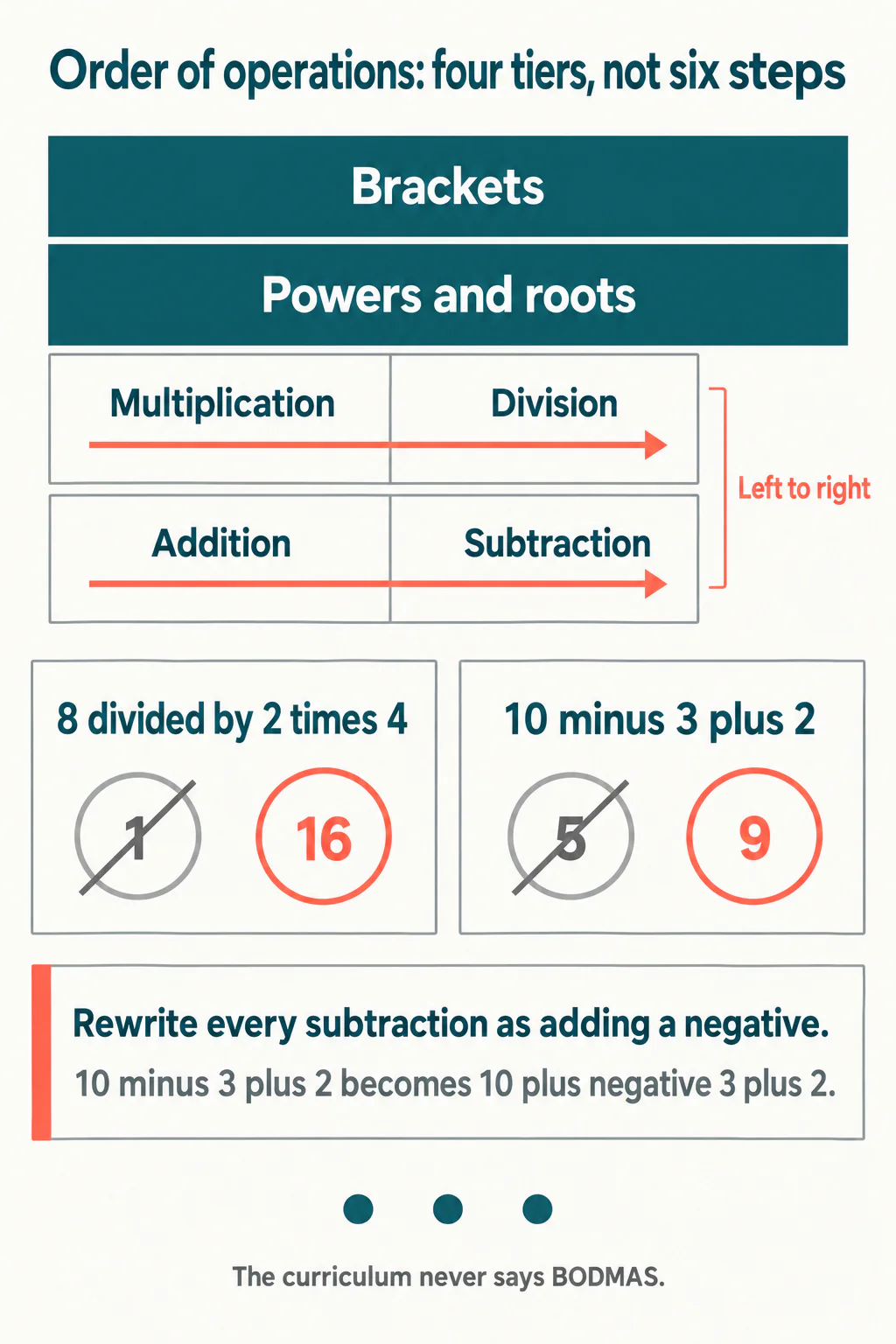
There are four levels of priority, not six steps. Two of those levels contain a pair of operations that rank equally and are read left to right, exactly like words on a page.
- Brackets. Anything grouped is worked out first, innermost group first.
- Powers and roots. Squaring, cubing, square roots.
- Multiplication and division together, left to right. Neither outranks the other.
- Addition and subtraction together, left to right. Neither outranks the other.
That is the whole rule. The reason tiers three and four pair up is not an arbitrary convention: dividing by 2 is multiplying by a half, and subtracting 3 is adding negative 3. They are the same operation wearing different clothes, so they cannot rank above each other.
This is the point where the concept lands or does not. A child who has understood that division is multiplication by a reciprocal will never again wonder which comes first. A child who has only memorised six letters will get it right on Tuesday and wrong in an exam.
The fix that removes the error completely
There is one habit worth more than any amount of re-explaining: rewrite every subtraction as adding a negative.
Take 10 − 3 + 2 and write it as 10 + (−3) + 2. Now every operation on that line is an addition, and addition can be done in any order at all. The left-to-right trap has not been navigated, it has been deleted. The answer is 9 whichever end you start from.
It takes about a week of practice for this to become automatic, and it pays off far beyond arithmetic. Every sign error in secondary algebra, and there are many, traces back to a student who never fully accepted that subtracting is adding a negative. Building it in at ten is much cheaper than repairing it at fourteen.
Not sure which level your child should start at? A free trial class with a Codeyoung teacher shows you exactly where they are and what they are ready for next, before you commit to anything.
Book a Free Trial →When does a child need this?
Later than most parents assume, and there is a real cost to teaching it early. Before the times tables are secure, an order-of-operations question asks a child to manage a rule and a recall problem at once, and the recall problem wins.
| Age | Stage | What matters |
|---|---|---|
| 7 to 9 | Before the rule | Multiplication and division facts becoming automatic. The order of operations is unusable without them. |
| 9 to 10 | Brackets appear | Grouping as an idea. The difference between 2 + 1 × 3 = 5 and (2 + 1) × 3 = 9. |
| 10 to 11 | Year 6 expectation | Using the order of operations across all four operations, which is exactly how the English curriculum words it. |
| 11 to 14 | Key Stage 3 | Powers, roots and reciprocals join the notation. Expressions start containing letters. |
| 14 plus | Algebra proper | Nested brackets, fraction bars and roots as grouping symbols. |
If your child is still counting up to work out 7 × 8, the order of operations is not the lesson they need this term. Secure recall first, and our guide to building number sense covers what that foundation involves.
The invisible brackets nobody teaches
Here is the part that costs marks in secondary school, and it appears in almost no order-of-operations lesson.
Some symbols group without any brackets being written. A fraction bar groups everything above it and everything below it. A square root sign groups everything underneath it. Both act as brackets that are not there.
So when a student meets an expression with 6 + 4 written above 5 and a division line between them, the top has to be finished before the dividing happens. The answer is 2, not 6 plus 0.8. Students who have only ever seen the rule demonstrated with round brackets read the fraction as a division sign and start dividing too early.
Show a child one fraction and one square root as grouping symbols, explicitly, before they meet either in algebra. Ten minutes at the right moment prevents a term of confusion. Our guide to mathematical symbols covers the wider habit of reading notation carefully, and exponents and powers covers tier two in more depth.
Five problems to check understanding
Ask for the working, not the answer. The answer tells you very little, and the working tells you everything.
- 12 ÷ 4 × 3 (answer 9, not 1. Tests the equal-rank trap.)
- 20 − 8 + 5 (answer 17, not 7. The other equal-rank trap.)
- 3 + 4 × 22(answer 19. Tests whether powers come before multiplying.)
- (6 + 2) ÷ (5 − 1) (answer 2. Two separate groups, both finished first.)
- 2 × (3 + 4 × 2) (answer 22. Tests nesting: the multiplication inside the bracket happens before the addition inside it.)
Question 5 is the diagnostic one. A child who works left to right inside the bracket gets 28 and has learned that brackets mean "do this first" without learning that the rule applies again inside them. That is a specific and fixable gap, and worth ten minutes when you find it. For applying this to worded questions, see our guide to solving maths word problems.
Wrapping up
The order of operations in math is four tiers, not six steps, and the two tiers that contain pairs are read left to right. Multiplication does not outrank division and addition does not outrank subtraction, whatever the acronym implies, because in each case they are the same operation written two ways. Teach the reason rather than the letters, get every subtraction rewritten as adding a negative, and point out that fraction bars and root signs group without brackets. A child who has those three things will not need the mnemonic at all, which is the point.
If your child is guessing rather than reasoning here, a 1:1 maths class is the fastest way to find out which of the four tiers is actually missing.
Codeyoung runs 1:1 live online classes for children aged 6 to 17, with a teacher who adapts the pace to your child rather than a fixed syllabus. The first class is free, so you can see how they respond before deciding.
Book a Free TrialSource: the national curriculum in England mathematics programmes of study.