
The cheapest-looking price on a kids' English platform is almost never the cheapest lesson. On one provider's own plans page this month, the same 30-minute 1:1 lesson was listed at three prices, from $7.96 to $17.25, and the lowest of them comes with a cancellation rule that can take the whole discount back. So the honest answer to what online English classes for kids cost has two parts: the published numbers, and the arithmetic that makes them comparable.
Every price below was read on the provider's own page on 12 November 2026. Prices change without notice, so treat them as a snapshot and the method as the part that lasts.
Key Takeaways
- Convert every offer to an hourly rate. Kids' English lessons run 25, 30, 50 or 60 minutes, so a per-lesson price on its own tells you very little.
- Live 1:1 English worked out at roughly $16 to $35 an hour on the published pages we checked, depending on commitment length and teacher type.
- A yearly plan can cost less than half per lesson, and at Cambly Kids the discount is reversed if you cancel early.
- Unused lessons often expire monthly or every 28 days. Buy the frequency your child will actually keep.
- Native-speaker tutors cost about a fifth more on Preply's kids' English page, which is not always the best use of the money.
What online English classes for kids cost on providers' own pages
Most kids' English companies do not print a full price list. A few publish enough to work with, and the table below holds only figures that appeared on the provider's own site.
| Provider and format | Published price | Lesson length | Works out per hour |
|---|---|---|---|
| Cambly Kids, 1:1, billed monthly | $17.25 a lesson | 30 minutes | $34.50 |
| Cambly Kids, 1:1, billed every 3 months | $11.15 a lesson | 30 minutes | $22.30 |
| Cambly Kids, 1:1, billed yearly | $7.96 a lesson | 30 minutes | $15.92 |
| Preply, 1:1 marketplace (Houston kids' English page) | Native speakers average $25 an hour, non-native $21 | Tutor cards show 50-minute lessons | $21 to $25 (page averages) |
| Novakid, 1:1 | "From 95 $ / per month" | 25 minutes | Depends on plan; not published |
| Codeyoung, 1:1 | From $22 a class (kindergarten to grade 2 tracks) | Not stated on the course page | Ask in the trial |
| Lingokids Plus, app (no live lesson) | $13.49 a month or $161.88 a year | Unlimited app use | Not comparable |
Three things in that table are worth pausing on. First, Cambly Kids' page did not say which of its 2, 3, 5 or 7 lessons-a-week options the per-lesson prices belonged to, so check at checkout. Second, Preply's own Houston page contradicts itself: the body text says kids' English classes average $14 for a 60-minute class, while the same page's structured data gives a range of $10 to $50 an hour with an average of $30. Marketplace averages are a starting point, not a quote. Third, our own online English classes page shows a "from" price per class but not the session length, which is exactly the gap this post tells you to close before you buy.
Lingokids is in the table for a reason. Its Help Center lists the yearly plan at $161.88, which is precisely twelve payments of $13.49. At the standard website price, the yearly plan saves nothing; the saving only exists when a promotion is running.
How to turn any offer into a cost per hour
Divide the price by the minutes, then multiply by 60. In practice that means four multipliers, because kids' English lessons cluster at four lengths.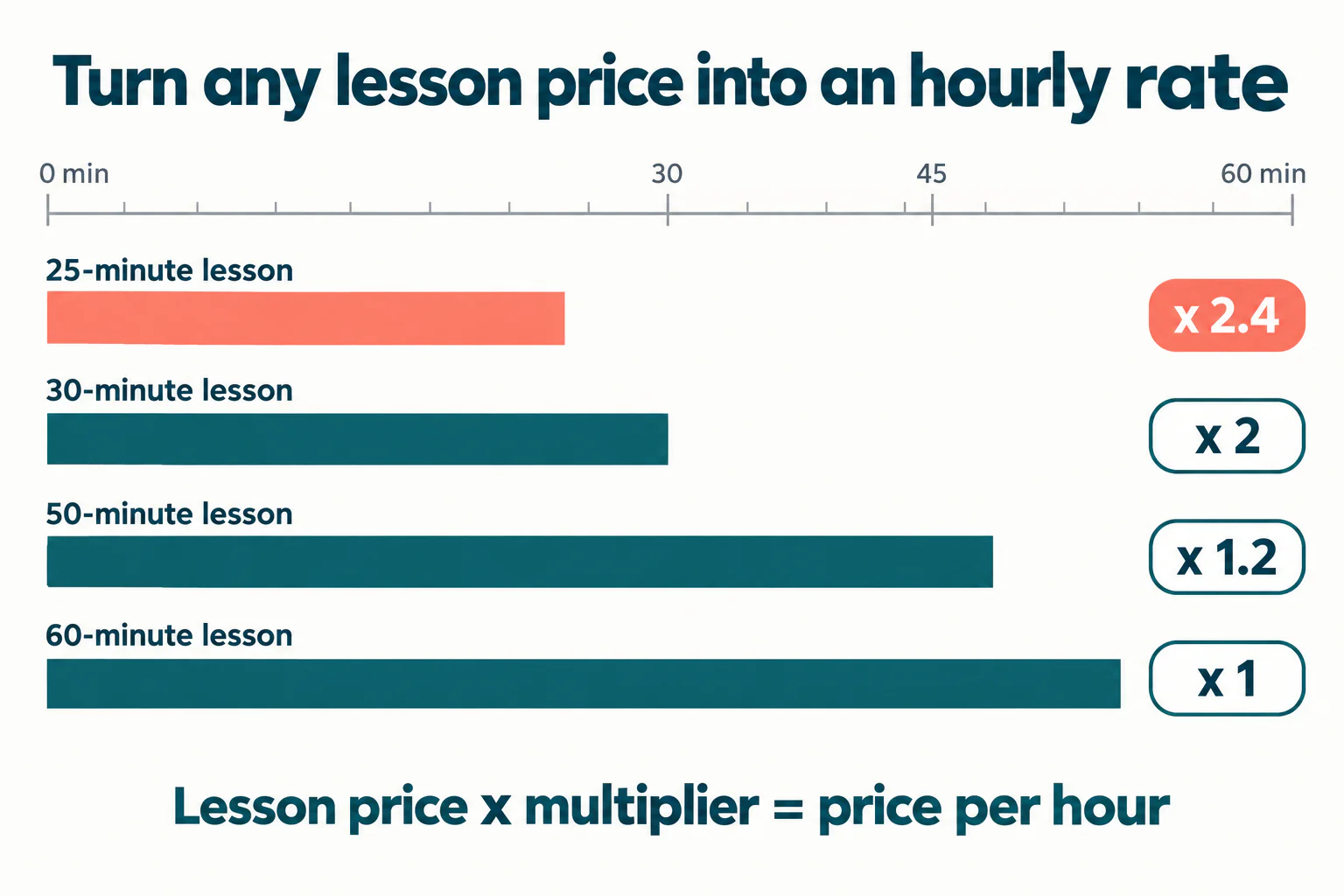
- A 25-minute lesson price times 2.4.
- A 30-minute lesson price times 2.
- A 50-minute lesson price times 1.2.
- A 45-minute group session, Novakid's speaking-group length, times about 1.33, and then divide by the number of children.
Short lessons are not a trick. A six-year-old genuinely does better with 25 focused minutes than with an hour of drifting, and Novakid says as much on its own pricing page. The point is only that, to take round illustrative numbers, a $10 25-minute lesson and a $20 50-minute lesson cost the same per hour, and parents routinely read the first as half the price.
Then divide by the children in the room
For a group class, the hourly rate is shared, and so is the teacher. An Outschool reading and writing listing we looked at ran twice a week for 50 minutes with 1 to 4 learners per class. Full, that is 12.5 minutes of teacher per child per session, before anyone has spoken.
For English specifically, the number that matters is not teacher attention but your child's talking time, and here groups lose more ground than they do in maths or coding. In my teaching experience, a child in a group of four reading and discussing a text might speak for three or four minutes in a 50-minute session. In a 1:1 lesson, the same child can speak for most of the half hour, because nobody else is waiting. The full argument for which format suits which weakness is in our guide to choosing the right online English class; this post is about what each one costs.
What drives the price of an English class
- Lesson length. The most visible number and the most misleading. See the multipliers above.
- Commitment length. The biggest single lever on the per-lesson price. Cambly Kids' yearly rate was 46 per cent of its monthly rate for the same 30-minute lesson.
- Teacher type. Preply's Houston kids' English page listed native speakers at an average of $25 an hour against $21 for non-native speakers, a premium of about 19 per cent. Novakid sells the same split as "Premium" (native) and "Standard" (non-native) teachers and says the cost depends on teacher type.
- Group size. Halves or quarters the price and the speaking time together.
- Siblings and promotions. Novakid states a family discount for two or more children; Lingokids' Help Center says its discounts are always calculated from the standard full price.
On the native-speaker premium, an honest view from someone who has run English programmes for children: for a beginner who needs to hear natural pronunciation and rhythm, it can be worth paying. For a child whose problem is decoding, comprehension or writing, it buys very little. A trained non-native teacher who knows how to correct a child's sentence without stopping them talking will usually do more for that child than an untrained native speaker chatting. Pay for teaching, and treat accent as one input.
Not sure what your child actually needs, or how many lessons a week they will keep up? A free trial class with a Codeyoung English teacher shows you where they are and what is worth paying for next, before you commit to anything.
Book a Free Trial →The cost of online English classes when you cancel early
This is the part of kids' English pricing that comparison pages tend to skip, and it is the reason a yearly plan is not automatically the cheap option.
Cambly Kids is admirably clear about it in its own help centre. Its cancellation article says: "When you cancel, you lose your discount because you are breaking that commitment." You are then charged the full price for the time the plan was active, and you get no refund at all if the undiscounted cost of the days used is higher than what you paid for the whole plan. Its own worked example, which it labels as not real prices, is a 12-month plan bought at a 20 per cent discount for $960, cancelled after six months with a $360 refund.
Now apply the same rule to a plan sold at 50 per cent off, which is how Cambly Kids labelled its yearly billing option when we checked. You have paid for six months at full price. Each month you use is charged back at full price. So the refund falls in a straight line, from everything at the start to half at month three, and reaches zero at month six. From there to month twelve, cancelling returns nothing.
None of that makes the yearly plan a bad buy. If your child has already been taking lessons happily with a teacher they like, half price for a year is a genuine saving. It makes it a bad first buy. Commit for a year after the monthly plan has proved the fit, not before.
Unused lessons and late cancellations
The second hidden cost is the lesson your child never takes. Three published policies, all checked on 12 November 2026:
- Novakid's terms of service: "Any unused classes will expire at the end of each month of your Billing Cycle and cannot be carried over." Individual lessons can be cancelled or moved up to 8 hours before the start; "any cancellation after that or a no-show is considered a completed class."
- Preply's subscription terms (updated 28 August 2026): lessons refill every 28 days and "unused lessons expire at the end of each billing cycle." The monthly plan is billed every four weeks, which is 13 charges a year, not 12.
- Cambly's general student help centre says weekly minutes refresh every Monday and unused minutes do not carry over. That article covers adult plans and does not mention Cambly Kids, so check the Kids terms for your plan.
Put those together and the real rule is simple: buy the number of lessons a week your child will attend in a bad week, not a good one. A plan of three lessons a week that your child manages twice is a 33 per cent price rise you will never see on an invoice.
What you actually get per hour
Once the prices are on the same footing, the comparison becomes a question of what each hour contains.
| Format | What the hour buys | Best value for |
|---|---|---|
| 1:1 live lesson | Speaking for most of the session, writing read and corrected in the moment, a plan that follows your child | Reading accuracy, writing, a child who is shy or behind |
| Small group class | Discussion, other children's ideas, a few minutes of individual speaking each | Confident speakers, debate, book clubs |
| Conversation-only platform | Talk time with a friendly adult, often without a structured syllabus | Fluency practice for children who already read and write well |
| App subscription | Unlimited games, vocabulary and listening, no one listening back | Exposure for younger children, alongside a class |
The most expensive mistake is not choosing the dearer format. It is paying for the wrong one: an app for a child who needs someone to hear them read, or a conversation platform for a child whose sentences fall apart on paper. If writing is the weakness, our piece on helping a child write better sentences shows what the paid hour should actually be spent on.
How to compare two offers fairly
Run every offer through the same five checks, in this order, and the cheapest headline price will often move down the list.
- How many minutes is a lesson? Convert to an hourly rate with the multipliers above.
- How many children per teacher, at most? Divide by it.
- How long am I committing for, and what happens if I cancel early? Ask whether the discount is clawed back.
- What happens to lessons we do not use? Carried over, refunded or lost.
- How late can we cancel a single lesson? Novakid's window is 8 hours. A child who wakes up ill at 7am for a 9am lesson has already paid for it.
The same method works across subjects. If you are budgeting for more than English, our breakdowns of what online coding classes cost and what online maths tutoring costs use the same per-hour and per-child arithmetic, so the three can be compared directly.
When the cheaper option is genuinely fine
A confident nine-year-old who reads widely, writes well and simply wants more chances to talk does not need a premium 1:1 programme. A conversation platform on a monthly plan, or a good small group, is a sensible spend, and the monthly plan keeps you free to stop.
Paid 1:1 time earns its price when something specific is wrong: decoding that is still slow at eight, comprehension that falls apart beyond the literal, writing that is much weaker than speech, or a child who will not speak in front of others. Those problems need someone listening closely, and that is what you are buying. Our guide to why children freeze when presenting covers the last of those in detail. Whatever you choose, check after about six weeks whether it is working, using the signs in how to tell if your child's class is working.
What to do with this
On the pages we checked, live 1:1 online English classes for kids cost roughly $16 to $35 an hour, with the low end reached only through a long commitment. Convert every quote to an hourly rate, divide group prices by the number of children, and read the cancellation clause before the price, because that clause decides what the discount is really worth.
Start monthly. Buy the lessons a week your child will keep in a bad week. Commit for a year only once the teacher has proved the fit. And use the free trial as an assessment: ask the session length, the commitment, and what happens to a missed lesson, then watch how long your child actually speaks.
Codeyoung runs 1:1 live online classes for children aged 6 to 17, with a teacher who adapts the pace to your child rather than a fixed syllabus. The first class is free, so you can see how they respond before deciding.
Book a Free TrialSources checked 12 November 2026, all on the providers' own sites: Cambly Kids plans and the Cambly Kids help centre article "Cancellation"; Cambly student support articles "How your plan works" and "Cancel your plan"; Novakid prices and Novakid terms of service; Preply's Houston English tutors for kids page and the Preply Subscription Services Terms (updated 28 August 2026); an Outschool group reading and writing class listing; the Lingokids Help Center article on Lingokids Plus prices; and codeyoung.com's English course page. Prices are US-dollar website prices as displayed on that date and change without notice.