
Parents almost always describe the problem the same way: my child needs help with English. It is the most reasonable sentence in the world and it is not enough to shop with, because online English classes for kids are at least five different products sold under one name, and the gap between them is bigger than the gap between any two providers.
A phonics programme and a debate club are both English classes. Buying the wrong one wastes a term and, worse, teaches a child that the thing they find hard is something they are simply bad at.
So start with the diagnosis.
Four children, four completely different classes
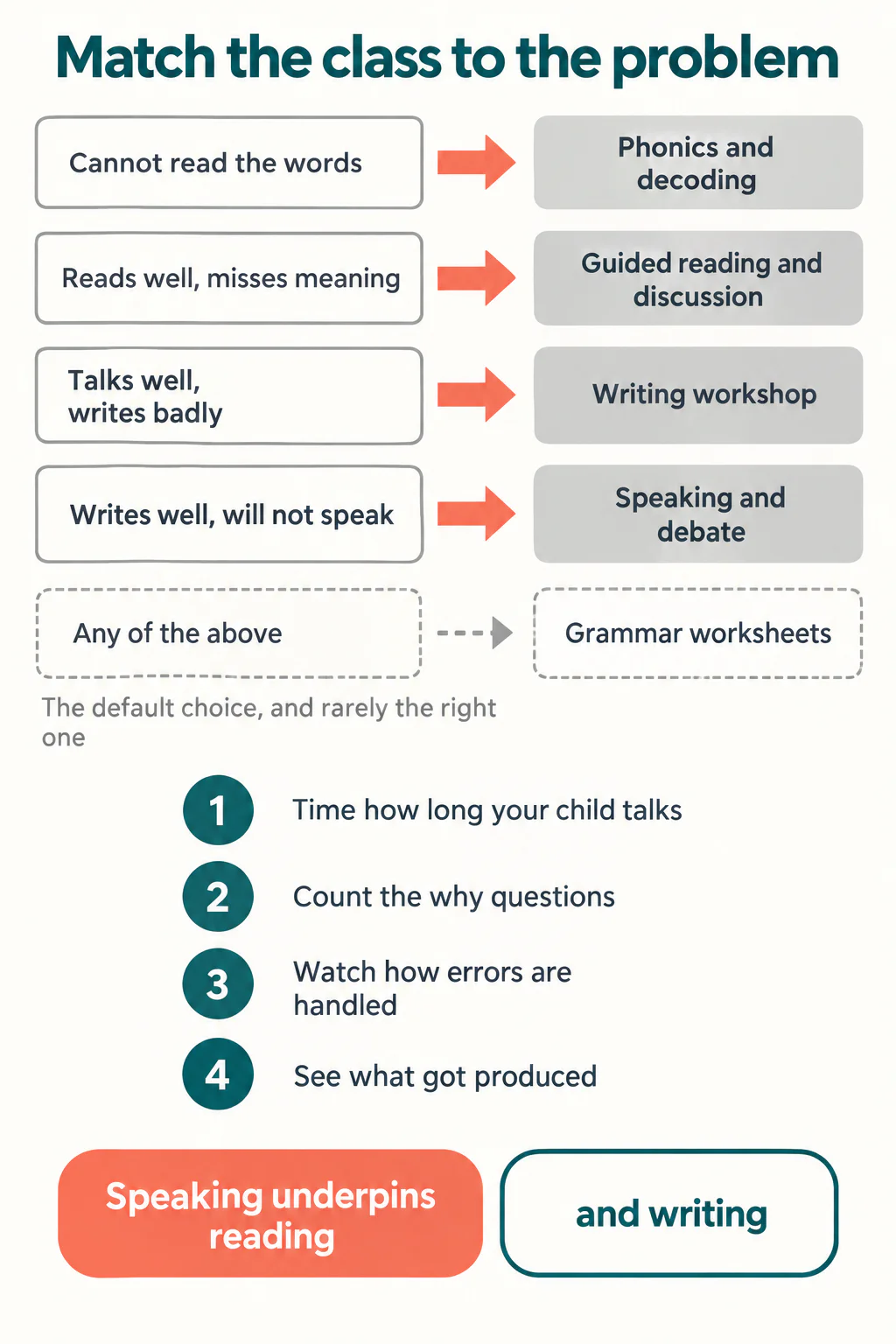
The child who cannot read the words. Reading is slow, effortful, full of guesses that look at the first letter and improvise. This is a decoding problem and it needs structured phonics work, not conversation practice. It is also the profile most often mislabelled as not trying. The national curriculum is direct about the consequences: if pupils "cannot decode independently and fluently, they will find it increasingly difficult to understand what they read and to write down what they want to say". We set out what to look for in phonemic awareness and how to build it.
The child who reads fluently and misses the point. Reads aloud beautifully, then cannot tell you why a character did something. This is comprehension and inference, and it responds to discussion of texts rather than more reading practice. More reading of the same kind usually changes nothing. We wrote about this specific mismatch in reading fluently but missing the meaning.
The child who talks brilliantly and writes badly. Tell me about your weekend and you get a vivid three-minute story. Write about your weekend and you get four flat sentences. The bottleneck here is transcription and sentence construction, not ideas, and the class needed is one where a child writes and someone reads it properly. Start with helping a child write better sentences, and note that a child whose spelling is fine in a test and poor in writing has a related problem, covered in why spelling scores do not transfer.
The child who writes well and will not speak. Good written work, silence in class, dread before a presentation. This needs a speaking class with a small enough group that speaking is unavoidable, plus deliberate work on nerves. See why children freeze up presenting and, for the reasoning side of it, teaching a child to argue well.
There is a fifth profile worth naming: the child learning English alongside another language at home, whose vocabulary in English lags their thinking. That child needs input and talk time rather than correction, and a teacher who understands the difference.
Matching the format to the problem
| Class type | Solves | Does not solve |
|---|---|---|
| Phonics or decoding programme | Reading accuracy and fluency | Comprehension, writing style |
| Guided reading and discussion | Inference, vocabulary, comprehension | Decoding, spelling |
| Writing workshop | Sentence construction, structure, editing | Reading accuracy, speaking confidence |
| Speaking and debate group | Fluency, confidence, listening | Writing accuracy, spelling |
| Exam or curriculum tuition | Specific test formats and mark schemes | Almost everything else, unless the exam is the problem |
Read the right-hand column carefully. A debate club will not fix spelling, and a writing workshop will not make a shy child speak. Both facts are obvious written down and routinely ignored at the point of purchase.
Why speaking work is not a soft extra
Speaking looks like the optional, fun part of English. The statutory requirements disagree. Across every primary year, pupils should be taught to "articulate and justify answers, arguments and opinions", to "give well-structured descriptions, explanations and narratives for different purposes", to "use spoken language to develop understanding through speculating, hypothesising, imagining and exploring ideas", and to "consider and evaluate different viewpoints, attending to and building on the contributions of others". That is a list of thinking skills wearing a speaking costume.
The curriculum then makes the connection explicit: "Spoken language underpins the development of reading and writing. The quality and variety of language that pupils hear and speak are vital for developing their vocabulary and grammar and their understanding for reading and writing."
Which leads to the most useful thing I can tell a parent about choosing a class, and it is a teaching judgement rather than a research finding, so take it as one. Most families buy grammar and should be buying talk. Grammar worksheets are easy to set, easy to mark and easy to show a parent, which is exactly why they are oversupplied. A child who has talked an idea through can usually write it. A child who has filled in apostrophe exercises for a term generally writes the same flat sentences with better punctuation.
Not sure which level your child should start at? A free trial class with a Codeyoung teacher shows you exactly where they are and what they are ready for next, before you commit to anything.
Book a Free Trial →Four things to watch in the trial lesson
Most providers offer a free first class. Almost nobody uses it well, because parents watch for whether their child enjoyed it. Enjoyment matters, and it is also the easiest thing in the world to manufacture for forty minutes.
Watch these instead.
- Time how long your child talks. Actually time it. In a group of eight with a teacher presenting for half the session, a child can speak for under three minutes and still come away saying it was good.
- Count the why questions. A teacher asking "what happened next" is checking attention. A teacher asking "why do you think she did that, and what in the text tells you" is teaching inference. The ratio between those two tells you what kind of class this is.
- Watch how errors are handled. Good teachers of younger children often reformulate rather than correct outright, repeating the sentence back properly so the child hears the right version without being stopped. Constant interruption produces a child who stops volunteering.
- See whether anything is produced. A sentence written, a paragraph read aloud, an opinion defended. A lesson where the child only receives is a presentation.
Listening deserves its own note, because it is the skill parents notice last and the one the curriculum lists first. If your child follows instructions poorly and misses detail in conversation, that is worth addressing directly rather than hoping a class fixes it in passing; we covered practical ways to work on it in improving your child's English listening skills.
What to expect at each age
| Age | Focus | What good looks like |
|---|---|---|
| 5 to 7 | Decoding, blending, early writing | Short sessions, lots of reading aloud, a teacher who hears every attempt |
| 7 to 9 | Fluency, comprehension, sentence building | Discussion of texts, writing that gets read back and revised |
| 9 to 11 | Inference, vocabulary, structured writing | Opinions with reasons, paragraphs with a plan, deliberate vocabulary work |
| 11 to 14 | Analysis, argument, speaking at length | Debate, evidence from the text, editing their own drafts |
| 14 to 17 | Exam technique, essays, presentation | Mark schemes, timed writing, and someone who reads full essays properly |
One honest caveat on that last row. If your child is preparing for a specific exam, buy a teacher who knows that exam. General English tuition is a poor substitute for someone who has read the mark scheme, and the two are frequently sold as though they were interchangeable.
Five questions before you enrol
- What is the maximum group size? Not the average. Speaking time divides by this number.
- How will you work out what my child needs in week one? Listen for reading aloud, a piece of writing, a conversation. Listen for a plan, not a syllabus.
- What will my child have produced by week eight? Specific answers indicate a specific plan.
- How do you handle mistakes? The answer tells you whether a hesitant child will keep talking.
- What happens if this is not the right class? A provider who can move a child from a speaking group into writing support without a fight is taking the diagnosis seriously.
Once a class is running, the question changes from what to buy to whether it is working, and that deserves its own set of signals. We set them out in how to tell whether your child's class is working.
What to do with this
Write one sentence naming exactly what your child struggles with. Not "English" but "reads accurately and cannot tell me what happened", or "talks for ten minutes and writes four sentences". That sentence is the whole brief, and any provider worth paying will ask you for it in the first five minutes.
Then use the trial lesson as an assessment rather than an audition. Time the talking, count the why questions, and look at what your child produced. A class that suits the actual weakness will show a change within about six weeks, usually in something small and unmistakable: an unprompted opinion with a reason attached, or a sentence that finally has a subordinate clause in it because your child wanted one.
Our online English classes run 1:1 so the plan starts from that one sentence rather than from a fixed course, and the first class is free precisely so you can run the checklist above on us.
Codeyoung runs 1:1 live online classes for children aged 6 to 17, with a teacher who adapts the pace to your child rather than a fixed syllabus. The first class is free, so you can see how they respond before deciding.
Book a Free TrialCurriculum requirements quoted from the Department for Education, national curriculum in England: English programmes of study, checked 24 September 2026.