

Key Takeaways
- For deep, personalized learning and mastering complex topics, one-on-one coding tutoring is more effective for most children than group classes.
- Group classes are a suitable choice for younger children seeking social interaction, for families on a strict budget, or for an initial, broad introduction to coding.
- The ideal format depends on a child's individual temperament, learning style, and specific educational goals.
- While one-on-one instruction can have a higher hourly cost, its accelerated pace often makes it more efficient and valuable in the long run.
What is the best format for my child's coding class?
For most families seeking deep, sustained skill development, one-on-one tutoring is more effective than group coding classes. This individualized format allows the curriculum, pace, and teaching style to be tailored precisely to your child's needs, which research has shown can significantly accelerate learning. While group classes have their place, private instruction ensures every minute is focused on your child's progress.
The decision ultimately hinges on your child's personality and your family's goals. Some platforms may suggest that a small group is nearly the same as private instruction, but a true one-on-one format guarantees undivided attention. At Codeyoung, our focus is exclusively on 1:1 live tutoring, ensuring the learning experience is built entirely around your child from the very first session. This article will help you navigate the trade-offs to make the best choice for your young learner.
The Quick Answer: The best coding class format depends on your child's unique learning needs and family goals.
What can private coding tutoring for kids do that group classes can't?
One-on-one coding tutoring offers a fully customized learning path, adaptive pacing, and immediate, personalized feedback that group classes cannot consistently provide. An instructor dedicated to a single student can adjust the lesson in real-time, spending more time on difficult concepts or accelerating through topics the child grasps quickly. This prevents the frustration of being left behind or the boredom of waiting for others to catch up.
This personalized approach is crucial for building a strong foundation. A private tutor can ensure a child masters core principles that align with established educational benchmarks, such as the K-12 Computer Science Frameworks outlined by Code.org. If a student struggles with a specific concept like loops or variables, the tutor can introduce new examples and exercises on the spot until the idea clicks. This targeted support helps overcome learning blocks and builds confidence without the pressure of performing in front of peers. For a deeper look into how these formats compare, you can review different perspectives on 1:1 vs group coding classes.
The benefits of a dedicated mentor extend beyond academic support. A private tutor can:
- Adapt to Unique Learning Styles: Whether a child is a visual, auditory, or kinesthetic learner, a tutor can modify their teaching methods to match.
- Explore Niche Interests: If a child is passionate about game development or artificial intelligence, the curriculum can be shaped around projects in those areas, boosting motivation.
- Provide Undivided Attention: The instructor can catch small mistakes and misconceptions immediately, before they become ingrained habits.
- Build a Strong Mentor-Student Relationship: A consistent, supportive relationship with a tutor can inspire curiosity and a long-term interest in technology.
Where do group classes work well?
Group coding classes are a good fit for children who thrive on social interaction, for families seeking a lower-cost introductory option, and for the initial exploration of programming concepts. The collaborative environment allows students to learn from their peers, share ideas, and work together on projects, which can be highly motivating for extroverted children. This format introduces coding in a fun, team-oriented setting.
In a well-run group class, instructors still aim to meet high educational standards, such as those developed by the Computer Science Teachers Association (CSTA), to ensure all students are exposed to core concepts. While the pace is set for the group average and individual attention is divided, the shared experience can be particularly beneficial for younger learners who are just beginning their coding education and may find a solo class too intense.
Group classes are often the right choice in specific situations, such as:
- First Exposure: For a child who has never tried coding, a group class can be a low-pressure way to see if they enjoy it.
- Budget Constraints: Group sessions are typically more affordable per hour than private tutoring.
- Developing Soft Skills: Working on a team project teaches collaboration, communication, and compromise.
- Social Motivation: Some children learn best when surrounded by peers, drawing energy and inspiration from the group dynamic.
What is the real trade-off between cost and pace?
The primary trade-off between group and one-on-one coding classes is the direct relationship between cost and the pace of learning. Group classes generally have a lower per-hour fee, but private tutoring often leads to faster and more thorough skill acquisition. This can make one-on-one instruction a more efficient and cost-effective choice over the long term.
A child might master in 10 private sessions what could take 20 group sessions to cover, due to the personalized attention and adaptive curriculum.
While the upfront investment for private tutoring may seem higher, the value comes from its efficiency. A private tutor can identify and resolve a child's specific roadblocks immediately, ensuring they fully grasp a concept before moving on. In a group setting, a child might remain confused about a fundamental idea for several lessons, slowing down their overall progress and potentially diminishing their confidence. Codeyoung focuses on making high-quality, 1:1 tutoring accessible, delivering the benefits of personalized instruction without an exclusive price tag.
| Feature | One-on-One Tutoring | Group Classes |
|---|---|---|
| Pacing | Fully customized to the individual student's speed. | Set to the average pace of the group. |
| Personalization | Curriculum and projects are tailored to the child's interests. | Follows a standardized curriculum for all students. |
| Social Interaction | Focused interaction with a dedicated mentor. | Collaborative learning with peers. |
| Cost Per Hour | Higher initial investment (e.g., $40+ per hour for some platforms). | Lower cost (can be as low as $10 per hour for some platforms). |
| Best For | Deep mastery, overcoming challenges, and exploring specific interests. | Initial exploration, social learners, and budget-conscious families. |
Ultimately, the most "cost-effective" option is the one that keeps your child engaged and consistently progressing. If a child is bored or lost in a group class, even a low-cost program provides little value. Conversely, if the primary goal is fun and social exposure, a group setting might be the perfect investment.
Which format fits my child's temperament?
Parents can select the best class format by matching it to their child's unique temperament and learning preferences. An introverted child or one who is easily distracted may thrive with the focused attention of one-on-one tutoring, while a social, competitive learner might be more engaged by the dynamics of a group class.
Observing how your child behaves in other learning and social environments can provide valuable clues. Does your child prefer to work through problems alone, or do they constantly seek out a partner to brainstorm with? Answering this question is key to choosing a format where they will feel comfortable and motivated.
Use this framework to guide your decision:
- If your child is shy or easily overwhelmed in groups: Choose one-on-one tutoring. A private setting provides a safe space to ask questions without fear of judgment and allows them to build a strong rapport with a single mentor.
- If your child is a social butterfly who loves teamwork: Choose a group class. The opportunity to collaborate with peers on projects can be a powerful motivator and helps develop important communication skills.
- If your child gets frustrated easily or has learning differences: Choose one-on-one tutoring. A dedicated instructor can immediately adapt their teaching style to overcome hurdles and provide the specific support your child needs to succeed.
- If your child learns very quickly and is often bored in school: Choose one-on-one tutoring. An individualized pace means they will never be held back and can advance to more complex topics as soon as they are ready.
- If you are unsure if your child will like coding: Start with a group class or a trial session. This offers a lower-commitment way to gauge their interest before investing in a more intensive program.
If your child shows a mix of these traits, consider a hybrid approach. You could start with one-on-one sessions to build a strong foundation and then join a group-based coding club or hackathon to gain collaborative experience.
How does Codeyoung teach one-on-one, and why?
Codeyoung is built exclusively on a one-on-one teaching model because our experience with over 50,000 children across 15+ countries shows it achieves the best results. This focused approach leads to deeper comprehension and an 80%+ course completion rate. Every session is a live, private class on Zoom, ensuring the instructor's full attention is on your child's learning journey.
Our commitment to this model is based on established educational research. A 1984 study by Benjamin Bloom found that students receiving one-on-one tutoring performed significantly better than those in conventional group settings. We see this principle in action every day. All sessions are recorded, allowing families to revisit complex topics anytime. This structure is a core part of our teaching philosophy, detailed further in our complete parent guide to online coding classes. Our belief in quality is why only about 0.1% of teacher applicants are hired, following rigorous checks for technical skill, communication, and empathy.
Our methodology, founded by an IIT Delhi alum and recognized by Forbes Asia 30 Under 30, is designed to create a personalized path for every student.
- Personalized Learning Path: A free trial class includes a placement diagnostic to customize the curriculum from day one.
- Proprietary Practice Platform: Our Noah AI platform provides adaptive exercises to reinforce concepts learned during live sessions.
- Proven Teaching Framework: Our CREATOR approach ensures lessons are engaging, creative, and build real-world problem-solving skills.
- Advanced Curriculum: Our 'AI & Machine Learning with Python' course for ages 10-17 takes students from basic commands to building complex projects like a Yoga Pose Detection app using tools like NumPy and PyTorch. This comprehensive, 192-session program demonstrates the depth achievable with dedicated instruction.
How do I switch formats as my child grows?
Parents should consider switching coding class formats when they observe clear signs that the current setting no longer meets their child's evolving needs or ambitions. A child's journey is not static; the right format at age 8 may be the wrong one at age 12. Recognizing these transition points is key to maintaining their interest and momentum.
The most common signal for a change is a mismatch between your child's pace and that of their class. If they are consistently bored or, conversely, constantly struggling to keep up, it is time to reassess. Listening to your child's feedback about their classes is the most direct way to know when a change is needed. For more tips on finding the right fit, our guide on choosing the best coding class for your child can be a useful resource.
Consider these common scenarios for making a switch:
- If your child is acing their group class and asking for more challenges: Transition to one-on-one tutoring. This will allow them to work on advanced, custom projects that match their new skill level and intellectual curiosity.
- If your child in a 1:1 class expresses a desire to work with friends: Look for a group-based hackathon, coding camp, or a supplementary group class. This allows them to develop collaborative skills without giving up the focused instruction they get from their private tutor.
- If your young child (6-8) is losing interest in their 1:1 sessions: Try a game-based group class focused on platforms like Scratch or Roblox. The social energy and playful competition might be what they need to reignite their interest.
- If your child has mastered block coding and wants to learn a text-based language like Python: This is a critical point to switch to one-on-one tutoring. The conceptual leap is significant, and personalized guidance can ensure they build a strong, error-free foundation in syntax and logic.
When making a switch, communicate with your child and the instructors. A good educational provider can help facilitate a smooth transition, ensuring that the new format builds upon what your child has already learned rather than starting over from scratch.
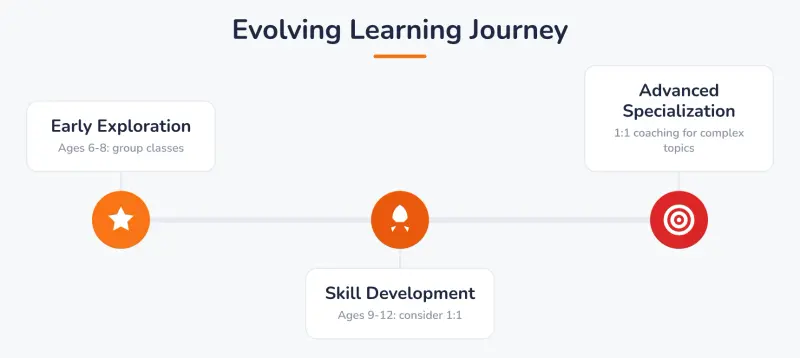
Evolving Learning Journey: Early Exploration (6-8) (Group classes for basics), Skill Development (9-12) (Consider 1:1 for personalised attention), Advanced Specialization (1:1 coaching for complex topics).
Frequently asked questions about 1:1 versus group
Is one-on-one coding worth the extra cost?
For many families, one-on-one coding is worth the cost because the accelerated, personalized learning leads to better outcomes and can be more efficient over time. A child might progress twice as fast with a private tutor, potentially making the total investment comparable to a longer-term group class. The value lies in mastering concepts more deeply and staying engaged.
Can group classes still provide individual attention?
While a great instructor in a group class will try to provide individual attention, it is inherently divided among all students. They can answer a question or offer brief help, but they cannot stop the lesson to provide the extended, tailored support a student might need to overcome a specific hurdle. True individualized attention is the defining feature of a 1:1 format.
At what age is one-on-one coding most beneficial?
One-on-one coding becomes most beneficial around ages 9-10, which is typically when children transition from visual block-based coding to text-based languages like Python or JavaScript. This transition involves more abstract thinking and complex syntax, and personalized guidance is crucial for building a strong foundation and preventing early frustration.
How do I know if my child needs one-on-one tutoring?
You'll know your child needs one-on-one tutoring if they show signs of being mismatched with a group pace, such as being consistently bored and finishing early, or being consistently confused and falling behind. Other signs include expressing a deep interest in a niche topic not covered by a standard curriculum or getting easily frustrated with a concept and wanting to give up.
Are private coding tutoring classes better than group classes for kids?
For most children aiming for deep understanding and mastery of complex topics, private coding tutoring classes are indeed better than group classes. One-on-one instruction offers an unparalleled level of personalization, allowing the curriculum to adapt precisely to your child's pace and specific learning style, which accelerates progress significantly. While group classes certainly offer valuable social interaction and are a budget-friendly option for younger learners or an initial introduction to coding, they often lack the individualized attention necessary for truly mastering advanced concepts. The higher hourly investment in private tutoring frequently proves more efficient and valuable long-term, as it propels your child further, faster. Ultimately, tailoring the approach to your child's unique temperament and educational goals is key to unlocking their full coding potential.