
It usually arrives about six weeks into a term. The class that was exciting in September has become the thing your child argues about on a Tuesday evening, and you are standing in the kitchen trying to decide whether you are teaching resilience or forcing something pointless.
The honest answer to whether you should let your child quit is that it depends entirely on why they want to, and that most parents make the decision before finding out. The question worth answering first is not "should they stop" but "what has actually broken".
There is a useful framework for that, and it comes from decades of motivation research rather than parenting opinion.
Why six weeks is the danger point
The timing is not a coincidence, and knowing that helps.
Early lessons in almost any subject are built to be winnable. A child makes something work in the first session, feels capable, and wants to come back. That is deliberate design, and it is good design.
Around week five or six, two things happen at once. The novelty wears off, and the material starts genuinely stretching them. For the first time, effort and visible progress come apart. They are working harder and their projects look no better than last month's.
That gap is uncomfortable for adults and genuinely confusing for children, who often read it as evidence that they are not good at this. Which is precisely when "I want to stop" arrives.
The three things that break
Psychologists Edward Deci and Richard Ryan spent decades on a question relevant to every kitchen-table argument: what keeps people motivated without external pressure. Their answer, self-determination theory, is that motivation rests on three psychological needs.
Autonomy. A sense that this is something you are doing rather than something being done to you.
Competence. A sense that you can actually succeed at it.
Relatedness. A sense of connection with the people involved.
When all three are met, motivation tends to sustain itself. When one breaks, it drops, and the child experiences that as simply not wanting to go any more.
This is the useful part for a parent. "I want to quit" is one sentence covering three completely different problems, each with a different fix. Two of them are usually repairable within a fortnight. The third sometimes means the class is genuinely wrong.
Not sure which level your child should start at? A free trial class with a Codeyoung teacher shows you exactly where they are and what they are ready for next, before you commit to anything.
Book a Free Trial →Which one has broken?
Children rarely announce the real reason, partly because they often do not know it. These questions get at it without an interrogation.
To test competence: "What was the hardest thing you did last week?" A child who names something specific is engaged and stretched. A child who says everything is hard, or cannot name anything at all, is probably drowning quietly. This is the most common cause and the least often spotted, because struggling children usually go quiet rather than complaining.
To test autonomy: "If you could change one thing about the class, what would it be?" An answer means they still have opinions, which means they are still invested. A shrug is a worse sign than a complaint. Children who feel they have no say stop having preferences.
To test relatedness: "Would you still want to stop if a different teacher took it next week?" This one works because it sidesteps the loaded question. A quick yes points to the subject or the level. Hesitation points to the relationship, which is usually the easiest thing to fix.
Ask these on a walk or in the car rather than straight after a lesson. Side-by-side conversations get far better answers from children than face-to-face ones.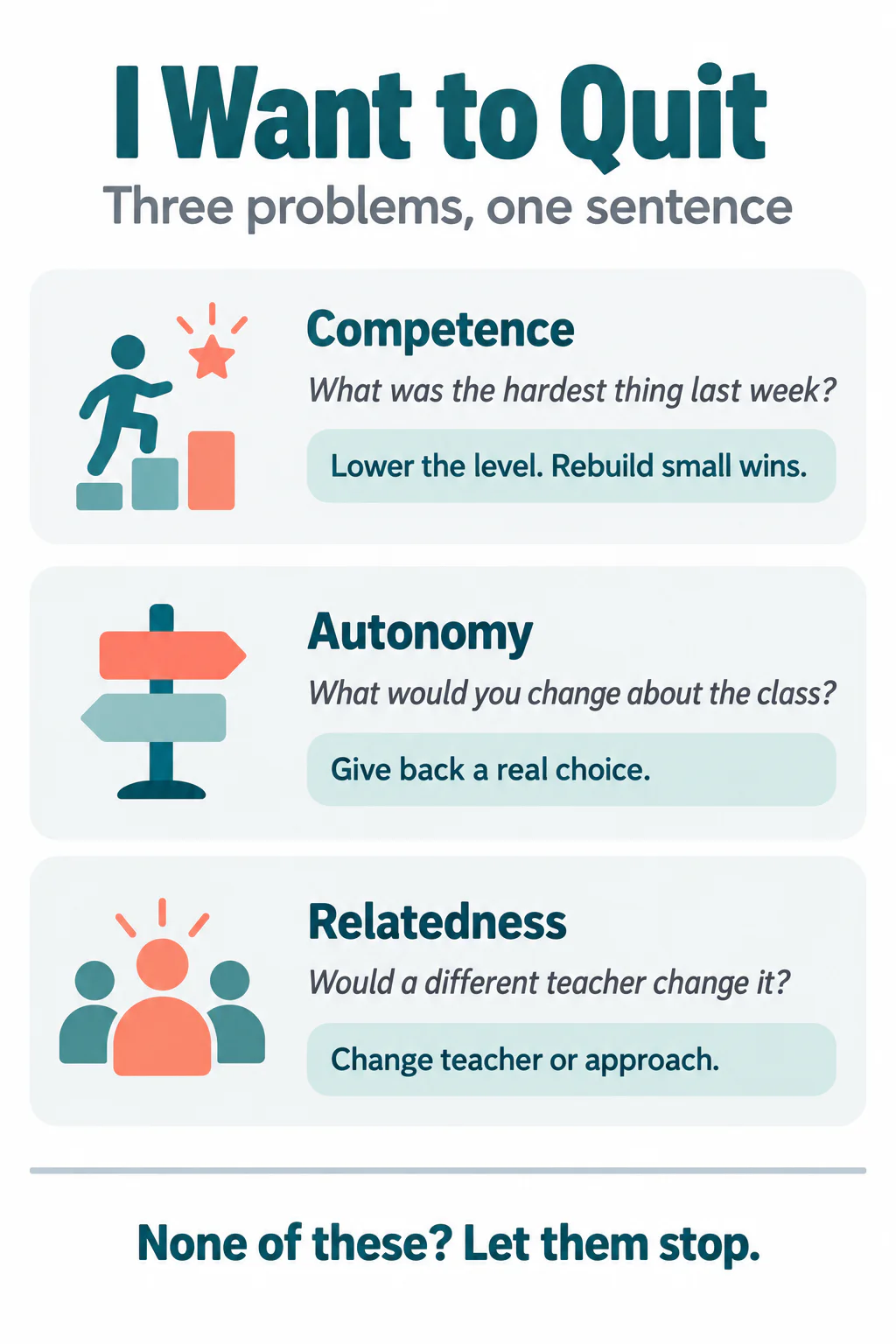
What each answer actually means
| What has broken | What it sounds like | What usually fixes it |
|---|---|---|
| Competence | "It's too hard." Quiet withdrawal. Avoiding homework. | Drop the level for two weeks. Rebuild a run of small wins. |
| Autonomy | "I never chose this." Shrugging. No opinions. | Hand back a real choice: the project, the topic, the time. |
| Relatedness | "I don't like the teacher." Vague reluctance. | Change teacher, or ask the teacher to change their approach. |
| Genuine mismatch | Specific, consistent, and they can explain it well | Let them stop. This is information, not failure. |
Competence problems are the ones parents miss most often, because a struggling child looks like a bored child from the outside. If you are unsure whether the class is landing at all, our guide on telling whether your child's classes are actually working covers the signals worth watching, and what to check during an online class covers the in-session basics.
When you should let them stop
This is the part most articles skip, so let me be direct: sometimes the right answer is yes.
Let them stop when their reason is specific and consistent. A child who says "I like building things but I don't like the maths part, and that's most of it now" has made a real assessment. Overriding that teaches them their judgement about their own experience does not count.
Let them stop when the timetable is genuinely full. Four activities and homework is not resilience-building, it is attrition. Something has to go, and better it goes deliberately.
Let them stop when you have fixed the fixable thing and nothing changed. If you lowered the level, gave them choice over projects, changed the teacher, and six weeks later they still dread it, you have your answer.
Quitting a badly matched activity is a skill. Adults who cannot leave things that are not working did not learn that skill somewhere.
When it is worth holding the line
The case for staying is strongest in one specific situation: when the child wants to quit precisely because it has become difficult, and nothing else is wrong.
This is the moment that matters, because the thing on the other side of it is the entire point. A child who pushes through week six and finds the work clicking in week nine has learned something no lesson teaches directly: that being stuck is temporary and normal rather than a verdict on their ability.
Children who never get that experience tend to develop a narrow sense of what they are good at, defined as the things that came easily. That narrowing is much harder to reverse later than a difficult term is to sit through now.
The same pattern shows up across subjects. It is the mechanism behind a child deciding they are bad at maths, and the fix is the same: separate "this is hard right now" from "I am not a person who can do this".
What to actually say
A conversation that works, in four moves.
- Take it seriously out loud. "Okay. Tell me what's going on." Not "you wanted to do this". The second one ends the conversation and you learn nothing.
- Ask the diagnostic questions. The three above. Listen for which need has broken rather than deciding yet.
- Change one thing and set a finish line. "Let's try four more sessions, and I'll ask your teacher to give you something harder. Then we decide together." A visible end point is the difference between persistence and being trapped.
- Actually decide at the finish line. If you said four sessions, revisit it at four. Nothing destroys trust faster than a deal that quietly becomes permanent.
The word "together" is doing real work in step three. It restores autonomy, which is often the thing that broke in the first place.
Frequently Asked Questions
Is it bad to let a child quit an activity?
Not inherently. What matters is whether they are quitting because the activity is genuinely wrong for them or because something fixable has broken. Letting a child leave a badly matched class teaches good judgement. Letting them leave the moment something gets difficult teaches that difficulty is a stop sign.
Why do children usually want to quit around six weeks in?
Because the novelty has worn off and the difficulty has risen at the same time. Early lessons are designed to be winnable, so the first few weeks feel good. Around week six the material starts genuinely stretching them, and the gap between effort and visible progress is at its widest.
Should I make my child finish the term?
Finishing what you started is a reasonable family rule, but apply it to a specific end point rather than indefinitely. Agreeing on four more sessions, then deciding together, gives the child a visible finish line and gives you real information. Open-ended insistence usually produces attendance without engagement.
What if my child says the class is boring?
Find out which kind of boring. Children use the same word for too easy and too hard. Ask what they did last lesson and whether they already knew how to do it. Boredom from repetition needs more challenge. Boredom from confusion needs the level lowered, and the two fixes are opposites.
How do I know if it is the teacher rather than the subject?
Ask whether they would still want to stop if a different teacher took the class next week. Children answer that honestly because it sidesteps the loaded question. A clear yes points to the subject or the level. Hesitation usually points to the relationship, which is the most fixable problem of the three.
Will quitting teach my child to give up on hard things?
Only if the conversation is skipped. What builds persistence is being helped to name why something is hard and trying one adjustment before deciding. A child who quits after that has practised the useful skill. A child who quits after a shrug has learned only that complaining works.
Where this leaves you
The question is not really whether to let them quit. It is what broke, because the answer changes everything that follows.
If competence broke, lower the level and rebuild some wins. If autonomy broke, give back a real choice. If the relationship broke, change the teacher. If none of those is true and the reason is specific and consistent, let them stop, and treat it as useful information about your child rather than a failure.
What you want to avoid is deciding without asking. That is how families end up either forcing a child through something genuinely wrong for them, or dropping something that needed one small adjustment and another month.
Codeyoung runs 1:1 live online classes for children aged 6 to 17, with a teacher who adapts the pace to your child rather than a fixed syllabus. The first class is free, so you can see how they respond before deciding.
Book a Free TrialSource: Ryan and Deci on self-determination theory and intrinsic motivation.