
A child who can subtract fluently is asked for the difference between 9 and 4, and says that one is odd and the other is even. That is not a maths error. It is a perfectly good answer to the question they heard, and the question they heard is not the one on the page.
Maths vocabulary defeats more children than maths does, and it does it invisibly, because the marking shows a wrong answer rather than a misread word. This is about the specific words that cause it and what actually works at home.
This is not a vocabulary gap
The instinct is to treat it as missing knowledge and to drill the definitions. That rarely works, and the reason is worth understanding.
Your child is not missing a meaning. They are holding two, and the wrong one is the one they have heard ten thousand times. Words like difference, product, mean and volume all have ordinary English senses that arrive automatically and arrive first. The maths sense has to beat the everyday sense in a race it usually loses, especially under time pressure in a test.
Linguists call these false friends. A definition list does not fix a false friend, because the child already knows the definition when you ask them cold. It fails in the moment, in a question, when the everyday meaning gets there first.
The words that do the damage
These are the ones I see most often across primary and lower secondary. Reading the middle column is the point: that is the meaning arriving first.
| Word | What it means at home | What it means in maths |
|---|---|---|
| difference | How two things are unlike | Subtract one from the other |
| product | Something you buy | The result of multiplying |
| of | Belonging to, part of | Multiply, as in half of 12 |
| mean | Unkind, or to signify | One particular average |
| odd | Strange | Not divisible by two |
| volume | Loudness | How much space a solid takes up |
| similar | Roughly alike | Same shape, exactly proportional |
| right | Correct, or a direction | Exactly 90 degrees |
| left | A direction | Remaining, after subtracting |
Two of those deserve more than a table row.
Of is the only word in English that silently means multiply, and children are never told so. Half of 12, a third of 60, 20 per cent of 80. A child who has not been told that "of" is an instruction reads it as a preposition and waits for the actual instruction to arrive.
Similar is worse, because the everyday meaning is not merely different, it is looser. In geometry two shapes are similar only if every angle matches and every side is in the same ratio. A child using the everyday sense will accept two vaguely triangle-ish triangles, and their reasoning collapses quietly from there.
The equals sign is the worst one
It is not a word, but it is the same failure and it does the most long-term damage.
Ask a child what equals means and most will tell you the answer comes next. That is a reasonable thing to conclude from the evidence: nearly every sum they have ever seen puts the working on the left and the answer on the right. Equals actually means the two sides are the same amount.
The classic test is to ask a child to fill in the box: 8 + 4 = ☐ + 5. The answer is 7. Falkner, Levi and Carpenter reported that only about 5 per cent of children in Years 1 and 2 gave it, and that when they put the same question to 145 sixth graders, every single one answered either 12 or 17. Not most. All of them.
12 is what you get if equals means "and here is the answer". 17 is what you get if you keep going and add the 5 as well. Both are consistent readings of a sign nobody ever explained.
This is the one worth fixing early, because it is the door into algebra. An equation is a statement that two things are the same, and a child who reads the equals sign as an instruction to compute cannot make sense of one. Falkner and colleagues also found the good news: with deliberate teaching of the relational meaning, fourteen of sixteen Year 1 and 2 children were answering correctly by the end of the year.
Not sure which level your child should start at? A free trial class with a Codeyoung teacher shows you exactly where they are and what they are ready for next, before you commit to anything.
Book a Free Trial →Schools are supposed to teach this explicitly
Parents are often surprised that this is a named expectation rather than something picked up along the way. It is named, and the demand escalates every stage.
- Years 1 and 2: pupils should "read and spell mathematical vocabulary, at a level consistent with their increasing word reading and spelling knowledge".
- Years 3 and 4: pupils should "read and spell mathematical vocabulary correctly and confidently".
- Years 5 and 6: pupils should "read, spell and pronounce mathematical vocabulary correctly".
The curriculum is just as direct about where the vocabulary comes from: "the quality and variety of language that pupils hear and speak are key factors in developing their mathematical vocabulary". It comes from talking, not from a list.
The American framing says the same thing from the other side. The Common Core Standards for Mathematical Practice ask that students "use clear definitions in discussion with others and in their own reasoning" and "state the meaning of the symbols they choose, including using the equal sign consistently and appropriately". That last clause exists because of exactly the problem above.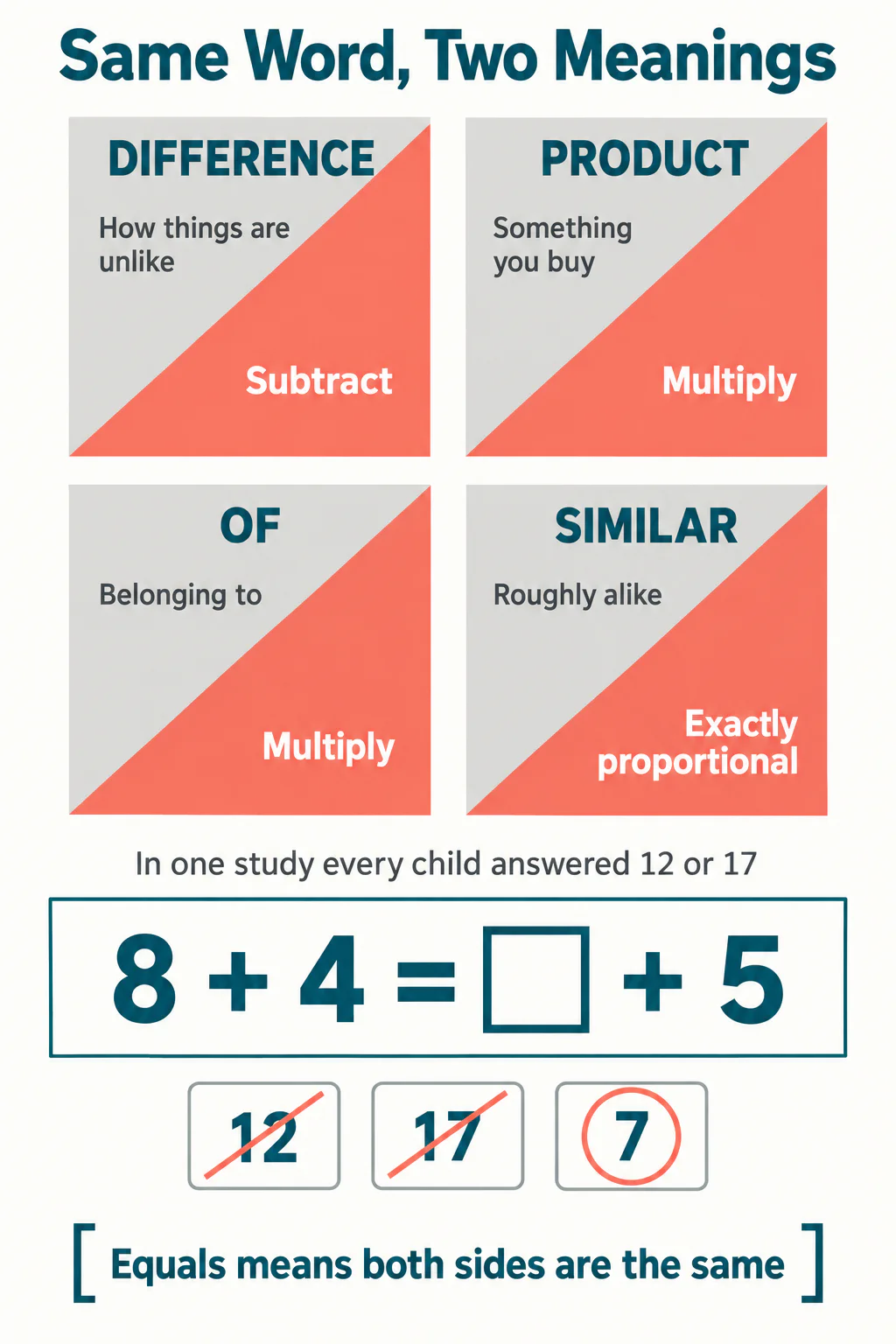
Four things that work at home
None of these take more than a minute, and all of them work better than a vocabulary list.
- Name the clash out loud. "This word means something different in maths." That single sentence does most of the work, because the problem is not ignorance, it is interference, and interference weakens the moment a child knows to expect it.
- Swap the word and re-read. Read the question aloud replacing the suspect word with its plain meaning. "What is the difference between 9 and 4" becomes "what do you get when you take 4 away from 9". If they can now do it, the maths was never the problem.
- Write sums backwards sometimes. 12 = 7 + 5 is a perfectly valid statement and almost no child ever sees one. A week of writing a few sums that way does more for the equals sign than any explanation.
- Ask them to say it back in their own words. Not the answer, the question. A child who cannot restate the question has found the problem for you.
Point two is also a diagnostic, and that is the part parents find most useful. It takes twenty seconds and it tells you whether to spend the evening on reading or on maths, which are completely different evenings.
When it is really a reading problem
Sometimes the word is not the issue and the whole sentence is. A child who reads fluently but loses the meaning will stall on a word problem for reasons that have nothing to do with number, which we wrote about in reading fluently but missing the meaning.
The failure modes stack in a predictable order, and it is worth knowing which one you are looking at:
- The word was misread. Fixed by the swap test above.
- The sentence was misread. Usually shows up as an answer to a plausible but different question.
- The child stopped after step one, which is its own distinct pattern and the subject of why children stop halfway through two-step problems.
- The method was wrong, which is the only one of the four that is actually a maths problem.
Most parents assume the fourth and start there. In my experience the first three account for the large majority of lost marks in primary, which is also why a child can lose marks with a right answer, as we covered in why your child loses marks for a right answer. Our guide to strategies for solving maths word problems covers the method side once the words are out of the way. Very often because a word in the question means something different in maths from what it means at home. Difference, product, of and mean all carry ordinary English senses that are wrong in a maths question, so the child reads a different question from the one printed and then answers it correctly. Subtract. The difference between 9 and 4 is 5. Outside maths, difference means how two things are unlike each other, which is why a child asked for the difference between 9 and 4 may answer that one is odd and one is even. That answer shows good thinking about the wrong question. Because almost every sum they meet is written that way, with the working on the left and the answer on the right. Equals actually means the two sides are the same. Falkner, Levi and Carpenter found that when 145 sixth graders were asked to complete 8 + 4 = _ + 5, every single one answered 12 or 17 rather than 7. That helps less than parents expect, because the child usually is not missing a definition. They hold a competing everyday meaning that is more familiar and fires first. What works better is naming the clash out loud: this word means one thing at home and a different thing in maths. Yes, explicitly, and the expectation rises each stage. England's national curriculum asks pupils in Years 1 and 2 to read and spell mathematical vocabulary, in Years 3 and 4 to do so correctly and confidently, and in Years 5 and 6 to read, spell and pronounce mathematical vocabulary correctly. Read the question aloud, replacing the suspect word with its plain meaning. If your child can then do it immediately, it was the word. If they still cannot, it is the maths. This takes about twenty seconds and it changes what you should do next completely.Frequently Asked Questions
Why does my child get maths questions wrong when they know the method?
What does difference mean in maths?
Why do children think the equals sign means the answer comes next?
Should I just make my child learn the definitions?
Is maths vocabulary actually part of the curriculum?
How do I tell a vocabulary problem from a maths problem?
The short version
A child who answers the wrong question well has a language problem, not a number problem, and the two look identical on a marked page. The words that cause it are ordinary ones carrying a second, stricter meaning: difference, product, of, mean, similar. The equals sign is the most damaging of all, because reading it as a cue to compute rather than as a statement of sameness blocks algebra later.
Name the clash, swap the word and re-read, and occasionally write a sum with the answer on the left. Those three habits cost almost nothing and they remove a surprising share of lost marks.
The curriculum expectations quoted above are in the national curriculum mathematics programmes of study, and the equals sign research is Falkner, Levi and Carpenter, Children's Understanding of Equality: A Foundation for Algebra. If the words keep getting in the way, our online maths classes for kids are 1:1, so a teacher can hear the misreading happen rather than only seeing the wrong answer afterwards.
Codeyoung runs 1:1 live online classes for children aged 6 to 17, with a teacher who adapts the pace to your child rather than a fixed syllabus. The first class is free, so you can see how they respond before deciding.
Book a Free Trial