
The MATHCOUNTS 2026-27 season has one date a parent cannot miss: 15 December 2026, the regular registration deadline and the last day a place is guaranteed. Chapter competitions follow across February 2027, and only students in grades 6 to 8 can enter.
This guide covers who is eligible, the three ways a child gets registered (school, homeschool, or as a non-school competitor), every deadline and fee, what each of the four rounds asks for, and how many children really move from chapter to state. That last number is smaller than most guides suggest. Every rule here was checked against MATHCOUNTS' own 2026-2027 rules and dates pages this week.
Key Takeaways
- Register by 15 December 2026. After that, fees rise and a place depends on your local coordinator.
- Grades 6 to 8 only, full time, three years maximum. A fifth grader in seventh grade maths cannot enter.
- Homeschoolers are not non-school competitors. They register as a school and file a separate form by 31 December.
- The national rules guarantee as few as six state places per chapter: the winning team of four and two more students.
- The written score is out of 46. Sprint counts once per problem, Target counts twice, and Countdown adds nothing to it.
Who can enter MATHCOUNTS?
US students enrolled full time in grades 6, 7 or 8. The official rules close the obvious loophole in so many words: students who are not enrolled in grades 6 to 8 full time "cannot participate, even if they are taking middle school math classes." There is no age rule, only the grade rule.
Two more limits are worth knowing early:
- Three years, total. "Participation in MATHCOUNTS competitions is limited to 3 years for each student." For a typical child that is simply grades 6, 7 and 8, but a student who repeats a grade cannot add a fourth season. School-based coaching sessions have no year limit.
- One school of record. A child competes for the school they are officially enrolled in, not a second school where they take one or two classes. Students at a virtual school register through that virtual school and are placed in a chapter by home address.
For younger children the honest answer is "not yet". MATHCOUNTS' FAQ says it is "currently developing a standalone grades 3-5 program", but nothing has replaced the grade 6 starting line for this season. Math Kangaroo, covered in our Math Kangaroo guide, starts at grade 1 and is the natural contest before MATHCOUNTS.
Three ways to register: school, homeschool or non-school competitor
A parent cannot simply sign a child up for MATHCOUNTS. The route depends on what the child's school does, and the rules set an order of preference.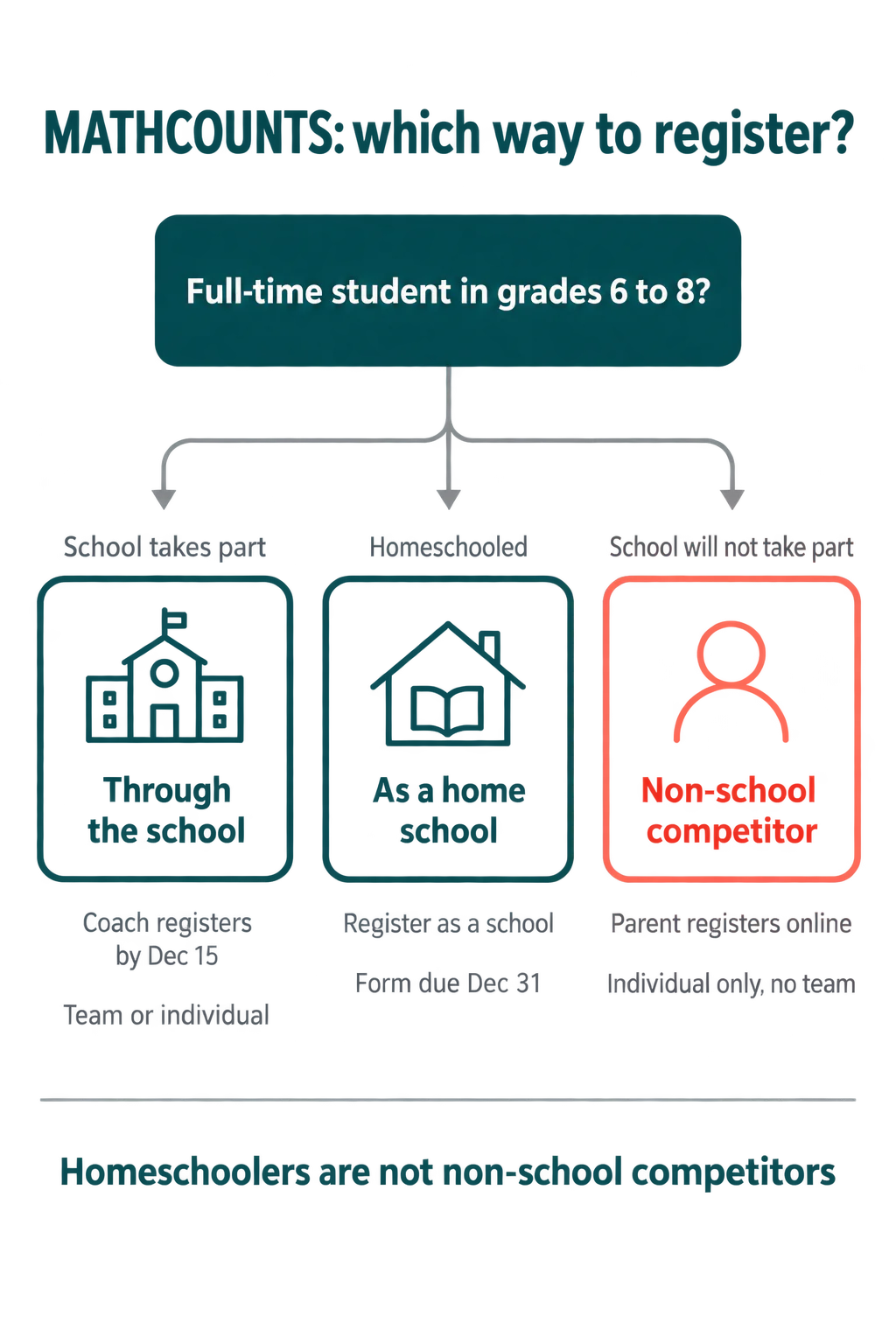
1. Through the school (the normal route)
A teacher acting as coach registers the school and pays per student. A school can send 1 to 14 students to its chapter competition: one team of four, plus up to ten individuals. Only the four team members sit the Team Round; the rules recommend "your strongest 4 Mathletes form your school team." The coach decides who those fourteen are, usually from the School Competition, which was released to coaches on 3 November 2026. Your first step is to ask whether the school already takes part.
2. Through a homeschool
This is the route most often described wrongly. A homeschooled child is not a non-school competitor. The rules say home school students register through their home school, which counts as their school of record, and home school groups that comply with state law are eligible too. The extra step is paperwork: the home school coach must send the 2026-2027 Home School Participation Form to the MATHCOUNTS national office by 31 December 2026, confirming the students are in grades 6 to 8 and that the home school complies with state law.
3. As a non-school competitor (NSC)
If a child's school will not register and will not support taking part, a parent can register them as an NSC. That route opened on 5 November 2026, online only, paid by credit card, with a separate registration for each child. The conditions are strict:
- Parents must confirm with school officials first that the school is not registering.
- An NSC competes as an individual only, never on a team, so the Team Round is off the table.
- There is a limit of 14 NSCs per school, first come, first served.
- If the school registers after all, MATHCOUNTS may cancel the NSC entry, and NSC fees are not refunded this season.
If you are weighing MATHCOUNTS against contests a parent can enter directly, our guide to how to enter math competitions compares the entry routes side by side.
MATHCOUNTS 2026-27 deadlines and fees
These are the national dates. The exact day of your chapter competition is set locally and appears in the Chapter and State Competition Search on mathcounts.org; details normally arrive from the chapter coordinator in early January.
| Date | What happens |
|---|---|
| 17 August 2026 | Registration opened; competition kits began shipping |
| 3 November 2026 | Early bird deadline ($42 per student for schools); School Competition released to coaches |
| 5 November 2026 | Non-school competitor registration opened |
| 15 December 2026 | Regular deadline: $48 per school student, $75 per NSC. Registering by this date guarantees participation |
| After 15 December 2026 | Late fees: $53 per school student, $85 per NSC. Accepted only at the local coordinator's discretion |
| 31 December 2026 | Home School Participation Form due at the national office |
| Early January 2027 | Chapter competition details sent to coaches |
| 1 to 28 February 2027 | Chapter competitions, about 500 nationwide |
| 1 to 31 March 2027 | State competitions in all 50 states and the territories |
| 9 and 10 May 2027 | National Competition in Washington, DC |
Three money details. Title I schools pay half, but NSCs do not get that discount. No extra fee is charged to advance from chapter to state. And school refunds carry a $50 cancellation fee and stop entirely after 1 February 2027. Fees are quoted from the official rules page; confirm them at checkout, because they are the detail most likely to change.
Not sure whether your child is ready for MATHCOUNTS-style problems, or which skills to build first? A free trial class with a Codeyoung maths teacher shows you exactly where they are and what they are ready for next, before you commit to anything.
Book a Free Trial →The four MATHCOUNTS rounds: Sprint, Target, Team and Countdown
A MATHCOUNTS competition takes about three hours and has the same four rounds at every level. They reward different strengths, which is why a child who is fast and a child who is careful can both do well.
| Round | Problems | Time | Calculator | Points |
|---|---|---|---|---|
| Sprint | 30 | 40 minutes | No | 1 per correct answer |
| Target | 8, handed out in 4 pairs | 6 minutes per pair | Yes | 2 per correct answer |
| Team | 10 | 20 minutes, worked together | Yes | 2 per correct answer, team score only |
| Countdown | Oral, head to head | Up to 45 seconds per problem | No | None; decides final rank where official |
How the scores are built
The Individual Score is Sprint correct answers plus twice the Target correct answers, so the maximum is 30 + 16 = 46. MATHCOUNTS itself calls an Individual Score of 23 out of 46 "highly commendable", which is a useful number to share with a child who comes home disappointed with a half-right paper.
The Team Score is the four members' Individual Scores added and divided by 4, plus twice the Team Round correct answers, out of 66. A team with only three students still divides by 4, which is why the rules warn that small teams "will be at a disadvantage."
Ties are broken by Sprint first: the student with the higher Sprint score takes the higher rank. That makes the no-calculator round the most important 40 minutes of the day, not the showier Countdown.
Countdown is optional, except where it decides everything
Countdown is the oral, head-to-head round families see in videos. The top 25% of students, up to a maximum of 10, are paired off and race to answer, until a first place individual is found. At chapter and state level a state chooses whether to run it officially, unofficially for fun, or not at all, and every chapter in a state must do the same. At the National Competition it is always official.
The detail that matters: Countdown adds nothing to the Individual Score, but "an official Countdown Round determines an individual's final overall rank." So in a state that runs it officially, a child who finishes the written rounds second can end the day ranked lower. Ask your coach which way your state runs it before February, and practise accordingly.
What the problems feel like
These three are written for this guide in MATHCOUNTS style, not taken from a real paper. Free past chapter and state papers are on mathcounts.org.
Sprint style, no calculator.The mean of five numbers is 12. One number is removed and the mean of the other four is 10. What number was removed? The five numbers total 5 × 12 = 60 and the four total 4 × 10 = 40, so the removed number is 20. Working with totals instead of averages turns a confusing question into two multiplications, which is the speed Sprint needs.
Target style, calculator allowed.A price is cut by 20%, then the new price is cut by another 15%. What single percentage cut gives the same final price? The price becomes 0.80 × 0.85 = 0.68 of the original, so the single cut is 32%, not the 35% most children write first. Target problems are rarely hard to calculate; they are built so that the obvious method is wrong.
Countdown style, out loud.What is 15% of 80? Ten percent is 8 and five percent is 4, so 12. The skill is splitting a number in your head within a few seconds. Our mental maths tricks for kids cover the splitting habits this round rewards.
From chapter to state to national: how many really advance
MATHCOUNTS is a ladder with four rungs, and the gaps between them are steep. This is the section where page one most often gets the numbers wrong.
- School to chapter: the coach picks up to 14 students: a team of four and up to ten individuals.
- Chapter to state: the official rule is that "the winning team will advance", together with the 2 highest-ranking competitors not on that team. That is a minimum of six students if the winning team has four. A state coordinator may advance additional teams or individuals, but the policy must be consistent across the state.
- State to national: the 4 highest-ranked Mathletes in each state, plus the coach of the winning team, get an all-expenses-paid trip. Those four form the state's team at nationals, for 224 competitors in all.
Here is the contrarian fact. One widely read prep guide tells parents that chapter advancement "varies by region (often top 10–25 students)". The national rules promise nothing of the kind. Some states do send more, but the guaranteed number is six, and for a child competing as an individual, including every NSC, the guaranteed route is one of just two individual places. That changes how a family should judge success. Reaching state is a real achievement; missing it at chapter is not a sign that a child is weak at maths. Look up your own state's advancement policy rather than assuming a top 10 or top 25 cut.
For comparison, the AMC 8, which runs from 21 to 27 January 2027, has no ladder at all: one 40 minute paper, and the score is the result. Many middle schoolers sit both, with the AMC 8 a useful timed rehearsal a few weeks before chapter.
The National Math Club: the free, non-competitive option
MATHCOUNTS runs a second programme that many parents never hear about. The National Math Club is free, non-competitive, and open to groups rather than individuals.
- Who: "any adult who leads a group" of at least 4 US students in grades 6 to 8 with regular in-person or virtual meetings can register. That includes schools and non-school groups such as tutoring centres, Boys & Girls Clubs and scout troops. One club per school or organisation.
- What you get: games, explorations, themed problem sets and a monthly challenge of five problems, through the Club Leader Dashboard.
- Silver Level: meet at least five times in the year with at least four eligible students each time.
- Gold Level: a Silver club completes one project from five options: an instructional video, maths in art, community service, a scavenger hunt or a data exploration.
- Dates: the Silver and Gold applications opened on 2 November 2026, the deadline to qualify for prizes and drawings is 15 April 2027, and winners and the Gold Level Honor Roll are announced on 14 May 2027.
For a homeschool co-op or a group of friends whose school does not run MATHCOUNTS, the club is a sensible first season: the same style of problems with no deadline pressure, and it can run alongside an NSC entry.
How to prepare for MATHCOUNTS between now and February
From late November there are about ten weeks before the first chapter competitions. That is enough, if the time goes on the right things.
- Get the free papers. Last season's chapter and state competitions, with answer keys and solutions, are free on the Past Competitions page. The 2026-2027 School Handbook has 250 problems with step-by-step explanations for registered coaches and NSCs, and a 30 problem preview is free.
- Time a full Sprint Round once. 30 problems, 40 minutes, no calculator. Then look at which problems were skipped, not just which were wrong. A child who spends five minutes on one early problem has borrowed it from the later ones.
- Practise Target with the actual calculator. Students bring their own. It cannot have a QWERTY keypad or Wi-Fi, and phones and tablets are not allowed. Find out in January if the family calculator is legal, not on the morning.
- Check the habit of rereading. In the Target example above, 35% comes from skipping the words "the new price". Ask your child to underline what the question actually wants before working.
- Request accommodations early. Requests go in writing at least three weeks before the chapter or state competition. Extra time and calculators for Sprint or Countdown are not permitted.
A teaching observation rather than a statistic: the students who improve fastest are not the ones who do the most problems. They are the ones who can explain why a method works, so a new problem looks like a variation on an old one instead of a stranger. That reasoning-first habit is what Codeyoung's online maths classes for kids build, 1:1.
The short version for parents
MATHCOUNTS 2026-27 is for full-time students in grades 6 to 8, for up to three seasons. Register through the school by 15 December 2026; homeschoolers register as a school and file their form by 31 December; non-school competitors are a last resort and compete only as individuals. Chapter is in February, state in March and nationals on 9 and 10 May 2027. Expect a score out of 46, treat 23 as strong, and remember that the guaranteed path from chapter to state is narrow: the winning team plus two.
Codeyoung runs 1:1 live online classes for children aged 6 to 17, with a teacher who adapts the pace to your child rather than a fixed syllabus. The first class is free, so you can see how they handle competition-style problems before deciding.
Book a Free TrialSources checked 28 November 2026: MATHCOUNTS 2026-2027 Official Rules and Procedures, Critical Dates for 2026-2027, the Competition Series overview, the Competition Rules FAQ, the National Math Club page and 2026-2027 National Math Club Rules and FAQ, the School Handbook page, the Past Competitions page and the registration page, all on mathcounts.org. AMC 8 dates are from our AMC 8 guide, which cites the MAA. Fees and local advancement policies can change, so confirm them with your coach or state coordinator.