
The 2027 Math Kangaroo competition is on Thursday 18 March 2027, and the date that matters to a parent right now is earlier: regular registration closes on 31 December 2026. After that a late window runs to 1 February at a higher fee, and then it is gone for the year.
This guide covers who can enter, how a parent registers a child through a center, how the 3, 4 and 5 point scoring actually works, what the problems look like at each level (with original practice problems and full solutions), how awards are decided, and how Math Kangaroo sits next to the AMC 8 and Bebras. Every rule below was checked against Math Kangaroo USA's own pages this week.
Key Takeaways
- Test day is 18 March 2027. Regular registration ends 31 December 2026; late registration runs 1 January to 1 February 2027.
- There is no penalty for a wrong answer in the USA. Several popular guides say one point is deducted. Math Kangaroo USA's own scoring page says the opposite.
- Grades 1 to 4 answer 24 questions, grades 5 to 12 answer 30, all in 75 minutes with no calculator.
- Kindergartners can enter, but they sit the Grade 1 paper and must read independently.
- A parent registers directly. Unlike the AMC 8, no school has to sign up first.
Who can enter Math Kangaroo?
Any student from kindergarten to grade 12 who can read and answer multiple choice questions on their own. That last condition is the real one. Math Kangaroo USA's logistics page puts it plainly: "All K-12 students qualify for participation if they know how to read and answer multiple choice questions independently." Nobody reads the questions aloud.
Three details about levels catch families out:
- Kindergarten has no paper of its own. Math Kangaroo USA's 2027 letter to host schools says "Kindergarten students take the Grade 1 test (must be able to read independently)." A five-year-old would be answering first grade questions in a 75 minute sitting, which is a lot to ask.
- A child cannot sit a level below their school grade. The registration page is explicit: "Participation at levels lower than the actual school grade level is not allowed." It says nothing about sitting above, so ask the organisers before trying.
- Practice material comes in pairs, but ranking does not. Past papers and practice sets are grouped as Levels 1 & 2, 3 & 4, 5 & 6, 7 & 8, 9 & 10 and 11 & 12. Awards, however, are decided "at each grade", so a second grader is ranked against second graders only.
The pairing comes from the international contest. The Kangourou sans Frontières association, which writes the questions, defines six age levels (Pre-Ecolier for roughly 6 to 8 year olds, then Ecolier, Benjamin, Cadet, Junior and Student), and its regulations let each country adapt the levels to its own school grades. Math Kangaroo USA has run the American edition since 1998, when it started in Chicago, and 2027 is its 30th competition.
Math Kangaroo 2027 dates and registration deadline
Math Kangaroo USA's public site still says only "March 2027", but its invitation letter to host schools gives the full timeline, and the date follows the international rule that the contest runs on the third Thursday of March.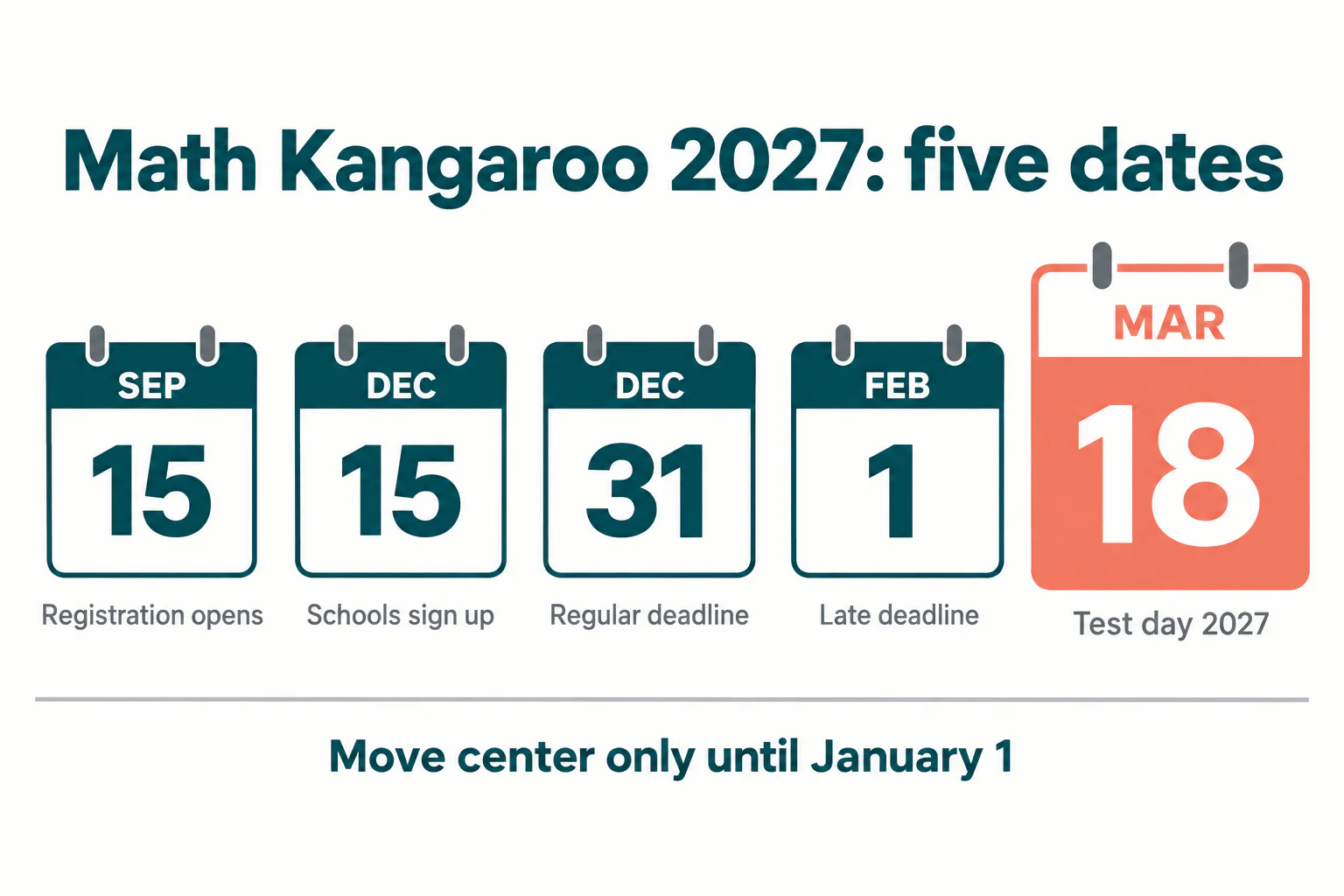
| Date | What happens |
|---|---|
| 15 September 2026 | Student registration opened |
| 15 December 2026 | Last day for a school to register as a center |
| 31 December 2026 | Regular registration closes ($20 per student) |
| 1 January 2027 | Last day to move a registration to a different center |
| 1 January to 1 February 2027 | Late registration ($35 per student) |
| Thursday 18 March 2027 | Competition day |
| About one month after the test | Answer keys published |
| By 1 May 2027 | Results released in the student's registration account |
One small warning on the fee. Math Kangaroo USA's "About the Test" FAQ still quotes $18 for regular registration. The registration page and the 2027 school letter both say $20, and those are the current figures. There are no refunds after registering, and any special accommodations have to be requested at the time of enrollment, not later.
How to register for Math Kangaroo through a center
Every child sits the test at a center: a school, learning center or community group that has agreed to host. The parent picks the center and registers the child, which is the key difference from the AMC 8, where a school must register before any family can. Our guide to how to enter math competitions compares entry routes across the major contests if you are weighing more than one.
- Find a center in your state. Math Kangaroo USA asks students to register "at a center located within the state where they reside". Its brochure counts 1,682 centers across all 50 states and some territories.
- Or choose a virtual self-proctored center. The online test "can be taken from any location with internet access on the designated day", and every student in the US is eligible for it, whatever their state.
- Register and pay through the registration account on Math Kangaroo's Oasis LMS portal. The same account later shows results and discount codes for practice material.
- Check the center before 1 January. The "Move registration" option only works until then.
- If your child's school is not listed, a teacher or PTA parent can register it as a center by 15 December. There is no application fee for the school, and the test can be given on paper or on classroom computers.
Some schools host private centers for their own students only. Those do not appear on the public list, and Math Kangaroo asks families not to share the access code outside the school community.
Not sure whether your child is ready for competition problems, or which kind of thinking to build first? A free trial class with a Codeyoung maths teacher shows you exactly where they are and what they are ready for next, before you commit to anything.
Book a Free Trial →The test format: questions, points and time
Every level is a 75 minute multiple choice test, and calculators and smartphones are not allowed. Each question has five answer options, the format the international regulations require. The number of questions depends on grade:
| Grades 1 to 4 | Grades 5 to 12 | |
|---|---|---|
| Questions | 24 | 30 |
| 3 point questions | 8 (questions 1 to 8) | 10 (questions 1 to 10) |
| 4 point questions | 8 | 10 |
| 5 point questions | 8 | 10 |
| Maximum score | 96 | 120 |
| Average time per question | about 3 minutes | about 2.5 minutes |
The questions get harder as the paper goes on, and the point value rises with them. That shapes how a child should spend the time. A first grader who spends 15 minutes on question 6 has borrowed that time from the 5 point questions at the end, which are worth more and need more thought.
The scoring rule most guides get wrong
Here is the fact worth reading twice. Math Kangaroo USA does not take points off for a wrong answer. Its scoring page says: "There are no points taken away for giving an incorrect answer."
That is not what parents will read everywhere. One widely read prep site tells families that "one point will be deducted for each incorrect answer, with no penalty for skipping a question", which would make skipping the smart move. In the US it is the reverse. A blank and a wrong answer both earn zero, so a blank can only cost points.
The confusion has a source. The international association's regulations fix the date and the five option format, but they let each member country adapt the question set and levels to its own schools, and scoring conventions differ between national contests. Advice written about another country's Kangaroo does not carry over. For an American child the rule is simple: fill in every answer before time runs out, guessing on anything left.
A worked example shows what a realistic score looks like. Say a third grader gets 6 of the 8 three point questions, 4 of the 8 four point questions and 2 of the 8 five point questions right, and guesses the rest wrong. That is 18 + 16 + 10 = 44 out of 96. The wrong guesses cost nothing, and if even one of them had landed it would have added 3 to 5 points.
Math Kangaroo sample problems by level, with solutions
The problems below are written for this guide in the Math Kangaroo style, not taken from a past paper. Official past papers and written solutions are available on mathkangaroo.org, and free sample questions for every year from 2006 are on its practice pages. What these show is the kind of thinking each level asks for: very little calculation, a lot of careful reading.
Levels 1 and 2 (grades 1 to 2), a 3 point style question
Kira has 3 red blocks and twice as many blue blocks. She gives away 2 blue blocks. How many blocks does she have now? (A) 5 (B) 6 (C) 7 (D) 8 (E) 9
Solution: Twice as many as 3 is 6 blue blocks. She has 3 + 6 = 9, then gives away 2, leaving 7, answer C. The trap is answer E, 9, from a child who stops before the last sentence. At this level most lost points are reading errors, not maths errors.
Levels 3 and 4 (grades 3 to 4), a logic question
Four children stand in a line. Cleo is last. Ben stands directly behind Ana. Dev is somewhere in front of Ana. Ana is not first. Who is second? (A) Ana (B) Ben (C) Cleo (D) Dev (E) It cannot be decided
Solution: Cleo takes place 4. Ben must be directly behind Ana, so Ana and Ben fill two places side by side among 1, 2 and 3. Ana is not first, so Ana is 2 and Ben is 3, which leaves Dev at 1, in front of Ana as required. Answer A, Ana. This is the most common Kangaroo shape at this level: several small clues, none useful alone, that only fix the answer together.
Levels 5 and 6 (grades 5 to 6), a geometry question
A rectangle is made of three identical squares placed in a row. The perimeter of the rectangle is 48 cm. What is the area of one square? (A) 16 cm² (B) 25 cm² (C) 36 cm² (D) 48 cm² (E) 64 cm²
Solution: If a square's side is s, the rectangle is 3s long and s wide, so its perimeter is 3s + s + 3s + s = 8s. Then 8s = 48 and s = 6, so each square has area 36 cm², answer C. The tempting wrong route is to count all twelve square edges, including the two inner ones, which are not on the perimeter.
Levels 7 and 8 (grades 7 to 8), a counting question
How many two-digit numbers have digits that add up to 9? (A) 8 (B) 9 (C) 10 (D) 11 (E) 12
Solution: List them by tens digit: 18, 27, 36, 45, 54, 63, 72, 81, 90. That is 9, answer B. The trap is answer A: a child who reasons "the tens digit runs from 1 to 8" forgets 90, where the units digit is 0. Listing systematically beats a formula here.
Levels 9 to 12 (grades 9 to 12), a number pattern question
What is the last digit of 72027? (A) 0 (B) 1 (C) 3 (D) 7 (E) 9
Solution: The last digits of the powers of 7 cycle with period 4: 7, 9, 3, 1, then 7 again. 2027 leaves remainder 3 when divided by 4, so 72027 ends like 73 = 343. Answer C, 3. No calculator could reach this number anyway; the question rewards spotting the cycle.
Notice what is missing from all five: long arithmetic. That is deliberate, and it is why quick mental arithmetic matters more than speed with a pencil. Our list of mental maths tricks that actually work covers the small calculations these problems still need. The bigger skill is patience: reading every word, then testing each option against the clues instead of guessing a pattern.
How scoring turns into awards
Results are released by 1 May in the registration account, and the answer keys appear about a month after the competition. Awards are decided by grade, at two levels:
- National: Math Kangaroo USA recognises "students who earn twenty top scores at each grade nationally". First place at each grade nationwide receives a gold medal, with silver and bronze for second and third.
- State: the three top scores at each grade in each state receive blue, red and white ribbons.
- Ties are shared, not broken. If several students in a grade earn the same top score, "they all rank 1 and all receive gold medals". There is no tie-break question.
- Prizes beyond medals can include books, games and gift cards for national and state winners, plus scholarships and summer camps, with priority to students who have placed well over several years. Awards must be claimed by 1 September of the competition year.
Because ranking is by single grade, a second grader is only ever compared with other second graders, never with older students who sat a paired practice level. For most children the realistic reward is the score itself, compared with their own score next year.
Math Kangaroo vs AMC 8 vs Bebras
All three are short, multiple choice and open to children well below high school, but they test different things and are entered in different ways.
| Math Kangaroo USA | AMC 8 | Bebras (USA) | |
|---|---|---|---|
| Who | Grades 1 to 12 (K sits Grade 1) | Grade 8 and below | Ages 6 to 18 |
| Length | 24 or 30 questions, 75 minutes | 25 questions, 40 minutes | As many tasks as possible in 45 minutes |
| Who registers | The parent, at any listed center | A registered site, such as a school | A teacher or coordinator |
| When | 18 March 2027 | A January window | 9 to 20 November 2026 (now closed) |
| Subject | Maths and logic | Middle school maths | Computational thinking, no coding |
For a middle schooler, Math Kangaroo and the AMC 8 are complements rather than rivals. The AMC 8 is faster, at 40 minutes for 25 questions, and leans on middle school content; Math Kangaroo gives nearly twice the time per question and leans on logic and careful reading. For a child in the early grades Math Kangaroo is the more natural first contest, because the AMC 8 is written around middle school content.
The Bebras Challenge is the closest cousin in spirit: puzzle-style problems, no syllabus, and short. A child who enjoyed Bebras in November is a good candidate for Math Kangaroo in March, and the registration window is still open.
How to prepare in the time left
From late November there are about sixteen weeks to the test. That is plenty, provided the time goes on the right thing.
- Sit one free sample paper untimed, together. Watch where your child gets stuck. Misreading usually shows up before maths does.
- Then sit one timed, in 75 minutes. Check whether the 5 point questions at the end got any time at all.
- Teach the guessing rule out loud. School tests train children that a wrong answer looks worse than a blank. Here a blank is never better, so the last two minutes go on filling every bubble.
- Do a few problems a week, slowly. Two problems a child had to fight for teach more than twenty that were recognised instantly.
- Practise without a calculator. None is allowed, and children who reach for one by habit lose minutes to arithmetic.
A teaching observation rather than a statistic: the children who do best on problems like these are rarely the fastest calculators in class. They are the ones who are comfortable not knowing how to start, and who try a small case, draw a picture or test an answer option until something gives. That is a habit built over months, and it pays off in ordinary maths class long after March. If you want structured help building it, Codeyoung's online maths classes for kids are taught 1:1.
The short version for parents
Math Kangaroo 2027 is on Thursday 18 March, and regular registration closes on 31 December 2026. A parent registers directly, at a center in their state or a virtual one, and any child from grade 1 up (or a kindergartner reading independently) can enter. The paper is 75 minutes, 24 or 30 questions, scored 3, 4 or 5 points each, and in the US a wrong answer costs nothing. Tell your child that last rule before test day, because it is the cheapest points they will ever earn.
Codeyoung runs 1:1 live online classes for children aged 6 to 17, with a teacher who adapts the pace to your child rather than a fixed syllabus. The first class is free, so you can see how they respond to problem solving before deciding.
Book a Free TrialSources checked 23 November 2026: Math Kangaroo USA home, registration, scoring, logistics, awards, "About the Test" and "About Registration" pages, free sample questions page, the MK 2027 invitation letter to host schools and the "Introduction to Schools" brochure; the internal regulations of Kangourou sans Frontières; the official US Bebras Challenge site. The AMC 8 format is from the MAA's AMC page; see our AMC 8 guide for its January dates. Fees and dates can change, so confirm them in your registration account before paying.