
Long division is the first piece of school maths where a single small slip, one zero left out, turns 605 into 65 and nobody notices until the teacher's red pen does. This guide to long division for kids is written for the child doing the sums and the parent sitting beside them. It walks through one fully worked example that contains both traps (a zero in the answer and a remainder), shows a 20-second way to check any answer, and lists the mistakes that cause most wrong answers.
It also settles a question that worries a lot of parents. If your child is in Grade 4 and still building division with boxes and chunks instead of the tidy "bus stop" layout, the Common Core standards say that is exactly where they should be. The standard algorithm is a Grade 6 expectation. The detail is further down, with the wording quoted from the standards themselves.
Key Takeaways
- Long division is one cycle repeated: divide, multiply, subtract, check, bring down.
- When the divisor does not fit, a zero goes in the answer. Leaving it out is the most expensive mistake in the method.
- Every answer checks itself: quotient × divisor + remainder = the starting number.
- Partial quotients gets the same answer with friendlier chunks, and many US schools teach it first.
- Common Core names the standard division algorithm in Grade 6 (6.NS.B.2), not Grade 4. England expects formal long division in Year 6.
What long division actually does
Long division splits a big sharing problem into a series of small ones, one place value at a time. Instead of asking "how many 7s are in 4,236?" all at once, which nobody can answer in their head, it asks about the thousands and hundreds first, then the tens, then the ones.
Four words come up constantly, and children who mix them up get lost in the instructions rather than the maths:
- Dividend: the number being divided (4,236).
- Divisor: the number you divide by (7).
- Quotient: the answer (605).
- Remainder: what is left over, which must always be smaller than the divisor (1).
A child who has only ever met division as equal jumps or equal groups should start there before any written layout. Our guide to making division visual with number line games covers that groundwork. Long division is what comes after the meaning is secure, not a replacement for it.
Long division step by step: the five-move cycle
Every long division, however big, is the same five moves on a loop. One common mnemonic is "Does McDonald's Sell Cheese Burgers", one word per move:
- Divide. How many times does the divisor fit into the current number? Write that digit in the answer line, directly above the last digit you used.
- Multiply. Multiply that answer digit by the divisor and write the product underneath.
- Subtract. Take the product away to find what is left.
- Check. Is what is left smaller than the divisor? If not, the answer digit was too small. Go back and make it one bigger.
- Bring down. Bring the next digit of the dividend down beside what is left. That is your new current number. Back to step 1.
When there are no digits left to bring down, whatever remains after the last subtraction is the remainder. That is the whole method. The difficulty is never the steps themselves; it is keeping the columns straight and knowing the multiplication facts well enough that each "divide" is quick.
A worked long division example: 4,236 ÷ 7
This example is chosen on purpose. It contains a step where the divisor does not fit, which forces a zero into the answer, and it finishes with a remainder. Work it once with your child, slowly, and most of the later trouble is already covered.
        6 0 5  r 1
     _________
  7 ) 4 2 3 6
    - 4 2
      ---
        0 3
      -   0
        ---
          3 6
        - 3 5
          ---
            1
Here is what happens at each pass of the cycle:
| Pass | Current number | Divide | Multiply | Subtract | Bring down |
|---|---|---|---|---|---|
| Start | 4 | 7 does not fit into 4, so use 42 instead | n/a | n/a | n/a |
| 1 | 42 | 42 ÷ 7 = 6 | 6 × 7 = 42 | 42 − 42 = 0 | the 3, making 3 |
| 2 | 3 | 7 does not fit into 3, so write 0 | 0 × 7 = 0 | 3 − 0 = 3 | the 6, making 36 |
| 3 | 36 | 36 ÷ 7 = 5 | 5 × 7 = 35 | 36 − 35 = 1 | nothing left |
The answer is 605 remainder 1. Notice pass 2. The 7 does not go into 3, and the temptation is to skip straight to 36. Skipping it writes the 5 one column too early and gives 65, an answer that is out by a factor of nearly ten. Writing the 0 is what holds the 6 in the hundreds place.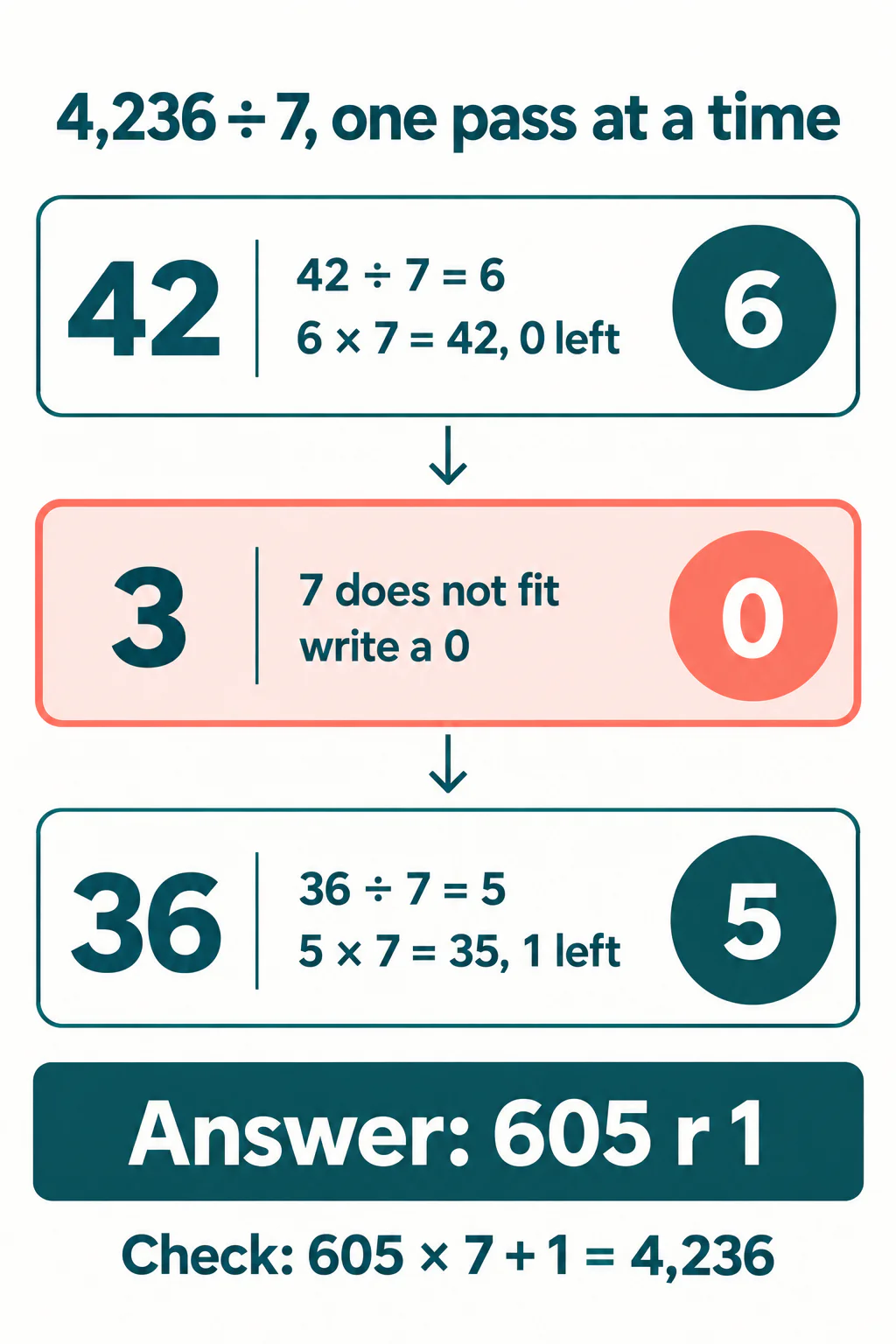
How to check a long division answer in 20 seconds
Division has a built-in answer key, because multiplication undoes it. Multiply the quotient by the divisor, add the remainder, and you should land back on the dividend.
For our example: 605 × 7 = 4,235, and 4,235 + 1 = 4,236. It matches, so the answer is right. Now try the wrong answer, 65 remainder 1: 65 × 7 = 455, plus 1 is 456. Nowhere near 4,236. The check catches the missing zero instantly.
Two quicker checks are worth teaching as habits:
- Estimate first. 7 × 600 = 4,200, which is close to 4,236, so the answer must be a little over 600. A child who writes 65 should feel that it is wrong before doing any multiplication.
- Remainder test. The remainder must be smaller than the divisor. A remainder of 8 when dividing by 7 means another 7 fitted and was missed.
Estimating before calculating is a skill in its own right, and it transfers well beyond division. We wrote a full guide to teaching children to ask whether an answer is sensible.
Not sure whether your child needs more work on the meaning of division or on the written method? A free trial class with a Codeyoung maths teacher shows you exactly where they are and what they are ready for next, before you commit to anything.
Book a Free Trial →The six long division mistakes that cause most wrong answers
These come up again and again when children learn long division, and each has a specific fix.
- Dropping the zero. The divisor does not fit, so the child brings down the next digit without writing anything in the answer. Fix: every digit brought down must produce a digit in the answer line, even if that digit is 0.
- A remainder bigger than the divisor. In 36 ÷ 7, a child who guesses 4 gets 4 × 7 = 28 and a leftover of 8. Since 8 is bigger than 7, the guess was too small. Fix: the "check" step, every time.
- A product too big to subtract. The same problem in reverse. Guessing 6 for 36 ÷ 7 gives 42, which cannot be taken from 36. Fix: try one less.
- Answer digits in the wrong column. Writing the 6 above the 4 instead of above the 2 shifts every digit after it. Fix: squared paper, one digit per square, and the rule that each answer digit sits above the last digit used.
- Forgetting to bring down, or bringing down twice. Children lose their place in a four-digit dividend. Fix: tick each digit of the dividend as it is brought down.
- Slow multiplication facts. If 7 × 6 takes thirty seconds, the child loses the thread of the method while hunting for the fact. This is the hidden cause behind many of the other five. Some fact-building strategies are in our list of multiplication tricks for kids.
Partial quotients: the method many US schools teach first
Partial quotients answers the same question, "how many 7s are in 4,236?", by taking away big friendly chunks of 7s and keeping a tally down the side. The child is allowed to use any chunk they are sure of. Everyday Mathematics, the University of Chicago programme used in many US schools, teaches it in its Grade 4 unit on division, which is why so many parents meet it for the first time on a homework sheet.
Here is 4,236 ÷ 7 done twice, once with a confident child's chunks and once with a cautious child's:
| Confident chunks | Left over | Cautious chunks | Left over | |
|---|---|---|---|---|
| Take 600 sevens (4,200) | 36 | Take 500 sevens (3,500) | 736 | |
| Take 5 sevens (35) | 1 | Take 100 sevens (700) | 36 | |
| Take 5 sevens (35) | 1 | |||
| 600 + 5 = 605, remainder 1 | 500 + 100 + 5 = 605, remainder 1 |
Both columns reach 605 remainder 1. Two things are worth noticing. The cautious child took an extra step and still got there, which is the point of the method: it rewards understanding, not just speed. And neither child can drop the zero, because nobody ever writes the 605 one digit at a time. The 600 arrives as 600.
Partial quotients is slower for big numbers, and that is the honest trade-off. The standard algorithm is the compressed version of the same idea: each pass of long division is a partial quotient where the chunk is restricted to one place value at a time. A child who understands partial quotients usually finds long division makes sense, rather than looking like a ritual.
A two-digit divisor: 9,876 ÷ 24
The same cycle works with a two-digit divisor; only the "divide" step gets harder, because the 24 times table is not memorised. Children estimate using the first digit, 2, and adjust.
- 98 ÷ 24 = 4 (4 × 24 = 96), leaving 2. Bring down the 7: 27.
- 27 ÷ 24 = 1 (1 × 24 = 24), leaving 3. Bring down the 6: 36.
- 36 ÷ 24 = 1 (1 × 24 = 24), leaving 12. Nothing left to bring down.
Answer: 411 remainder 12. Check: 411 × 24 = 9,864, plus 12 is 9,876. And because 12 is exactly half of 24, the answer can also be written as 411½ or 411.5. England's Year 6 curriculum asks pupils to interpret remainders as whole-number remainders, as fractions or by rounding, depending on the context.
What does the remainder mean?
Word problems test this more than the method. If 75 children sit 8 to a table, 75 ÷ 8 = 9 remainder 3, since 9 × 8 = 72. The answer to "how many tables?" is 10, not 9, because the 3 leftover children still need a seat. If the question were "how many full tables?", the answer would be 9. Same division, two correct answers, depending on the question.
When do children learn long division?
Later than most parents think, at least in the US. Here is what the official documents actually say, quoted from the Common Core State Standards and from England's national curriculum.
| Stage | What is expected |
|---|---|
| US Grade 3 (3.OA.C.7) | "Fluently multiply and divide within 100"; know all products of two one-digit numbers from memory by the end of the year |
| US Grade 4 (4.NBT.B.6) | Whole-number quotients and remainders, up to four-digit dividends and one-digit divisors, "using strategies based on place value, the properties of operations, and/or the relationship between multiplication and division" |
| US Grade 5 (5.NBT.B.6) | The same, with two-digit divisors, still by strategies |
| US Grade 6 (6.NS.B.2) | "Fluently divide multi-digit numbers using the standard algorithm" |
| England Year 4 | Non-statutory guidance: practise the formal written method of short division with exact answers |
| England Year 5 | Statutory: divide up to 4 digits by a one-digit number using the formal written method of short division and interpret remainders |
| England Year 6 | Statutory: divide up to 4 digits by a two-digit whole number using the formal written method of long division |
Read the US rows carefully, because this is where a lot of online advice gets it wrong. The words "standard algorithm" do not appear in the Common Core division standards until Grade 6. Grades 4 and 5 ask for correct answers by strategies (partial quotients, area models, equations) and for the child to explain the calculation. For comparison, the standard algorithm for multiplication is a Grade 5 standard (5.NBT.B.5). Division gets an extra year.
So a Grade 4 child who is shaky on the bus stop layout but can solve 4,236 ÷ 7 with chunks is not behind. They are doing what the standard asks. If you are weighing a broader worry, our guide on how to tell whether your child is behind in maths sets out what actually signals a gap.
England moves faster. Short division, the compact layout often nicknamed the "bus stop" method because the bracket looks like a shelter, is a statutory Year 5 requirement, and full long division with two-digit divisors is Year 6. A family moving between the two systems can find their child either ahead or behind by a year on this topic, purely because of the timetable.
How to help with long division at home
The order matters more than the amount of practice. A child pushed into the formal layout before division makes sense learns a sequence of moves to copy, and copied moves collapse the first time a zero or a remainder appears. A pattern that comes up again and again in tutoring: the children who struggle most with long division are rarely weak at the steps. They are weak at the idea underneath, and the steps give them nowhere to stand.
A sequence that works:
- Meaning first. Sharing 42 counters into 7 groups, or jumping back in 7s on a number line. Ten minutes is enough if it lands.
- Partial quotients next. Let the child choose their own chunks. Praise a correct answer reached in five steps as much as one reached in two.
- Then the standard layout, introduced as "the short version of what you already do". Use squared paper.
- Check every answer by multiplying back. Make it non-negotiable and quick, like a seatbelt.
- Five problems, not thirty. One with a zero in the quotient, one with a remainder, one exact, one two-digit divisor if they are ready, and one word problem where the remainder changes the answer.
If your child was taught a method you do not recognise, ask them to teach it to you. Explaining a method is one of the best tests of whether they understand it, and you will learn quickly whether the gap is the idea or the layout.
Long division for kids: what to remember
Long division is five moves on a loop: divide, multiply, subtract, check, bring down. The two places children go wrong are predictable, a missing zero in the quotient and a remainder that is too big, and both are caught by multiplying the answer back. Partial quotients reaches the same answer by friendlier chunks and is often taught first in US classrooms, which is consistent with Common Core leaving the standard algorithm until Grade 6. In England, the formal written methods arrive earlier, in Years 5 and 6. Whichever system your child is in, secure the meaning before the layout, and the layout stops being something to memorise.
Codeyoung runs 1:1 live online maths classes for children aged 6 to 17, with a teacher who adapts the pace to your child rather than a fixed syllabus. See how the Codeyoung maths course works, or book the first class free and watch how your child responds before deciding.
Book a Free TrialSources checked 12 November 2026: Common Core State Standards for Mathematics, standards 3.OA.C.7, 4.NBT.B.6, 5.NBT.B.5, 5.NBT.B.6 and 6.NS.B.2, as published at thecorestandards.org; the national curriculum in England: mathematics programmes of study (Department for Education), Years 3 to 6; Everyday Mathematics (University of Chicago School Mathematics Project), Grade 4 Unit 6 family pages. Every worked example in this article was checked by multiplying back. Individual US states and districts set their own pacing, so check your school's scope and sequence for exact timing.