
If your child comes home talking about Gold Quest, snowball tag or a leaderboard, they have been doing retrieval practice without noticing. The four platforms behind nearly every classroom quiz game, Kahoot, Blooket, Wayground and Gimkit, all do the same underlying thing: they ask a question and wait for an answer. What separates them is how many questions a child answers in ten minutes, and how much of that time goes on the game wrapped around the questions.
Most comparisons rank these on how fun they are. That is the wrong axis, and the published evidence is unusually clear about why. Below is what each one actually is, the single rename that may have broken your school's web filter, and the settings that decide whether a homework assignment produces real practice or a child clicking through to the end screen.
Key Takeaways
- Quizizz is now Wayground. The domain moved to wayground.com and school network filters may need updating.
- Quizzing as practice is rated Strong evidence in a US Department of Education practice guide. Using quizzes to work out what to teach next is rated Low.
- Pure competition is the weakest configuration in the research. Competition combined with collaboration beat it, and team modes exist on all four platforms.
- Blooket publishes a question frequency rating for every game mode, which is the most useful number any of these platforms gives away and almost nobody uses it.
- One Blooket homework setting decides everything. Requiring correct answers turns a wrong answer into more practice; requiring questions lets a child click through.
What the four platforms actually are
They are not four versions of the same product. The pacing model differs, and pacing is what decides how much practice happens.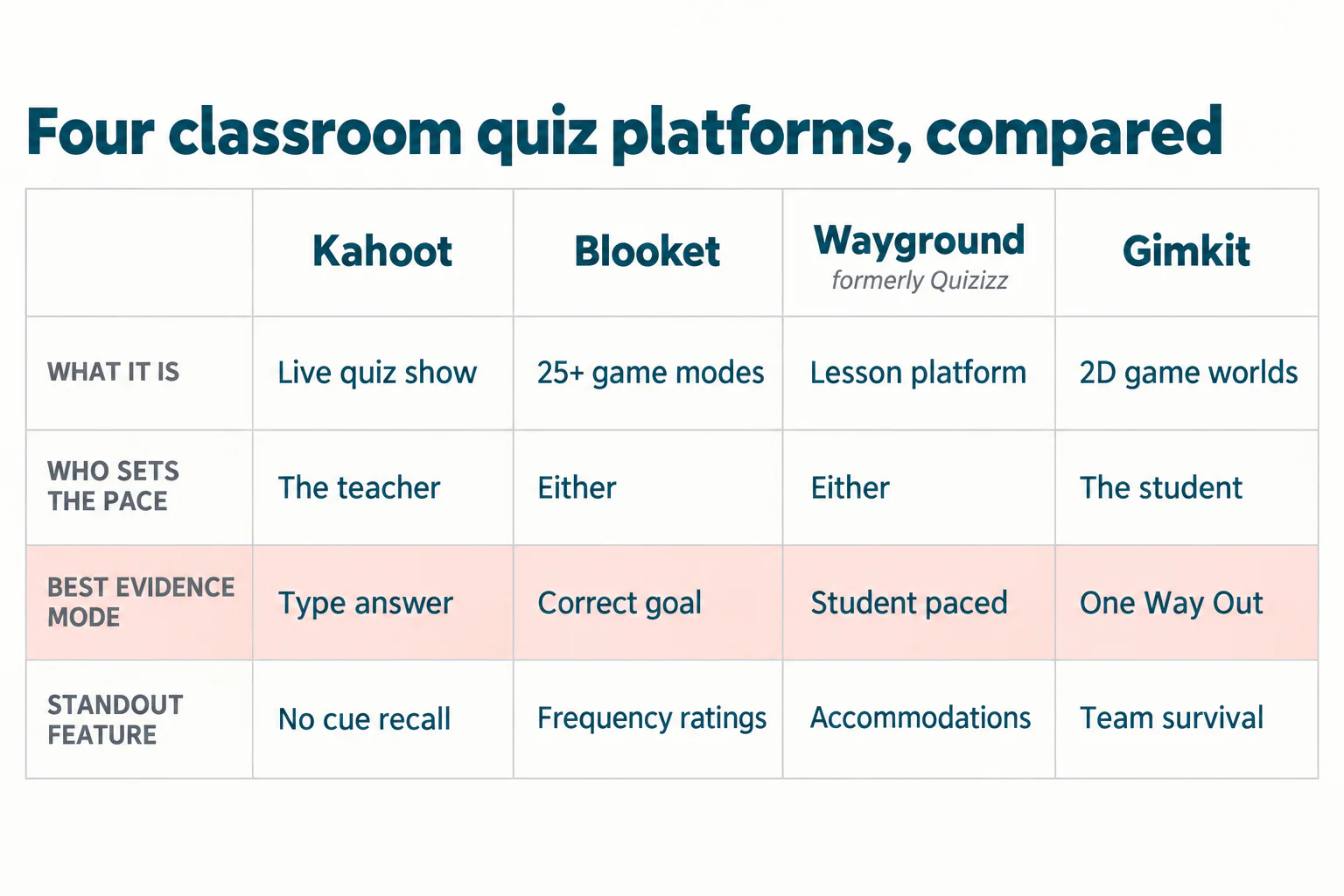
Kahoot is a live quiz show. Questions and answers appear on a shared classroom screen while children answer on their own devices, and the teacher controls when each question starts and ends. The whole class moves together, which is excellent for energy and limiting for volume.
Blooket is a library of more than 25 game modes built on top of a question set. The same set of questions can be played as a live game, solo, or assigned as homework.
Wayground, until recently Quizizz, has grown past quizzes into lessons, passages, flashcards and interactive video, with 18 or more question types. It offers Live, Classic, Student-paced, Instructor-paced, Paper Mode and Test mode, and it connects to Google Classroom, Teams, Moodle and other systems.
Gimkit is the furthest from a quiz. Children answer questions to earn in-game currency or energy, then spend it on upgrades or on moving through a 2D world. Answering is the engine, not the activity.
Is Quizizz still Quizizz?
No. Quizizz has renamed itself Wayground, and this matters practically rather than cosmetically. Visiting quizizz.com now redirects to wayground.com, which we confirmed directly on 3 November 2026.
Almost nothing else changed. The company states that accounts work "just like before", that classes and resources "are still available with no changes", that join links including joinmyquiz.com continue to work, and that "Quizizz Inc. is still the legal entity" so existing school contracts remain valid. The interface is the same.
The one line worth passing to your school office is the company's own: "Please share this article with your IT team so they can update firewalls and filters if needed." A school that allowlisted quizizz.com by name and has not added the new domain can find the platform unreachable on school devices while working perfectly at home. If homework stopped loading in the computer room this term, that is the first thing to check.
What the evidence says a classroom quiz is for
It is for making children retrieve what they already met, not for finding out what they missed. That distinction is drawn sharply in the What Works Clearinghouse practice guide published by the US Department of Education, which rates each of its recommendations by strength of evidence.
Of the seven recommendations in that guide, exactly two are rated Strong. One is "use quizzes to re-expose students to key content". The other is "ask deep explanatory questions". Everything else lands on Moderate or Low.
Two of those ratings should change how you read a Blooket report. Using quizzes to re-expose content: Strong. Using "tests and quizzes to identify content that needs to be learned": Low. Asking questions before a new topic is introduced: Low as well.
So the strongly supported use of these four platforms is the unglamorous one. Play the same question set again next week. The weakly supported use is the one teachers and parents prize most, the dashboard that claims to show the gaps. A report tells you a child missed four questions on fractions. It cannot tell you whether that was a misconception, a misread, or a guess made while being chased across a 2D map.
Not sure which level your child should start at? A free trial class with a Codeyoung teacher shows you exactly where they are and what they are ready for next, before you commit to anything.
Book a Free Trial →The leaderboard is the part the research likes least
Gamification does help, modestly. A 2020 meta-analysis in Educational Psychology Review pooled the research and reported small but real effects: g = 0.49 on cognitive learning outcomes across 19 effect sizes and 1,686 students, g = 0.36 on motivation, and g = 0.25 on behaviour. The authors note that the cognitive effect held up when only the most rigorous studies were counted, while the motivational and behavioural effects were "less stable".
The interesting finding is not the headline number. It is which kind of game worked. The authors report that "inclusion of game fiction and combining competition with collaboration were particularly effective", and they distinguish constructive competition, which is "good-natured and encourages cooperation and mutual support", from destructive competition, where "succeeding by tearing others down is required, resulting in feelings of irrelevance and oppression". Plain competition, they write, "can thwart feelings of relatedness when the goal is to defeat each other".
Put that beside what the platforms actually ship. Blooket's Gold Quest has children answering questions "to take Blooks from other players or defend their Blooks from being taken". Gimkit's Snowbrawl is a knockout mode, and Snowy Survival ends when every player has been caught. Those are the modes children ask for, and they are the configuration the evidence supports least.
The same platforms carry the alternative. Gimkit's One Way Out is explicitly collaborative: children answer questions to gain energy and move around a spaceship, and in Gimkit's words "the only way to win is to get your entire group safely off the ship". Blooket and Kahoot both support team modes. None of this makes the knockout modes harmful, and a Friday afternoon is allowed to be fun. It does mean that if you are choosing one mode to use every week, the team mode is the better default, and it is the better default for an anxious child by a wide margin.
How many questions does your child actually answer?
This is the number that decides how much practice happened, and it varies enormously between modes on the same platform. Blooket is the only one of the four that publishes it, and it is the most useful thing any of them gives away.
Every Blooket mode preview carries a Questions line with two attributes: prompting style, either Synced or Self-Paced, and frequency, either Normal or High. Café and the honey-making mode are listed as Self-Paced with High frequency. Classic is Synced with High frequency. Others sit at Normal. A teacher choosing on evidence should sort by that line and pick self-paced, high-frequency modes, because self-paced means no child waits for the slowest answer in the room.
The contrast inside a single platform is stark. Blooket's Tower Defense has children answer three questions between each wave, then spend the tokens on building defences. The building is the fun part and it is also the part where no retrieval happens. Gimkit's 2D modes work the same way: in Don't Look Down, children "answer questions to earn the energy you need to move and jump", so a confident player spends much of the session navigating.
Kahoot sits at the other extreme by design. In a live game the whole class waits for the timer on every question, so the number of retrievals is capped by the lesson, not by the child. Kahoot's own answer to this is the mode most teachers skip: in assigned student-paced games, "questions and answers are displayed on players' screens and you can turn the timer off". That single change converts Kahoot from a group activity into individual practice.
One more Kahoot setting earns its place here. Alongside multiple choice, Kahoot offers type answer questions, which it describes as checking knowledge "without cues". The practice guide specifically recommends "closed-book" quizzes that "require students to actively recall specific information", and a multiple-choice question hands over four cues before the child recalls anything. Type-answer is harder, slower, less popular and closer to what the research measured.
The one homework setting that changes everything

When a Blooket set is assigned as homework, children answer until they hit a Correct Goal, and the teacher chooses what counts toward it. The two options sound almost identical and behave completely differently.
Choose Correct Answers and, in Blooket's words, "incorrect answers do not count toward the goal", so a child who gets one wrong has to answer another question. A wrong answer generates more retrieval practice, which is precisely the mechanism the Strong recommendation describes. Choose Questions and "incorrect responses count toward completion", so a child can reach the target by clicking through at speed. Accuracy still appears in the results, but the practice did not happen.
Same question set, same assignment, same child, two very different twenty minutes. If you are a parent looking at a completed homework report, that setting is the context you need before reading anything into the score. If you are a teacher, it is a two-second decision worth making deliberately every time.
Which one should you pick?
Pick by the job, not by the brand. All four are free to start, and the question sets you build transfer poorly between them, so it is worth choosing once.
- A ten-minute whole-class review: Kahoot. The shared screen and the teacher-controlled pace are the point, and nothing else does the room as well. Its entry plan capped a live game at 50 participants when we checked on 3 November 2026.
- Homework you want to be real practice: Blooket, assigned with the Correct Answers rule, in a self-paced high-frequency mode. Free games capped at 60 players, rising to 300 on the paid tier.
- A mixed-ability class: Wayground. It is the only one of the four with accommodations built in, letting you assign the same task while giving individual children extra time, read-aloud or reduced answer choices. Its Paper Mode also runs without a device for every child.
- Older children who disengage from quizzes: Gimkit, in a collaborative mode such as One Way Out. Accept that retrieval per minute falls and treat it as motivation rather than practice.
Price tiers and participant caps move around on all four, so confirm the current numbers on each provider's own plans page rather than on any comparison article, including this one. For ideas that need no account at all, our round-up of online classroom review games for elementary students covers the offline half of the same job, and our step-by-step guide to building a Kahoot game walks through the setup end to end. For language classes specifically, these ESL activities and games pair well with a short quiz at the end.
Where this leaves you
These four platforms are better than their reputation as classroom sugar, but for a duller reason than their marketing suggests. The retrieval is doing the work, the game is doing the motivating, and the published evidence rates the first far more highly than the second. A child who answers forty questions in a plain self-paced mode has practised more than one who answers twelve while winning a tower defence.
The limit is worth being honest about. The other Strong recommendation in that practice guide is asking deep explanatory questions, and no multiple-choice engine can ask a child why their answer is wrong, or notice that two children reached the same wrong answer by different routes. That part still needs a person. Quiz apps are very good at the practice and cannot do the teaching, which is the right division of labour as long as nobody confuses the two.
Codeyoung runs 1:1 live online classes for children aged 6 to 17, with a teacher who adapts the pace to your child rather than a fixed syllabus. The first class is free, so you can see how they respond before deciding.
Book a Free TrialSources checked 3 November 2026: Organizing Instruction and Study to Improve Student Learning, IES practice guide; Sailer and Homner, The Gamification of Learning: a Meta-analysis; Wayground, Blooket, Gimkit and Kahoot support documentation. If your child needs the teaching rather than the practice, our online maths classes start with a free trial.