
A few weeks into term is when the question surfaces. The classes are booked, the routine has settled, and a parent starts wondering whether any of it is landing. Usually they check the same two things: does my child seem to enjoy it, and are they making things.
Both feel like sensible evidence. Neither is reliable, and one of them is actively misleading.
The good news is that whether your child's classes are working is genuinely assessable from the outside, without understanding the subject yourself. It just requires looking at different signals than the obvious ones. Here is what actually predicts progress, what to watch for instead, and a short test you can run this week.
Why enjoyment is weak evidence
Enjoyment matters. A child who dreads a class will not last a year in it, and that alone justifies caring about it.
But enjoyment and learning come apart more often than parents expect. A class can be enjoyable because it is well-paced and genuinely stretching. It can also be enjoyable because it is easy, because the teacher is warm, or because the child is allowed to do things they already know how to do. From the outside, and often from the child's own report, these feel identical.
The same applies to output. A finished game or a polished project looks like proof. It is only proof if the child could rebuild something similar without the teacher sitting there. Plenty of impressive-looking work is produced by a child following instructions faithfully while understanding very little of why.
The performance trap
There is a well-established finding in learning research that explains most of this confusion, and once you know it, you cannot stop noticing it.
Robert and Elizabeth Bjork drew a distinction between performance and learning. Performance is what a child can do right now, in the lesson, with the material fresh and the teacher nearby. Learning is what survives to next week. These two things are not the same, and worse, they frequently move in opposite directions.
Their work on what they called desirable difficulties found that the conditions producing the smoothest performance during practice often produce the weakest retention afterwards. Conditions that feel harder, such as spacing sessions out, being tested rather than shown, and mixing topics rather than blocking them, slow visible progress while building something more durable.
The implication for a parent is uncomfortable but useful. A class where your child looks confident and fluent may be building less than a class where they visibly struggle. What you observe during the lesson is performance. What you want is learning. You have to look for it somewhere other than the lesson.
This is also why the familiar advice to "check they are paying attention" is thin. Our guide on making sure your child is actually learning during an online class covers the in-session basics. This post is about the evidence that shows up afterwards.
Not sure which level your child should start at? A free trial class with a Codeyoung teacher shows you exactly where they are and what they are ready for next, before you commit to anything.
Book a Free Trial →Six signals that a class is working
Each of these happens outside the lesson, which is precisely why they are worth trusting.
1. They do something with it unprompted
The strongest single signal. A child who opens the project on a Saturday, or tries to add something nobody asked for, has internalised enough to have their own ideas. This is rarer than parents think and it matters more than anything a report card says.
2. Their questions get more specific
Early questions are broad: how does this work, what does this button do. As understanding builds, questions narrow: why did it do that when I changed this one thing. A child asking narrower questions in November than in September is learning, regardless of what they have produced.
3. They can explain it to someone who knows nothing
Ask them to teach you. Explaining to a beginner requires actually understanding, not just recalling. A child who can handle a follow-up question has the concept. A child whose explanation collapses has memorised a sequence of steps.
4. They recover from being stuck
Watch what happens when something breaks. Early on, most children stop and wait for rescue. Progress looks like trying two things before asking. This is often the first thing to shift, and it is worth more long term than any specific skill.
5. Old work starts to look bad to them
When a child cringes at something they made two months ago, their standards have risen faster than their output. That gap is what improvement feels like from the inside, and it is a reliable indicator even when the current work is still rough.
6. It leaks into other subjects
The slowest signal and the most valuable. A child who starts breaking a maths problem into steps, or debugging a science experiment rather than declaring it broken, has transferred the underlying habit. Our guide to computational thinking for kids covers what that transfer looks like.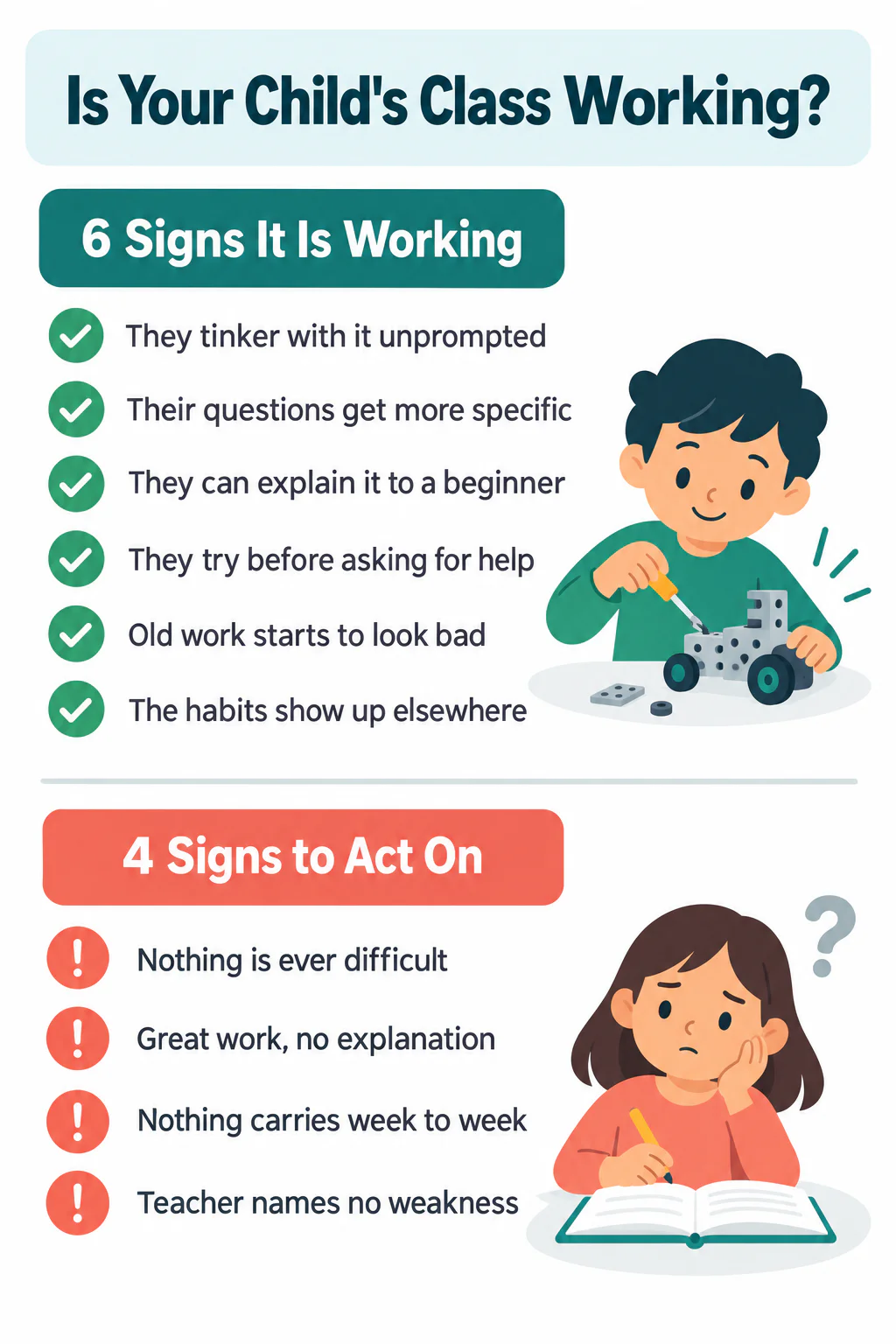
What are the warning signs?
Four patterns are worth acting on. None of them is fatal on its own, and all of them are fixable if raised early.
Everything is finished and nothing is difficult. If a child completes every task easily and never gets stuck, the level is wrong. Smooth lessons feel successful to everyone involved and build very little.
The work is good but the child cannot explain it. Usually a sign the teacher is doing too much of the thinking. Polished output with no underlying grasp is the most common way a class looks fine while achieving nothing.
Nothing carries between sessions. If each lesson starts from scratch and last week has evaporated, either the spacing is wrong or nothing is being consolidated. Some forgetting is normal and healthy. Total forgetting is not.
The teacher never mentions a weakness. A teacher who only reports that your child is doing brilliantly is either not looking closely or not telling you. Ask directly what your child finds hardest. A good teacher answers immediately and specifically, because they have noticed.
One thing that is not a warning sign: frustration. A child who gets annoyed when something does not work is engaged. What matters is what happens next, which is the difference described in what to do when your child says they are bad at maths.
A five-minute test you can run this week
You do not need to understand the subject to do this. Pick a quiet moment, not straight after a lesson.
- Ask them to show you something they made recently. Note whether they are keen or reluctant.
- Ask how one specific part works. Point at something and ask what it does. You are listening for understanding, not vocabulary.
- Ask what they would change if they started again. A child who can criticise their own work has standards, which means they have a mental model of better.
- Ask what was hardest. If nothing was hard, that is your answer. If they name something specific, they were working at the right edge.
- Ask what they want to make next. An answer means the class has given them ideas. A shrug does not condemn it, but two shrugs a month apart are worth a conversation.
Three or more good answers means it is working, even if you have seen nothing impressive. Mostly blanks means it is worth talking to the teacher before the term gets away from you.
Frequently Asked Questions
How long before I should expect to see progress?
Expect signs of engagement within three or four weeks and signs of independent skill by about eight. What you should not expect early is polished output. A child building something clumsy without help is further along than a child producing something impressive with a teacher guiding every step.
My child enjoys the class but cannot explain what they learned. Is that a problem?
It is worth investigating, though not always a problem. Some children simply find it hard to summarise. Ask them to show you instead of tell you. If they can rebuild something or talk you through what a piece of their project does, the learning is there even when the words are not.
Should my child find the class difficult?
Somewhat, yes. Learning research consistently finds that conditions which feel harder during practice produce better long-term retention than conditions which feel easy. A class that never strains a child is unlikely to be moving them forward. The line to watch is strain without distress.
What if my child says the class is boring?
Find out which kind of boring. Too easy and too hard both get described as boring by children. Ask what they did in the last lesson and whether they knew how to do it before. Boredom from repetition needs more challenge. Boredom from confusion needs the opposite.
How do I judge a class if I do not understand the subject?
You do not need subject knowledge. Ask your child to teach you something from the lesson. If they can explain it to a beginner, they understand it. If the explanation collapses under a simple follow-up question, they have memorised steps rather than grasped the idea.
When should I actually change classes?
When you see the same warning sign for six to eight weeks after raising it with the teacher. One bad month is normal, particularly in a busy term. A pattern that does not respond to a direct conversation is the point at which a change is usually justified.
What to do with this
The thing worth remembering is that the lesson is the worst place to judge a lesson. Everything visible there is performance, and performance is a poor guide to what will still be there in six months.
Watch the week instead. Does anything carry over, do the questions sharpen, does the child come back to it when nobody is asking them to. Those are slower signals and much harder to fake.
And if the answers are thin, raise it with the teacher before you conclude anything. Most classes that are not working are fixable with a change of level or approach, and a teacher who responds well to that conversation is usually a teacher worth keeping. One who has no specific answer about your child's weaknesses has told you something useful too.
Codeyoung runs 1:1 live online classes for children aged 6 to 17, with a teacher who adapts the pace to your child rather than a fixed syllabus. The first class is free, so you can see how they respond before deciding.
Book a Free TrialSource: Bjork and Bjork on introducing desirable difficulties into practice and instruction.