
A child works out how much fabric is needed for four curtains, each 1.4 metres long, and writes 56 metres. They have checked it twice. The method is fine. The decimal point moved, and nothing in their checking process was ever going to catch that, because they checked the steps rather than asking the question at the heart of this post: is this answer sensible?
Estimation is on the curriculum from age seven in both England and the United States, and it is the first thing that gets dropped when time is short. That is backwards. It is the cheapest mistake-catching tool a child will ever own, and it takes about ten seconds a question.
Why re-checking does not catch the big errors
Because re-checking replays the same thinking. A child who reads back through their working sees the steps they meant to do, agrees with themselves, and confirms an answer that is off by a factor of ten.
The errors that survive re-checking are precisely the ones that matter most:
- Decimal point errors. 5.6 becomes 56. The digits are all correct, so nothing looks wrong.
- Operation errors. Dividing where multiplying was needed. The arithmetic is flawless and the answer is nonsense.
- Unit errors. Centimetres reported as metres.
- Dropped-digit errors. Copying 4,200 down as 420 halfway through.
Each one produces an answer that is wildly the wrong size, and size is exactly what step-by-step checking does not look at. A separate check is needed, one that never touches the working at all.
What estimation actually is, and what it is not
Estimating means rounding the numbers to something easy, doing that easier calculation properly, and getting a range the real answer must land inside. It is a calculation, performed correctly, on simpler numbers.
Children frequently believe it means guessing, and that belief is why they resist it. Guessing feels like cheating, and it feels beneath them. Saying clearly that an estimate is a real sum with easier numbers changes how they treat it.
Here is the whole technique, worked:
| Question | Round it to | Estimate | So the real answer |
|---|---|---|---|
| 29 × 21 | 30 × 20 | 600 | starts with a 6 |
| 4 × 1.4 m | 4 × 1.5 m | 6 m | is about 6, not 56 |
| 187 ÷ 4 | 200 ÷ 4 | 50 | is somewhere near 45 to 50 |
| 38% of 82 | 40% of 80 | 32 | is around 30, not 3 or 300 |
Notice what the estimate gives you in every row. Not the answer. The size of the answer. That is enough to catch every error in the list above, and it is available before the real calculation starts.
Where this sits in the curriculum
Earlier than most parents expect, and it builds year on year rather than appearing once.
England's national curriculum for mathematics sets out a clear progression. In Year 3 pupils should "estimate the answer to a calculation and use inverse operations to check answers". Year 4 repeats and consolidates it. By Year 5 they "use rounding to check answers to calculations and determine, in the context of a problem, levels of accuracy". By Year 6 they "use estimation to check answers to calculations and determine, in the context of a problem, an appropriate degree of accuracy".
The American equivalent lands at the same age. Common Core standard 3.OA.D.8 asks grade 3 pupils to "assess the reasonableness of answers using mental computation and estimation strategies including rounding".
Two different countries, two different curriculum traditions, both putting it at age seven or eight. That is not an accident of drafting. It is because estimation is a prerequisite for everything that follows, and children who skip it carry the gap into secondary maths.
Not sure which level your child should start at? A free trial class with a Codeyoung teacher shows you exactly where they are and what they are ready for next, before you commit to anything.
Book a Free Trial →The sentence to build the habit around
"Roughly how big should this be?"
Ask it before the working starts, not after the answer is written. That ordering is the whole thing. An estimate produced after the answer is contaminated by the answer, because the child now knows what they are aiming at and will round in whichever direction agrees with it.
Before is a prediction. After is a justification. Children make the second one look exactly like the first, and it catches nothing.
The second sentence, for when they disagree
When the estimate says 600 and the written answer says 6,090, most children pick the written answer and move on. They trust the algorithm over their own judgement, which is a reasonable thing to have learned in a system that awards marks for method.
The useful response is not to tell them which is right. It is: "one of these is wrong. Which one, and how do you know?"
That converts a disagreement into the actual maths lesson. Sometimes the estimate was too rough and the answer stands. More often the answer has a problem, and the child finds it themselves because they now know which digit is suspicious. Either way they have practised the only habit that matters here, which is taking the disagreement seriously rather than ignoring it.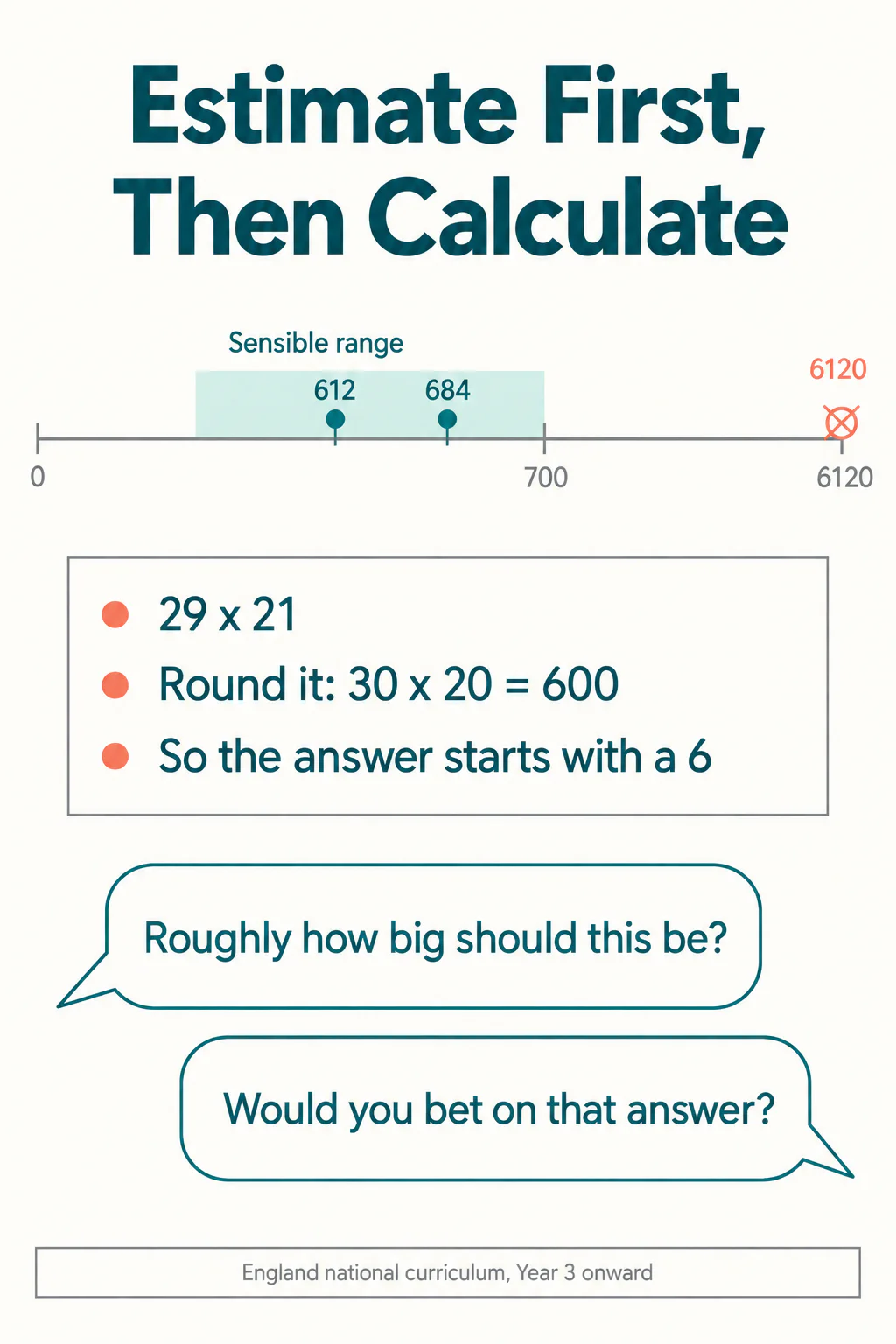
Building it at home without a worksheet
The habit transfers from real situations far better than from practice questions, because in real situations the answer gets checked by reality a few minutes later.
Things that work, in roughly increasing order of difficulty:
- Journey times. Ask for a guess before setting off, then compare on arrival. Immediate feedback, no marking.
- The shopping total. Ask for a rounded estimate before reaching the till. Round each item to the nearest pound or dollar as you go.
- Quantities by eye. How many books on that shelf, how many cars in the car park. Then count a sample and scale it.
- Cooking quantities. Doubling a recipe is estimation and proportional reasoning at once, with a result you can taste.
- Distances and heights. Using a known reference, such as a door being about two metres.
Point four is worth dwelling on. Doubling a recipe forces a child to reason about proportion rather than repeat a procedure, which is the same underlying skill that makes ratio questions manageable later. Our guide to how maths is used in everyday life has more in this direction.
What does not work: adding an "estimate first" box to a homework sheet. Children fill it in after the calculation, because the incentive is to have the box match. Estimation taught on paper alongside the real sum almost always becomes a formality.
The objection worth answering
Parents reasonably ask whether this slows a child down when exam time is tight. It is a fair concern and the answer is specific rather than reassuring.
Rounding 29 × 21 to 30 × 20 takes about five seconds. Call it ten with the comparison at the end. Across a forty-question paper that is roughly six minutes, which is real.
Against that: a single decimal-point error costs the whole mark, and in multi-step questions it poisons every subsequent step too. Marking schemes do award method marks, and our post on why a right answer still loses marks explains how that works, but an error of size early in a question usually takes several marks with it.
The honest version: for a child who makes few careless errors, estimation is a modest net cost. For a child who regularly loses marks to answers of the wrong size, it is the single highest-return habit available. Most children are in the second group, and parents usually know which group their child is in.
What good looks like by age
| Age | Can do |
|---|---|
| 7 to 8 | Rounds to the nearest ten and says whether an answer is about right |
| 9 to 10 | Estimates before calculating without being prompted, on multiplication and division |
| 11 to 12 | Handles decimals and percentages, and notices when their own estimate was too rough |
| 13 plus | Chooses an appropriate degree of accuracy for the context rather than rounding by habit |
The last row is the one that separates a competent student from a confident one. Knowing that a building-materials calculation should round up and a budget should round down is judgement, not arithmetic, and it only comes from having estimated in contexts where the direction mattered.
Children who arrive in secondary maths without this tend to be fine right up until questions get multi-step, at which point wrong-sized intermediate answers start propagating and confidence goes with them. That is usually the point where families start looking for help, and it is a large part of what our online maths classes spend their first few sessions repairing.
Start with one question
Pick one piece of homework this week and ask, before any working starts, roughly how big the answer should be. Write the estimate down where it can be seen. Then let them calculate.
If the two agree, say so and move on. If they disagree, resist saying which is right and ask which one they trust. That single exchange, repeated a dozen times over a term, produces a child who notices when a number is impossible. There is no shortcut to it and no worksheet that does it faster, but there is also very little else in primary maths that pays back as reliably.
Codeyoung runs 1:1 live online classes for children aged 6 to 17, with a teacher who adapts the pace to your child rather than a fixed syllabus. The first class is free, so you can see how they respond before deciding.
Book a Free Trial