
Most families get stuck one step earlier than they expect. The hard part of math competitions for kids is not choosing between them or preparing for them. It is working out who is allowed to sign your child up, because every major contest answers that question differently and none of them lead with it.
One takes a parent's registration directly. One will not accept a parent at all and says so plainly. One runs through a teacher who has to volunteer for the job months in advance. The result is that plenty of interested children never sit one, not for lack of ability or willingness, but because nobody could find the door.
Here is how entry works for four of the main contests, what each one is for, and what to do when your child's school is not part of the system.
Which math competitions can a child actually enter?
Four cover most of the ground for children between about five and fourteen, and they divide cleanly by age and by country.
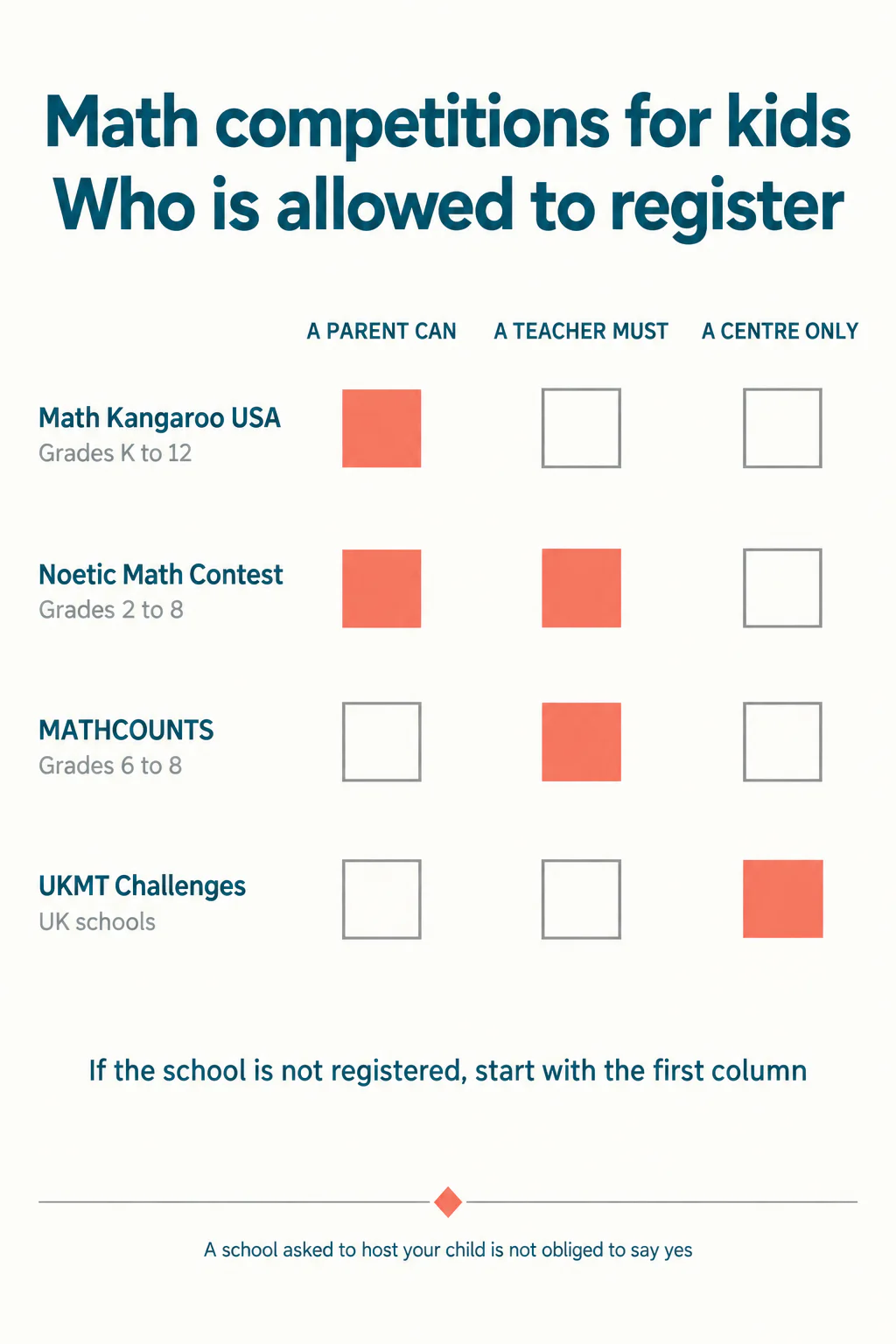
| Competition | Ages or grades | Where | Who registers |
|---|---|---|---|
| Math Kangaroo USA | Grades K to 12 | US, in person or online | A parent can, directly |
| Noetic Learning Math Contest | Grades 2 to 8 | US | A teacher by team, or a parent via the at-home edition |
| MATHCOUNTS | Grades 6 to 8 | US | A school coach, with a limited non-school route |
| UKMT Challenges | Primary through senior school | UK and British international schools | A registered centre only |
Read the right-hand column first. It determines whether this is a form you fill in this evening or a conversation with your child's school that needs to start a term early.
The direct route: Math Kangaroo
Math Kangaroo USA is the easiest entry point for a family acting on its own, and it covers the widest age range of the four. Registration for the 2027 individual competition opened on 15 September 2026, and the contest runs in March 2027. It can be sat in person or online.
Two things make it a sensible first competition. It starts at Grade K, so a six-year-old is not too young, and because a parent registers the child, there is no dependency on a teacher having heard of it. For a family testing whether their child enjoys this kind of problem at all, that independence is worth a lot.
The closed route: the UK Challenges
The UK Mathematics Trust runs the largest set of school maths competitions in Britain, including the Primary Kangaroo and the Junior, Intermediate and Senior Mathematical Challenges, with Olympiad rounds above them. It is also the one that will stop a parent dead.
UKMT states the rule without softening it: "All students must be entered into our Challenges via a registered UKMT centre." There is no individual entry. The institution also has to be in the UK, a Crown Dependency, or a British international school.
If your child's school is not registered, UKMT's own guidance is that "you can approach any of your local schools to ask if they are registered. If they are, you can ask them to host your child for the Challenges, however they are not obliged to do so."
That final clause is the honest answer to a question most articles skip. A school doing you a favour may say no, and it is within its rights. Plan for that rather than discovering it in February.
Not sure which level your child should start at? A free trial class with a Codeyoung teacher shows you exactly where they are and what they are ready for next, before you commit to anything.
Book a Free Trial →The coach-led route: MATHCOUNTS
MATHCOUNTS is the best known US middle school contest and the most structured of the four. It describes itself as a national programme for students in grades 6 to 8, and it is a season rather than a single event.
There are four stages in order. School competitions run from August 2026 to January 2027, where a coach selects who advances. Chapter competitions follow across February 2027, roughly 500 of them nationwide, with each school sending up to 14 competitors. State competitions run through March 2027, and the national competition is on 9 and 10 May 2027. No additional fees are required to advance to the state level.
The rounds are worth knowing before your child commits, because they test different things:
- Sprint: 30 problems in 40 minutes, no calculator.
- Target: four pairs of problems, six minutes per pair, calculator allowed.
- Team: 10 problems in 20 minutes for four-student teams, calculator allowed.
- Countdown: up to 45 seconds per problem, no calculator, and optional.
Two caveats. MATHCOUNTS does not start until Grade 6, which catches out parents of younger children who have heard of this one first and assume it is the entry point. And the school stage depends on a teacher agreeing to coach, so the practical first step is asking whether your school already participates, not registering anything.
The at-home route: the Noetic contest
The Noetic Learning Math Contest fills the gap below MATHCOUNTS, covering grades 2 to 8, and it runs twice a year. The autumn 2026 window is 12 to 25 November and the spring 2027 window is 1 to 15 April.
It is normally a team event: a teacher registers a team of up to 30 students for 129 dollars per contest, which covers practice tests, awards and shipping. There is also an at-home edition with its own registration that a parent can use, which makes it the second of these four that does not require a school to cooperate.
For a child in Grade 3 or 4 who likes number puzzles, this is a gentler introduction than anything else here, and the November window means it is the nearest opportunity on the calendar.
What to do when the school is not registered
This is the common case and it is not a dead end. Work through it in this order.
- Ask the school first, and ask the right person. The question is whether the school already enters any maths competition, put to the head of maths rather than the office. Many schools participate in something and never tell parents.
- Take the contests that do not need the school. In the US that means Math Kangaroo's individual competition and the Noetic at-home edition. Between them they cover Grade K to Grade 12.
- Ask a neighbouring school, early and politely. For UKMT this is the only route, and since nobody is obliged to host your child, a request made in October lands better than one made the week before.
- Offer to be the reason it happens. Schools often decline because of staff time, not principle. A parent willing to help organise a sitting changes that calculation more often than you would think.
Should your child enter one at all?
Probably yes, and for a reason that has little to do with winning. A competition problem is built so that recognising the topic does not tell you what to do. That is the whole design. It is also precisely the gap that ordinary classwork leaves, because school problems usually arrive in a chapter that announces which method to use.
A child who has only ever practised that way can be fluent and still freeze, because they have learned to identify procedures rather than to think about an unfamiliar situation. Watching them sit with a problem they cannot immediately classify, and find a way in, is worth more than the certificate.
Which leads to the thing I would push back on hardest. The instinct once a child is entered is to drill past papers against the clock. For most children that is the wrong preparation and it can do real harm. Timed repetition trains speed on question shapes you have already seen, and these contests deliberately avoid question shapes you have already seen. Worse, it converts a reasoning exercise into a performance test, which is how a curious child acquires math anxiety.
Better preparation is fewer problems, much more slowly. Three past problems in an hour, with the child talking through dead ends, beats thirty in the same hour. If they get one out in twenty minutes after two false starts, that was a good hour. Our guide to strategies for solving math word problems covers the same habit of reading before reaching, and checking whether an answer is sensible is the other half of it.
And if your child is already anxious about maths, start somewhere else. Competitions are a poor first intervention for a child who is struggling, and building confidence has to come before adding a timed event. For a child who is bored rather than behind, the picture flips entirely, and telling those two apart is the first job.
Where to start this week
If your child is in Grade 2 to 8 in the US, the Noetic autumn window on 12 to 25 November is the closest date and the at-home edition needs nobody's permission. If they are younger or older than that, Math Kangaroo's individual registration is already open for March 2027. If you are in the UK, the only move is the school, and the conversation should happen now rather than in the spring.
One competition, sat without much preparation, tells you more than any amount of deliberation about whether your child enjoys this. That is the point of the first one.
Codeyoung runs 1:1 live online classes for children aged 6 to 17, with a teacher who adapts the pace to your child rather than a fixed syllabus. The first class is free, so you can see how they respond before deciding.
Book a Free TrialOur online math classes work the same way these problems do, building the reasoning before the method. If your child is drawn to puzzles rather than exercises, that is the thread worth pulling, and coding competitions run on much the same principle.
Entry rules, dates and formats verified on 6 October 2026 against MATHCOUNTS, the UK Mathematics Trust, Math Kangaroo USA and Noetic Learning. Dates and fees change each cycle, so confirm with the organiser before registering.