
Key Takeaways
Online math tutoring for middle schoolers can range from free resources and low-cost subscriptions around $15 per month to premium 1:1 sessions that can cost $30 or more per class.
The primary factors driving tutoring costs are the format (1:1 vs. group), the tutor's qualifications and experience, and the frequency and length of the sessions.
Evaluating a tutoring service should focus on its value, such as personalized learning plans and teaching quality, not just the hourly rate.
Before paying for a service, parents can assess quality by asking about the tutor's experience with a child's specific challenges, their methods for tracking progress, and how they adapt to different learning styles.
How much does online math tutoring cost for middle schoolers?
For parents seeking middle school math help online, tutoring costs vary widely, from free self-study platforms to premium one-on-one instruction priced at $30 or more per session. Subscription services offering homework help, like Chegg, can be as low as around $15 per month. The price you pay is determined by the level of personalization, the tutor's expertise, and the instructional format.
The landscape of digital math support is broad. Some services, like the K12 tutoring platform, offer support across more than 100 different academic courses to help students improve their grades. Others focus on specific needs; for example, Tutor.com is the official provider of online tutoring to the Department of Defense for military families and offers 24/7 help. Understanding the differences between these models is the first step in finding the right fit for your child and budget. When you start exploring the options, you will find that a clear grasp of what to look for in online maths classes for kids helps narrow the field considerably.
To make an informed choice, it helps to categorize the options based on their typical cost and service model. This allows parents to align their budget with their child's specific academic needs, whether that is occasional homework assistance or intensive, personalized instruction.
Free Self-Directed Platforms: Services like Khan Academy offer extensive video libraries and practice problems at no cost. These are excellent for motivated, independent learners but lack the personalized feedback and live interaction of a tutor.
Low-Cost Subscription Services: Platforms offering on-demand homework help or access to pre-recorded lessons often charge a monthly fee. These are budget-friendly options for getting quick answers to specific problems.
Tutoring Marketplaces: Websites that connect parents with independent tutors often have a wide range of prices, with average hourly rates for independent math tutors on some platforms falling between $18 and $22. Quality and experience can vary significantly between individual tutors.
Dedicated Tutoring Companies (Group): Some companies offer small-group online classes. This model provides more interaction than a video library at a lower cost than 1:1 sessions, but the instruction is not fully individualized.
Dedicated Tutoring Companies (1:1): The most personalized option, one-on-one tutoring, involves a dedicated instructor working directly with your child. This premium model commands the highest price but offers a curriculum and pace tailored specifically to your child's learning gaps and goals.
What drives the cost of online math tutoring for kids?
The cost of online math tutoring is primarily driven by three factors: the instructional format (one-on-one versus group), the tutor's qualifications and experience, and the frequency of sessions. A highly experienced math teacher providing daily, personalized 1:1 sessions will naturally cost more than a college student leading a weekly group review class.
The most significant cost differentiator is the choice between group and individual instruction. Group sessions spread the cost of the tutor among several families, making them a more affordable option. However, the tutor's attention is divided. One-on-one tutoring offers an exclusive, focused learning environment where the curriculum can be adapted in real-time to a student's progress and questions. This is particularly effective when a child is falling behind and requires a program designed to catch up by addressing specific learning gaps.
Research from Benjamin Bloom in 1984 found that 1:1 tutoring is about two standard deviations more effective than conventional group instruction.
This finding highlights why personalized instruction is often considered a high-value investment. The additional cost translates directly into a more efficient and effective learning experience. Several components contribute to the final price tag for a family:
Tutor Expertise: Tutors with advanced degrees, specialized certifications, or years of classroom experience command higher rates. A service with a rigorous vetting and hiring process will reflect this quality in its pricing.
Instructional Format: One-on-one tutoring is the premium option. Small-group classes (typically 3-5 students) offer a middle ground, while large-group or webinar-style classes are the most economical.
Session Length and Frequency: Most services offer discounts for purchasing packages of multiple sessions or committing to a longer-term schedule. A plan with multiple sessions per week will have a higher total cost but a lower per-session rate than a single, ad-hoc class.
Curriculum and Resources: The cost may also include access to proprietary learning platforms, practice software, progress-tracking reports, and recorded sessions for later review. These resources add significant value beyond the live instruction time.
Are there free and low cost math tutoring options worth trying first?
Yes, there are numerous high-quality free and low-cost math resources that families can explore before committing to a paid tutoring service. Platforms like Khan Academy provide a completely free library of video lessons and practice exercises for nearly every math topic. For self-motivated students, these tools can be highly effective for reviewing concepts or practicing new skills.
Many educational organizations and even schools provide lists of recommended learning tools. The National Council of Teachers of Mathematics, for instance, started the Illuminations website, which hosts over 100 math activities. Similarly, MathTV offers access to 10,000 free math videos, allowing students to see problems solved by different tutors. Other platforms like Thinkport.org provide collections of self-paced, 20-minute lessons aligned to Algebra I standards. These resources are excellent supplements to classroom learning.
While these tools are valuable, their primary limitation is the lack of personalized, interactive support. They cannot diagnose the root cause of a student's struggle, adapt to their learning pace, or answer specific questions in real-time. If a child's difficulties persist after using these resources, it is often one of the clear signs your child needs a math tutor for more structured, one-on-one intervention. Free resources are a powerful first step, but they cannot replace the targeted guidance of an experienced teacher.
How to judge the value of math tutoring, not just price?
The best way to judge a math tutoring service is by its potential to create measurable progress for your child, not by its hourly rate alone. A lower-priced service that fails to build skills or confidence is a wasted investment. High-value tutoring is defined by a personalized approach, exceptional teaching quality, and transparent progress tracking. This is why our online math classes begin with a free trial class that includes a placement diagnostic to create a truly customized learning plan.
A key indicator of quality is the selectivity of the teaching staff. At Codeyoung, only about 0.1% of teacher applicants are hired after a rigorous process that includes background, technical, and communication checks. This ensures every student is paired with a highly qualified educator. Another sign of a value-focused service is transparency, such as providing recordings of every session so families can review the material and observe the teaching methods firsthand. These features contribute more to a child's success than a simple price comparison can reveal.
Use the following framework to determine which type of service provides the most value for your family's specific situation.
If your child is generally self-sufficient but struggles with specific homework problems: A low-cost subscription service for on-demand help might be the most cost-effective choice.
If your child learns well with peers and needs a general concept review: A small-group tutoring class offers a balance of social interaction and expert guidance at a moderate price point.
If your child is falling significantly behind or experiences math anxiety: The targeted, adaptive support of 1:1 tutoring is likely the highest-value option, as it is designed to address core conceptual gaps and rebuild confidence directly.
If your child is an advanced learner who is bored in class: A premium 1:1 service can provide an accelerated and enriched curriculum that keeps them engaged and challenged beyond schoolwork.
If your budget is the primary limiting factor: Start with the excellent free resources available online and supplement with peer study groups or school-provided academic support before considering paid services.
When more than one of these situations applies, prioritize the most pressing academic or emotional need. For a student who is both behind and anxious, addressing the anxiety with a patient, dedicated 1:1 tutor provides the foundational value that enables academic progress.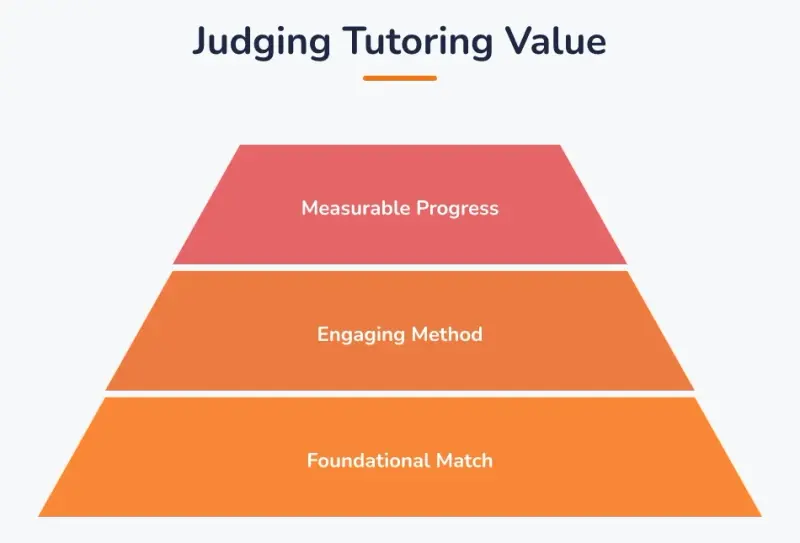
Judging Tutoring Value, from foundation to top: Foundational Match, Engaging Method, Measurable Progress.
Which questions reveal a math tutor's real quality before you pay?
Before committing to a service, asking specific, probing questions can reveal the true quality of the instruction your child will receive. These questions go beyond pricing and scheduling to assess a tutor's methodology, experience, and ability to connect with your child. A quality provider will have clear, confident answers to these inquiries.
What is your experience with my child's specific challenge?
Instead of just asking if a tutor covers "middle school math," describe your child's specific issue. For example, "My child understands the concepts in class but panics during tests," or "They struggle specifically with word problems involving fractions." An experienced tutor will be able to describe concrete strategies they have used with other students who had the same problem, which is especially important for students with math anxiety that requires a specific approach.
How do you measure and report on student progress?
A vague answer like "we'll see improvement" is a red flag. A high-quality tutoring service should have a systematic process for tracking progress. Ask if they conduct initial assessments, set specific learning goals, and provide regular reports to parents. Knowing how they define and demonstrate success is critical for understanding the value you are receiving.
How do you adapt your teaching style to different learners?
Every child learns differently. A great tutor can adjust their methods for visual, auditory, or kinesthetic learners. Ask them for an example: "What would you do if my child wasn't understanding your explanation of a concept?" Their answer should describe a flexible approach, such as using virtual whiteboards, real-world examples, or interactive tools, rather than simply repeating the same explanation.
What is your process for hiring and training tutors?
This question reveals the standards of the entire organization. A reputable company will be proud to discuss its rigorous hiring criteria, background checks, and ongoing professional development for its teachers. The answer provides insight into the consistency and quality you can expect, regardless of which specific tutor is assigned to your child.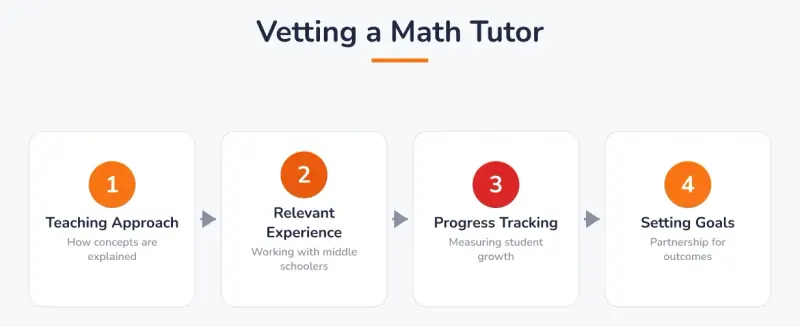
Vetting a Math Tutor. Steps: 1. Teaching Approach (How concepts are explained), 2. Relevant Experience (Working with middle schoolers), 3. Progress Tracking (Measuring student growth), 4. Setting Goals (Partnership for outcomes).
Frequently Asked Questions
How many hours of math tutoring does a child need per week?
For most middle school students, one or two one-hour sessions per week is sufficient to reinforce concepts and address learning gaps without causing burnout. The ideal frequency depends on the child's specific goals, whether they are catching up on foundational skills or preparing for an advanced test.
At what age should a child start math tutoring?
A child can benefit from math tutoring at any age as soon as a specific need arises, such as falling grades, homework frustration, or a desire for advanced challenges. Early intervention in elementary or middle school is often more effective than waiting until high school when learning gaps have widened.
Is online math tutoring as effective as in-person tutoring?
Yes, for many students, online math tutoring is equally or more effective than in-person tutoring. Online platforms offer access to a wider pool of expert tutors, flexible scheduling, and interactive digital tools. Features like recorded sessions for review provide a unique benefit that in-person tutoring cannot.
What technology do we need for online math tutoring?
All you need is a reliable internet connection and a computer, tablet, or laptop with a microphone and camera. Most tutoring services use common video conferencing software like Zoom and provide any proprietary learning software through their own platform, requiring no complex setup from the family.
How much should parents spend on online middle school math tutoring?
For online middle school math tutoring, parents should plan to spend anywhere from zero dollars on high-quality free resources, through about $15 per month for effective subscription services, up to $30 or more per session for targeted 1:1 support tailored to their child's unique learning challenges. The optimal investment isn't merely a dollar amount, but rather what provides the most value, factoring in whether a group setting or personalized instruction best suits your student, along with the tutor's experience and the desired frequency of sessions. Prioritize services that offer personalized learning plans and demonstrate exceptional teaching quality over just the hourly rate. Before committing financially, confidently inquire about a tutor's specific experience with similar challenges, their methods for tracking progress, and how they adapt instruction to different learning styles, ensuring every dollar spent contributes directly to your child's mathematical growth and confidence.