
Most answers to this question are a range so wide it tells you nothing: anywhere from ten dollars a class to a hundred and fifty. The range is real, but it is not the useful part. What matters is that two classes with identical price tags can differ by a factor of five in the thing you are actually buying, which is a teacher paying attention to your child.
Here is what online coding classes cost in 2026 according to providers who publish their prices, and one calculation that reframes the whole comparison.
What the published prices say
Very few kids' coding companies put numbers on a page. Create and Learn does, and its rates as of 24 September 2026 look like this:
| Format | What you get | Price | Per session |
|---|---|---|---|
| Intro class | One hour, small group | $0 | Free |
| Group class | 4 sessions of 55 minutes, max 5 students | $94.50 | About $24 |
| Private 1:1 | 4 sessions of 55 minutes | $240 | $60 |
| Private group | 4 sessions, your own group of friends or siblings | $240 plus $28 per extra child | About $16 each at six children |
Compare that with Codingal, whose pages describe courses, lesson counts and certificates in detail and carry no price at all, sending parents to a free trial lesson instead. That is a common model rather than a trick. It does mean that any figure you see quoted for a company that does not publish rates came from somebody's anecdote.
So a fair 2026 picture for live online classes: roughly $15 to $30 a session in a group, and roughly $40 to $70 a session one to one, with discounts of 5 to 20 per cent for longer courses and for siblings. Self-paced video platforms sit far below that, usually as a monthly subscription, and they are a different product rather than a cheaper version of the same one.
The calculation nobody does
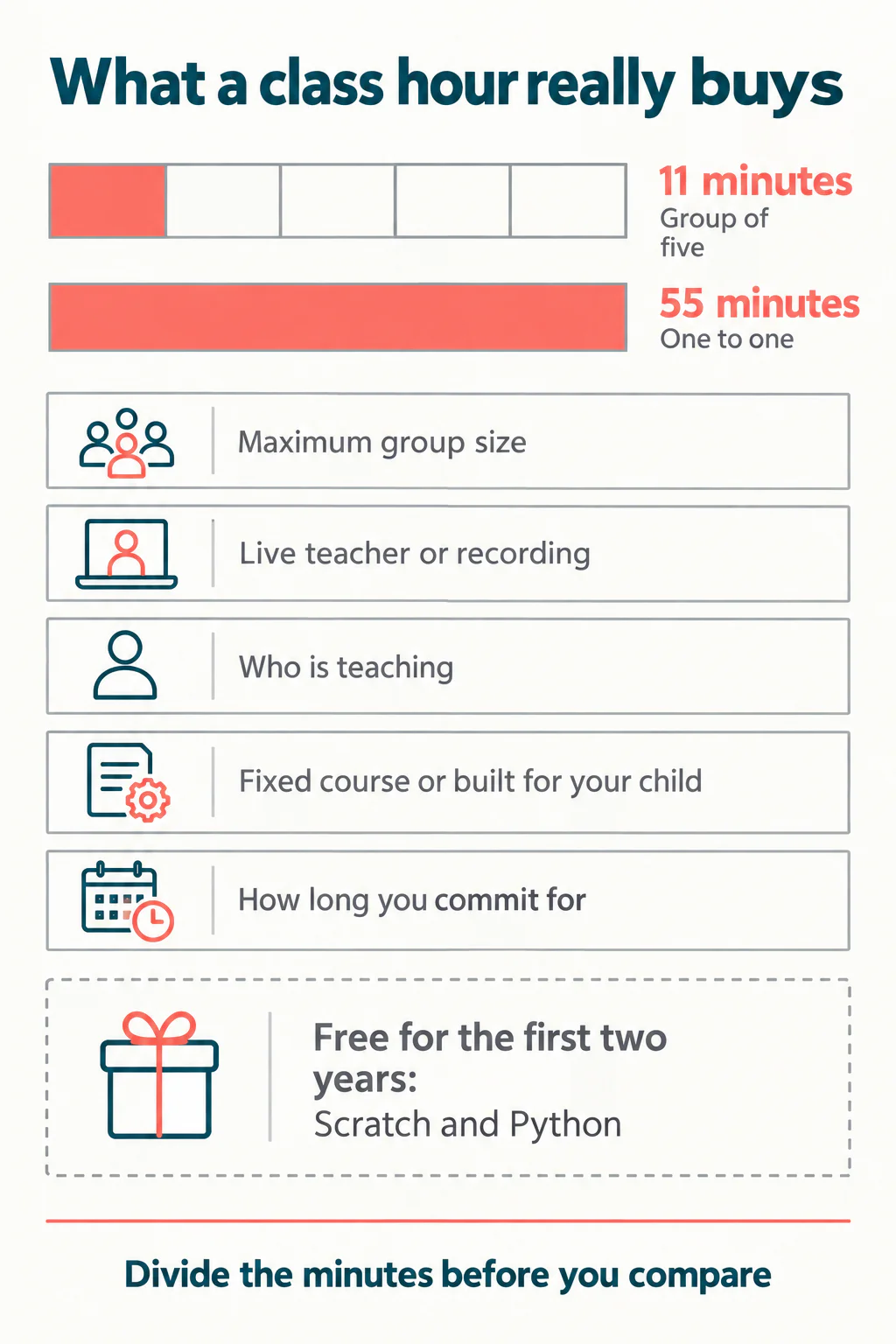
Take the group class above. Fifty-five minutes, up to five children, about $24. Now divide the teacher's time by the number of children: roughly 11 minutes of individual attention per child per session, which works out near $2.15 for each of those minutes.
The private session is $60 for 55 minutes of attention. That is about $1.09 a minute.
The class that costs two and a half times as much buys attention at half the price. That is not a sales argument so much as an arithmetic one, and it holds for any provider you care to run it on. Ask the group size, divide, and compare.
Now the honest caveat, because this calculation flatters one format and hides what the other is good at. Children do not only learn from direct attention. A group gives a child other people's questions, other people's bugs, and a reason to keep up. Some children work harder because someone else is building a game too. For a child who mainly needs exposure and enthusiasm, absolute cost is the right measure and a group class is excellent value.
The calculation matters most for the child who is stuck. A child who gets confused in minute six of a group class waits an average of, well, a long time. That is the situation where you are paying for attention you never receive.
What actually drives the price
- Group size. The single biggest factor, and the one least often stated up front. Ask for the maximum, not the average.
- Live or recorded. A live teacher costs money every week. A video course costs money once. Both have their place, and the price gap between them is honest.
- Who is teaching. A trained teacher who can explain a loop three different ways is a different hire from a university student reading a lesson plan. This is invisible on a pricing page and obvious in a trial class.
- Curriculum or bespoke. A fixed course is cheaper to run. A plan built around what your child actually wants to make costs more and tends to survive contact with an eight-year-old better.
- Commitment. Term-length packages and subscriptions cost less per session and lock you in earlier, usually before you know whether the teacher suits your child.
Not sure which level your child should start at? A free trial class with a Codeyoung teacher shows you exactly where they are and what they are ready for next, before you commit to anything.
Book a Free Trial →The costs nobody mentions, and the ones that do not exist
Start with the good news, because it is better than most parents expect. For the first two years of learning, the software is free. Scratch runs in a browser at no cost and is maintained by MIT. Python is free to download. Any laptop bought in the last five years will run both.
So a course that requires a paid licence, a particular tablet, or a robotics kit is adding cost for a reason that may be good, but it is adding cost. Price it in before you compare.
The real extras worth asking about:
- Cancellation and rescheduling. Children get ill. Find out what happens to a missed session before you need to know.
- Unused sessions. Refundable, transferable to a sibling, or lost. This is the clause parents forget to ask about.
- Changing teachers. Fit matters more than credentials for a nine-year-old. A provider confident in its team will say yes without hesitating.
- Certificates and competition fees. Sometimes bundled, sometimes billed separately, and rarely worth choosing a course over.
What is worth paying for at each age
The most expensive mistake in this category is not choosing the pricier class. It is buying the wrong thing for the age.
| Age | What they need | What to spend on |
|---|---|---|
| 6 to 8 | Sequencing, cause and effect, finishing something | Short live sessions, block coding, a teacher who is patient. Length matters less than frequency. |
| 9 to 11 | Loops, variables, debugging their own work | The stage where feedback earns its price. A stuck child at this age quietly decides they are bad at it. |
| 12 to 14 | Moving from blocks to text, real projects | A teacher who can read their code and explain the error, not a video that shows correct code. |
| 15 to 17 | Depth, portfolio, sometimes exams | Subject expertise. This is where a cheap generalist teacher stops being enough. |
Two of those rows deserve an argument rather than a table cell. Paying for a Python course for an eight-year-old because it sounds more advanced is the most common way families waste money on coding. Children pushed into typed syntax before they can hold a loop in their head bounce off it, decide programming is not for them, and the fix costs more than the original course did. Blocks are not a toy version of coding. They are the same logic without the typing, and the logic is the hard part. Our guide on whether your child is ready to start coding goes through the readiness signals in detail.
The other row is the nine to eleven band, where the money makes the most difference. That is the age at which children start writing programs long enough to break, and a child who cannot get unstuck stops starting new things.
When free is genuinely enough
A self-directed twelve-year-old with an idea for a game and a habit of finishing things can get a long way on free tutorials, and some of the best young programmers I have taught started exactly there. If that describes your child, spend nothing for six months and see what they build.
What free material cannot do is notice. It cannot see that your child has understood loops but is quietly avoiding variables, or that they gave up on a project three weeks ago and have been rewatching the same lesson since. That noticing is the entire product you are buying with a live class, and it is the reason a cheaper course that nobody completes is not cheap.
Worth comparing honestly before you decide: group classes against 1:1, and what a good trial class should actually show you in how to read a free trial class. If your child also has maths support in the mix, our note on what online maths tutoring costs uses the same attention-minute arithmetic.
Four questions before you pay
- What is the maximum group size? Not the typical size. The maximum.
- What is the total cost and the per-session cost? Get both, since a package price hides the rate and a rate hides the commitment.
- What happens to sessions we miss? Ask before you need the answer.
- What will my child have built by session eight? A provider who can answer specifically has a plan. A provider who answers with skills has a syllabus.
The hardest part of this is judging the teacher rather than the price list, and we wrote about that separately in how to find a good live coding tutor.
What to do with this
Expect $15 to $30 a session for live group classes and $40 to $70 one to one, and treat any quote outside that band as a question rather than a verdict. Then stop comparing prices and start comparing attention: group size, who teaches, and what happens when your child gets stuck in minute six.
The cheapest class your child finishes is better value than the best class they quietly stop attending, and the signal that it is working shows up in about six weeks. They explain their own code without being asked. They fix a bug before calling you. They start something nobody set them. If you want to see what that looks like for your child before spending anything, a trial class costs nothing and answers more than a pricing page can. Our online coding classes for kids run 1:1 for exactly the reason the arithmetic above sets out.
Codeyoung runs 1:1 live online classes for children aged 6 to 17, with a teacher who adapts the pace to your child rather than a fixed syllabus. The first class is free, so you can see how they respond before deciding.
Book a Free TrialPrices are the providers' own published figures, checked 24 September 2026: Create and Learn pricing and Codingal. Third-party prices change without notice.