
Ask a twelve-year-old what algebra is and most will say the same thing: it is the maths with letters in it. That answer is reasonable, and it is also almost exactly backwards. In the history of algebra, the letters are the newest part. Scribes in Mesopotamia were solving problems we would now call quadratic equations around 2000 BC. Nobody used a letter to stand for an unknown number until 1591. The subject is roughly 4,000 years old and its notation is roughly 430.
That gap is the most useful thing a student can know about algebra, because it explains why the notation feels hard. It was the hardest part for everybody. It took mathematicians thirty-six centuries to invent it.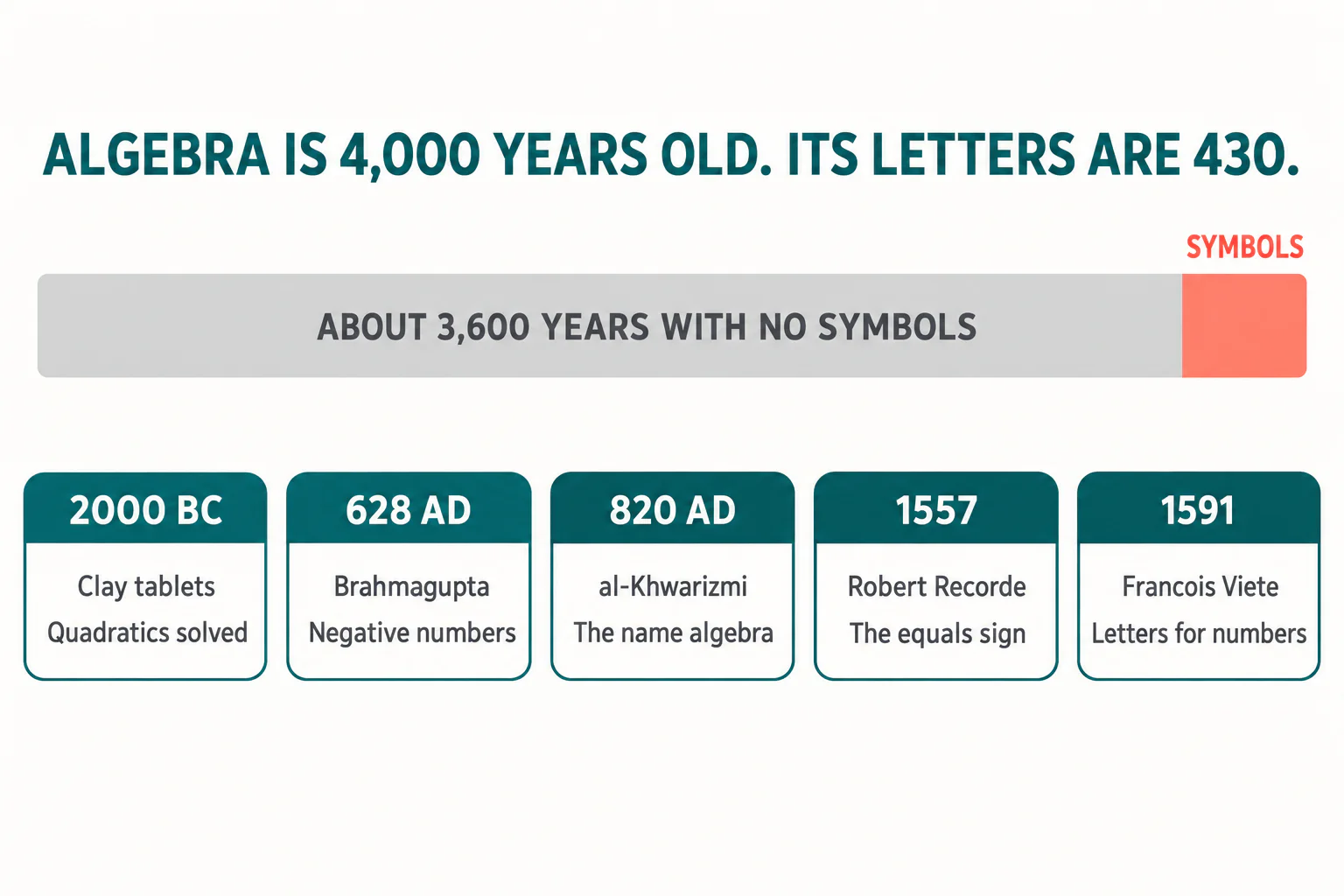
2000 BC: solving quadratics without writing a single equation
The earliest algebra we can read sits on clay. Two tablets found at Senkerah on the Euphrates in 1854 date from around 2000 BC, and tablets of this period show Babylonian scribes handling two families of problem that match what we would write as x² + bx = c and x² − bx = c.
Here is one, in the scribe's own order of operations. A rectangle has an area of 60 and its length exceeds its breadth by 7. Find the sides. The tablet says: take half of 7, giving 3.5; square it, giving 12.25; add the area, giving 72.25; take the square root, giving 8.5; subtract the 3.5 to get 5.
The breadth is 5, the length is 12, and you can check it in your head: 5 × 12 = 60, and 12 − 5 = 7. Now look at what the scribe actually did. Halve the coefficient, square it, add, take a root, subtract. That is completing the square. It is the quadratic formula, executed as a recipe, about 2,800 years before anyone wrote a formula down.
Two things are worth noticing with a child in front of you. The first is that the Babylonians worked in base 60 rather than base 10, which is why we still have 60 minutes in an hour and 360 degrees in a circle. The second is the part that matters here. As the historians at St Andrews put it when they present these problems in modern symbols, "nothing like a symbolic representation existed in Babylonian times." The scribe had no x. He had a procedure, in words, for a specific rectangle.
That is the pattern for the next three thousand years. The maths arrives early. The writing arrives late.
628: India writes down what a negative number is
Algebra could not finish being invented until somebody was willing to accept an answer below zero, and that took a surprisingly long time. In 628 the Indian mathematician Brahmagupta wrote the Brahmasphutasiddhanta, which contains the first clear arithmetic of zero and negative numbers. He explained them in terms of money, which is still the best way to teach them.
- "A debt minus zero is a debt."
- "A fortune minus zero is a fortune."
- "A debt subtracted from zero is a fortune."
- "The product or quotient of two debts is one fortune."
Read the last one again. It is the rule every student is handed as "a negative times a negative is a positive," which sounds arbitrary. Brahmagupta's version does not sound arbitrary at all. Two debts cancelling into a fortune is a sentence a nine-year-old can picture, and it was written fourteen hundred years ago.
He also got something wrong, and the error is worth showing children. He claimed that zero divided by zero is zero. It is not, and the question of what dividing by zero means stayed unresolved for another thousand years. A famous mathematician being confidently wrong about something a modern student can test on a calculator is a more honest picture of how maths works than a list of triumphs.
820: the book that named algebra and contained no algebra symbols
Around 820, at the House of Wisdom in Baghdad under the Caliph Al-Mamun, Muhammad ibn Musa al-Khwarizmi wrote Hisab al-jabr w'al-muqabala. The title is where the word comes from, and the two Arabic terms in it are both instructions:
- Al-jabr means completion. It is the move that removes a negative term from an equation by adding the same thing to both sides.
- Al-muqabala means balancing. It is the move that cancels equal powers appearing on both sides.
So "algebra" is not the name of a subject that somebody happened to choose. It is the name of a technique: the restoring and balancing you do to a statement to get it into a shape you can solve. Every student who has been told to "do the same thing to both sides" is following al-jabr, by name, from a book written twelve hundred years ago.
Now the part almost nobody mentions. Al-Khwarizmi's mathematics, in the words of the St Andrews historians who catalogue it, "is done entirely in words with no symbols being used." No x. No exponent. No plus sign. And no equals sign, because the equals sign would not exist for another 737 years.
He also could not write a single quadratic equation, because he had no negative numbers to work with. Brahmagupta had published the rules 192 years earlier in India, but they had not been taken up. So instead of one equation, al-Khwarizmi reduced everything to six standard forms, each with its own recipe, because without negatives you cannot move a term to the other side and keep the same shape.
His worked example is still the one textbooks use: solve x² + 10x = 39. He takes half of the roots, which is 5, and completes the square geometrically, drawing a literal square with four rectangles attached to its sides. The answer is 3. The proof is a picture.
This is why the six forms matter more than they look. Once negative numbers were accepted, all six collapse into ax² + bx + c = 0, and one formula covers every case. Nothing new had to be discovered. The simplification came from being willing to write a number below zero. If a student wants a reason why negative numbers were worth the trouble, that is the reason, and it is a better one than "you will need them later."
Not sure which level your child should start at in maths? A free trial class with a Codeyoung teacher shows you exactly where they are and what they are ready for next, before you commit to anything.
Book a Free Trial →1557: two parallel lines, because nothing can be more equal
The equals sign has an inventor, a date and a stated reason, which makes it one of the most teachable facts in mathematics. Robert Recorde introduced it in The Whetstone of Witte in 1557, and explained his choice of two parallel line segments in his own spelling: "bicause noe 2 thynges can be moare equalle."
Before that, mathematicians wrote the word, or an abbreviation of the Latin aequalis, every single time. Imagine doing a page of simultaneous equations and writing out "is equal to" at every step. The symbol is not decoration. It is compression, and compression is what made longer arguments possible at all.
The plus and minus signs arrived in print slightly earlier, in German commercial arithmetic of the late fifteenth century, before anyone used them as algebraic operators in the modern sense. The point to take from this stretch of the story is that the symbols did not arrive as a set. They were invented one at a time, by different people, over about 150 years, mostly to save writing.
1591: somebody finally uses a letter for a number
The last piece is the one students think came first. In 1591, Francois Viete published In artem analyticam isagoge at Tours, and suggested using letters as symbols for quantities, both known and unknown. His own convention was vowels for the unknowns and consonants for the things you already knew.
That single idea changes what algebra can do. Before letters, a method had to be described through an example: take this rectangle of area 60, halve this 7. After letters, you state the method once and it covers every rectangle at the same time. Al-Khwarizmi's six recipes and the Babylonian scribe's procedure are the same mathematics as the modern formula; what they lacked was a way to say it in general.
Viete's vowels-and-consonants scheme did not survive. The version everybody now uses, where letters from the start of the alphabet are the knowns and letters from the end are the unknowns, came later from Rene Descartes. That is the actual origin of x. It is not a mysterious symbol for the unknown. It is just a letter from the far end of the alphabet, assigned by a convention that has held for nearly four centuries because it works.
What this changes about teaching algebra
Three things follow from the chronology, and they are practical rather than decorative.
Teach the notation separately from the reasoning
A child who can work out that two numbers multiply to 60 and differ by 7 has done the Babylonian scribe's work completely. If they then stall on 2x² − 7x = 0, the gap is not mathematical reasoning. It is translation, and translation responds to practice at translating rather than to more worked examples. Our guide on why two-step word problems stall covers that translation step in detail.
Give the reason for negative numbers before the rules
Six separate equation types collapsing into one is a visible payoff. Brahmagupta's debts and fortunes give the rules a meaning. Between them they answer the question students actually ask, which is not "how do negatives work" but "why would anyone bother."
Symbols are compression, not difficulty
Every symbol in the story was invented to write less. A student who sees √, = and x as obstacles has them exactly inverted; they are the shortcuts, and the long version is a paragraph of Arabic prose with a geometric diagram attached. Saying that out loud changes how some children look at a page of equations.
Algebra also sits underneath every line of code a child writes. A variable in Scratch is Viete's idea with a different name, and a loop is al-Khwarizmi's recipe written so a machine can follow it. That is not a coincidence of vocabulary. The word algorithm and the word algebra come from the same man and the same book.
The short version
Algebra is about 4,000 years old. Its methods were working on clay tablets in 2000 BC, its rules for negative numbers were written in India in 628, and the book that gave it its name was finished in Baghdad around 820 without using a single symbol. The equals sign is from 1557 and the letters are from 1591. Everything a student recognises as algebra belongs to the last tenth of the story, which is a fair reason to be patient with a child who finds that part hard.
If this is the kind of question your child asks, it is worth feeding. Children who want to know where things came from tend to hold onto the method better than children who only ever meet the finished formula. For more of the same ground, our piece on who invented maths takes the wider view, and Vedic maths for kids looks at a different ancient tradition that is still in use.
Codeyoung runs 1:1 live online maths classes for children aged 6 to 17, with a teacher who adapts the pace to your child rather than a fixed syllabus. If algebra notation is the sticking point, a teacher can see that in one session and work on the translation rather than on more practice questions. The first class is free, so you can see how they respond before deciding.
Book a Free TrialSources checked 16 October 2026: MacTutor History of Mathematics archive, University of St Andrews, biographies of al-Khwarizmi, Brahmagupta, Viete and Recorde, and the topic article on Babylonian mathematics. Dates and quoted wording are taken from those entries. Further reading: MacTutor on al-Khwarizmi and MacTutor on Babylonian mathematics. Codeyoung's online maths classes cover algebra from first variables to quadratics.