
Read a nine-year-old's story out loud and you can hear the machinery. We went to the park and then we saw a dog and then it started raining and then we went home. The ideas are fine. Something in the assembly is not, and the usual parental diagnosis, that they need more vocabulary or more grammar, sends the work in exactly the wrong direction. If you want to help your child write better sentences, the target is narrower than it looks and the evidence about what works is unusually clear.
It is also slightly uncomfortable, because the thing most of us reach for first turns out to be the one intervention in the research that made writing worse.
What "and then" is actually telling you
It is not a vocabulary problem. A child who writes and then four times in a paragraph can usually tell you the same story aloud with far more colour. It is not an imagination problem either; the events are all there.
It is a syntax problem, and specifically a shortage of joins. The child owns one connector and uses it for every relationship between two ideas, whether that relationship is sequence, cause, contrast or simultaneity. English has dozens of ways to link two thoughts. They have one, so everything comes out as a list.
Once you hear it that way, the fix becomes obvious in shape if not in method. They do not need more words. They need more ways to put the words they already have into a single sentence.
What the research says works
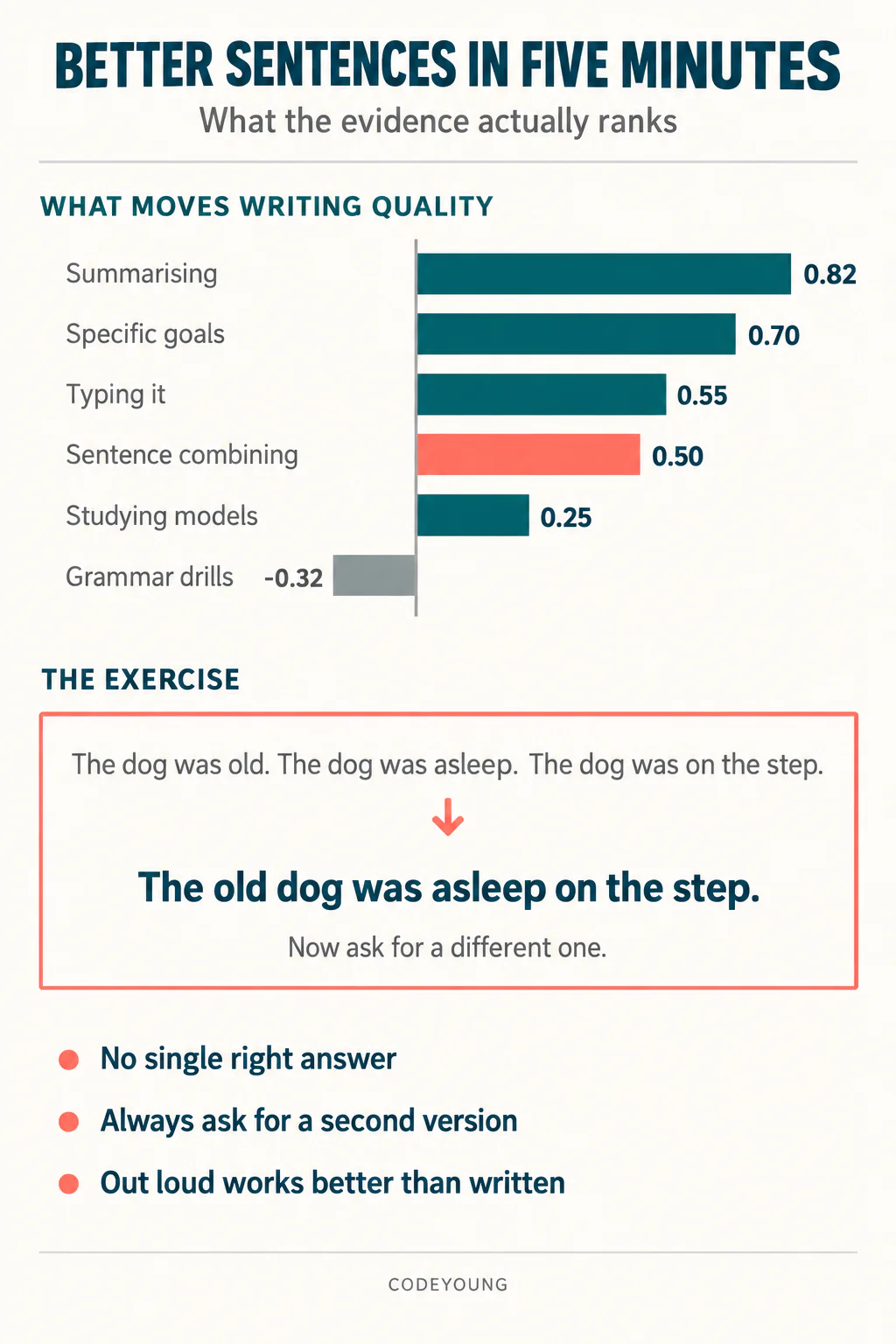
The largest study of this is Writing Next, a 2007 meta-analysis by Steve Graham and Dolores Perin covering pupils in grades 4 to 12. It sorted writing interventions by average weighted effect size, which is a measure of how much a thing actually moves the outcome.
| What was taught | Effect on writing quality |
|---|---|
| Strategy instruction | 0.82 |
| Summarisation | 0.82 |
| Peer assistance | 0.75 |
| Setting specific goals for the piece | 0.70 |
| Word processing | 0.55 |
| Sentence combining | 0.50 |
| Prewriting, inquiry, process writing | 0.32 each |
| Studying models of good writing | 0.25 |
| Traditional grammar instruction | minus 0.32 |
The bottom row is the one worth sitting with. Teaching pupils to identify parts of speech and label clauses did not merely fail to improve their writing. In this body of studies it was associated with writing that got slightly worse, probably because the time came out of the writing itself.
That is not an argument that grammar knowledge is worthless. It is useful for reading closely, for learning other languages and for talking about writing with a teacher. It is an argument that it is a poor lever for the specific job of making a child's sentences better, which is what most parents are actually trying to do when they buy a grammar workbook. You can read the full Writing Next report free from Carnegie Corporation.
Six rows above it sits the thing almost nobody at home has heard of.
Not sure whether your child's writing is behind or just underdeveloped in one area? A free trial class with a Codeyoung teacher shows you exactly where they are and what they are ready for next, before you commit to anything.
Book a Free Trial →Sentence combining, in five minutes
You give the child two or three short, deliberately flat sentences about the same thing. They join them into one good sentence. That is the whole exercise.
Start here:
The dog was old. The dog was asleep. The dog was on the step.
A first attempt usually comes back as The dog was old and asleep and on the step. Accept it, then ask for another one. Second attempts tend to arrive as The old dog was asleep on the step. Ask for a third. Somewhere around here a child produces something like On the step, an old dog slept, and looks slightly surprised at themselves.
Three things make this work, and all three get lost if you turn it into a worksheet.
- There is no single right answer. That is the point. The child is choosing, not recalling, which is why it transfers to their own writing and a grammar exercise does not.
- Ask for more than one version. The first attempt is always the obvious one. The interesting things happen on the third.
- Do it out loud. Especially with younger children. Handwriting is a bottleneck that has nothing to do with the skill you are building.
Once it is going, vary the raw material so the joins vary. Sentences that share a subject push towards adjectives. Sentences with a cause buried in them push towards because and so. Sentences describing two things at once push towards while and as. Every one of those is a connector your child did not previously own.
And use their own writing as the source. Take four consecutive short sentences out of last week's story, put them on a page stripped of everything else, and ask for one sentence. That is when the transfer actually happens.
What to work on at each age
| Age | What you will hear | What to practise |
|---|---|---|
| 6–7 | Very short sentences, mostly one clause | Oral joining only. Two sentences into one, out loud, no writing. |
| 8–10 | Chains of and then | Written combining, three sentences at a time. Collect connectors on a list. |
| 11–13 | Correct but uniform. Every sentence the same length. | Deliberate variation. A long sentence, then a very short one. |
| 14–17 | Competent but flat, or overwritten | Combining and splitting. Which idea deserves its own sentence? |
The 11 to 13 row is where most parents stop noticing a problem, because the writing is no longer wrong. Uniformity is a subtler fault than repetition and it is the one that separates adequate writing from good writing. Rhythm is a real tool, and a child can be taught to use it on purpose. It is one of the things our online English classes for kids work on directly once the basics are secure.
Three more things that beat "write more"
Volume alone does very little. Three interventions from the top of that table translate straight into a kitchen table.
Set one specific goal per piece. Not "make it better". Something countable: this story must contain three sentences that do not start with a name, or it must have one sentence under five words. Specific product goals scored 0.70, and a goal a child can check themselves is worth more than a comment they have to interpret.
Ask them to summarise something. Summarisation scored 0.82, the joint highest in the analysis, and it is the least writing-shaped activity on the list. Have them tell you a film's plot in three sentences. Compressing forces every choice that good sentences require.
Let them type. Word processing scored 0.55. For a child whose handwriting is slow, the keyboard removes a physical constraint that has been quietly limiting how much revising they are willing to do. Revision is where sentences improve, and nobody revises when rewriting means copying the whole page out again.
What not to say
Three habits that undo the work.
Do not correct during the first draft. A child being corrected mid-sentence stops taking risks, and risk is where the third version of the dog sentence comes from. Let the draft end. Then pick one thing.
Do not ask for "more describing words". This produces the other failure mode: sentences stuffed with adjectives that still do not connect to each other. A dull sentence rarely improves by getting longer.
Do not mark everything. A page covered in corrections is read once, briefly, with a sinking feeling. One improvement per piece is genuinely better, because it gets applied. If your child has started saying they are bad at writing, that pattern is usually why, and our post on why children freeze up when they have to perform covers the same dynamic in speaking.
It is also worth checking that the problem is writing at all. A child who reads fluently but does not absorb much of what they read often writes in flat sequences for a related reason, and our guide on reading fluently while missing the meaning is the better starting point if that sounds familiar. For the underlying terminology, our explainer on how parts of speech build sentences is useful for talking about the work, as long as it stays a vocabulary for discussion rather than the exercise itself.
What this comes down to
To help your child write better sentences, stop treating the symptom as a knowledge gap. They do not need to be told what a subordinate clause is. They need practice choosing between ways of joining two ideas, which is a decision rather than a fact, and five minutes of sentence combining a few times a week gives them more of it than a term of labelling exercises will.
Take four short sentences out of something they wrote last week. Ask for one sentence. Then ask for a different one. That is the whole programme, and it works because the child is the one making the choice.
Codeyoung runs 1:1 live online classes for children aged 6 to 17, with a teacher who adapts the pace to your child rather than a fixed syllabus. The first class is free, so you can see how they respond before deciding.
Book a Free Trial