
Your child hands you a page. You read it, and within four seconds your eye has found "becuase" and stopped there. Almost everyone does this, and it is the reason most attempts at giving feedback on a child's writing improve the spelling and nothing else.
Surface errors are visible. Structural problems are not. So parents comment on what they can see, children learn that writing is a spelling test with extra steps, and the part that would actually make the writing better goes unmentioned for years. There is a better order, and it is not complicated.
Why the spelling goes first, and why that is a problem
Misspellings are high-contrast. They interrupt reading in a way a weak paragraph order does not, so the eye lands on them first and the brain files the piece as "needs correcting" before it has assessed anything else.
Two things follow, both bad.
The child learns that the measurable part of writing is accuracy, and starts writing defensively: shorter sentences, safer vocabulary, fewer risks. A child who writes "went" instead of "sprinted" because they are unsure of the spelling has made their writing worse in order to make it more correct. That trade happens constantly and nobody notices.
And the second: once a page has been marked for spelling, the child stops listening. Whatever you say next about their argument or their ending arrives after a judgement has already been delivered. They have moved on.
The order that works: meaning, structure, surface
Work from the outside in. Deal with what the piece is trying to do before touching how it is spelled.
- Meaning. Did it do what you wanted it to do? Is the point clear to somebody who was not there when you thought of it?
- Structure. Does the order help a reader? Is the strongest part buried in the middle? Does the ending stop or just trail off?
- Surface. Spelling, punctuation, capital letters.
The reason for this order is practical rather than philosophical. If the third paragraph is going to be cut, correcting its spelling was wasted work, and worse, the child now has a corrected paragraph they are reluctant to lose. Fixing the surface early makes the deeper changes harder, because effort has been invested in the wrong place.
This is not a home-grown theory. England's national curriculum for English separates the two explicitly. Pupils in Years 5 and 6 are expected to "evaluate and edit by assessing the effectiveness of their own and others' writing" and to "propose changes to vocabulary, grammar and punctuation to enhance effects and clarify meaning", with "proofread for spelling and punctuation errors" listed as a distinct, later activity. Evaluation and proofreading are treated as different jobs.
Not sure which level your child should start at? A free trial class with a Codeyoung teacher shows you exactly where they are and what they are ready for next, before you commit to anything.
Book a Free Trial →Say what worked, and say why
The most useful sentence a parent can produce is not a correction. It is a specific observation about something the child did deliberately.
Compare:
| Not useful | Useful |
|---|---|
| That's lovely. | You ended on a four-word sentence after a long one. That is why it lands. |
| Good description. | You told me the kitchen smelled of burnt toast. That did more than three sentences about the room would have. |
| Nice ending. | You did not explain the ending. Leaving it unexplained is what makes it work. |
The difference is repeatability. "Lovely" tells a child the piece was acceptable. The right-hand column tells them which specific choice produced the effect, and a choice can be made again on purpose next time. That is the entire mechanism by which writing improves.
It also requires you to read properly, which is the hidden cost. You cannot produce the right-hand column while half-watching something else, and children can tell.
Ask one question, not five
A page returned with nine annotations reads as a verdict. A page returned with one question reads as interest.
Children cannot act on nine comments anyway. Working memory does not stretch that far during revision, so what actually happens is that they fix the three easiest and ignore the rest, which are usually the three that mattered least. Choosing for them is more honest and more effective.
Questions that tend to open something up:
- "What did you want me to feel here?"
- "Which bit are you proudest of?"
- "Who is this written for?"
- "What happens if you start at the second paragraph?"
- "Is there a sentence you nearly cut?"
That last one is unusually productive. Children almost always have a sentence they were unsure about, and the conversation about why they kept it is a conversation about audience and effect, which is exactly the territory that is hard to teach directly.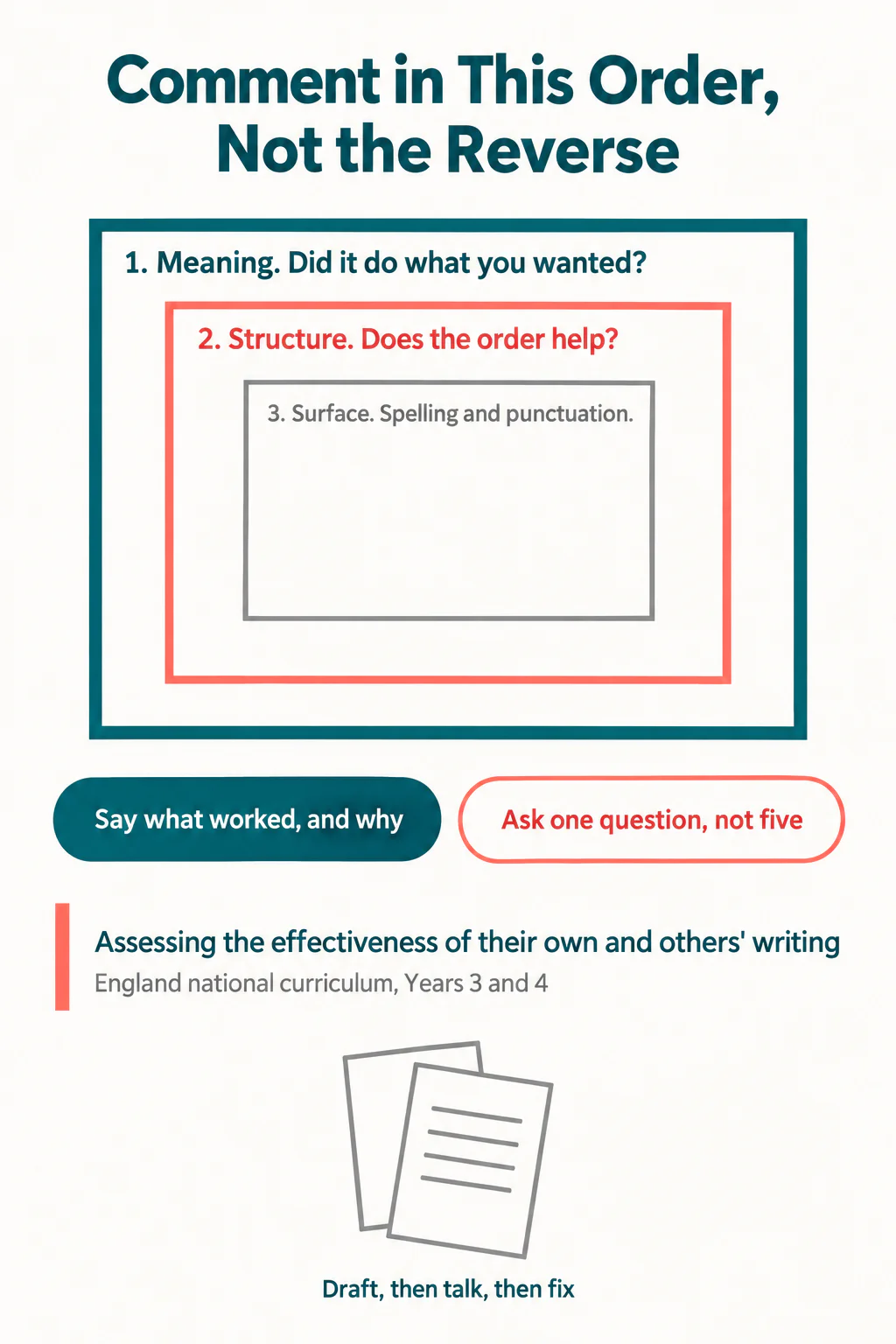
Reading it aloud does most of the work for you
Before any feedback at all, have the child read the piece aloud to you. Not you reading it to them. Them, out loud, from their own page.
Children self-correct as they read. They hit a sentence that does not work and stumble, and the stumble tells them something the page did not. Missing words appear. Repeated openings become obvious. A paragraph that runs on too long simply runs out of breath.
Say nothing while they read. The silence is the technique. Parents who interject at the first stumble remove the only moment where the child notices the problem themselves, which is the moment worth having.
Afterwards, ask what they would change. In our experience most children name at least one real problem unprompted, and a problem a child has identified themselves gets fixed properly rather than patched. This is the same principle we described in how to help your child write better sentences, applied at the level of the whole piece rather than the sentence.
What to expect at each age
Feedback that assumes more capacity than a child has produces defensiveness, not improvement.
| Age | Can respond to | Cannot yet |
|---|---|---|
| 6 to 7 | One concrete suggestion, given warmly, about one sentence | Reordering a piece, or cutting anything |
| 8 to 9 | Questions about clarity, and adding a missing detail | Judging their own writing without a reader present |
| 10 to 11 | Structural suggestions, cutting a weak paragraph | Holding audience in mind consistently throughout |
| 12 plus | Feedback on tone, register and effect on a reader | Taking criticism of a piece they care about calmly, reliably |
Cutting is the hard one. Children under about ten experience deleting a sentence as losing work, because the work was the writing of it. Around ten to eleven that changes, and cutting becomes possible. Asking an eight-year-old to remove a paragraph usually produces tears rather than a better piece, and the ask was simply premature.
Children giving each other feedback
Worth doing, and expected earlier than parents assume. The curriculum asks Years 3 and 4 pupils to evaluate and edit "by assessing the effectiveness of their own and others' writing and suggesting improvements". Peer feedback is a taught skill at age seven or eight, not an advanced extra.
It also does something feedback from an adult cannot. When a sibling or classmate says "I did not understand that bit", the writer receives evidence rather than an opinion. A confused reader is proof the writing was unclear, and it is much harder to argue with than a parent's judgement.
Two rules make it work rather than degenerate:
- The reader says what they understood, before saying anything they liked or disliked. Retelling the piece back is the feedback.
- The writer does not defend. They listen and write down what the reader said, and decide afterwards, alone.
The second rule matters more. A writer who argues during feedback stops receiving it, and the same is true of adults in workplaces. It is a skill worth having early, and it sits close to the argument-structure work we covered in how to teach your child to argue well.
The one thing not to do
Do not rewrite their sentence to show them how it should go.
It is the fastest way to demonstrate the improvement, and it ends the child's ownership of the piece instantly. What they learn is that their version was the wrong version and yours is available on request. The next draft will be written with one eye on what you would have written, which is the opposite of developing a voice.
If a sentence genuinely needs surgery, describe the problem and let them operate. "I lost track of who was speaking here" is actionable and leaves the solution with them. Writing out the fixed version is not feedback, it is co-authorship.
Building real independence in writing is slow, and it is largely what our online English classes are shaped around: a teacher who asks rather than rewrites, one change at a time.
Try it on the next piece
Ask them to read it to you and say nothing until they finish. Then name one thing that worked and why it worked. Then ask one question about meaning. Stop there.
The spelling will still be wrong, and you will find that hard. Leave it for the proofread, which is a separate job done later with a different attitude. A child who believes a parent reads their writing for what it says, rather than for what is wrong with it, keeps showing you their writing. That is worth considerably more than a corrected page.
Codeyoung runs 1:1 live online classes for children aged 6 to 17, with a teacher who adapts the pace to your child rather than a fixed syllabus. The first class is free, so you can see how they respond before deciding.
Book a Free Trial