
A child props a plank on three books, sends a toy car down it, and times the run. Then they add two more books to make it steeper and send the car again. Steeper is faster, they announce, and they are probably right. But on the second run they also started the timer when they let go rather than when the car crossed the floorboard, and used a different car because the first one had rolled under the sofa.
Three things changed. The experiment can only answer a question about one. That is what a fair test is for, and the idea is simpler than the vocabulary around it suggests: change one thing, keep everything else the same, and measure the same way every time. Where it goes wrong at home is almost never the apparatus. It is the measuring.
What this post covers
- What a fair test is, and what controlled variables actually do.
- What the national curriculum expects at each stage, including the word "help" in Years 3 and 4.
- Why the word "fair" itself confuses children, and the phrase that fixes it.
- The mistake that ruins most home experiments, which is a change in procedure rather than in equipment.
- A ten-minute fair test you can run in a hallway, and why not every science question is one.
What is a fair test?
It is a comparison where only one thing is allowed to differ. You pick the thing you want to investigate, change that, hold everything else still, and measure the outcome identically each time. Then any difference you see has only one candidate explanation.
The three jobs have names, and the names are worth knowing mainly so that a parent can follow a school worksheet:
- The thing you change on purpose. One only.
- The thing you measure as a result.
- Everything you keep the same, which is called the controlled variables.
The third category is the one that does the work and the one children skip. A child can usually tell you what they changed and what they measured. Ask what they kept the same and you will often get a pause, because keeping something the same requires no action and so leaves no memory of a decision.
What does the curriculum expect, and when?
The progression here is unusually clear, and knowing it will save you from pushing a child two years ahead of where they should be. The national curriculum programme of study for science sets out working scientifically expectations by stage.
| Stage | What is expected, in the curriculum's own words |
|---|---|
| Key stage 1 Years 1 and 2 | "performing simple tests". Fair tests and variables are not mentioned at all |
| Lower key stage 2 Years 3 and 4 | "setting up simple practical enquiries, comparative and fair tests" and "recognising when a simple fair test is necessary and help to decide how to set it up" |
| Upper key stage 2 Years 5 and 6 | "planning different types of scientific enquiries to answer questions, including recognising and controlling variables where necessary" and "recognise when and how to set up comparative and fair tests and explain which variables need to be controlled and why" |
Three things are worth drawing out of that table.
First, the phrase "help to decide how to set it up". In Years 3 and 4 the child is explicitly a junior partner in the design. An adult is expected to be doing some of the thinking. A parent who hands a nine-year-old a blank method sheet and expects an independently controlled experiment is asking for Year 5 work.
Second, the word "why" arrives only in Years 5 and 6. Before that, a child is expected to recognise that a test should be fair. Explaining which variables matter and giving reasons is a later and much harder task, and it is the one most home-science guides open with.
Third, key stage 1 does not mention fairness. A six-year-old performing a simple test is doing exactly what is asked of them. Introducing variables at that age does not accelerate anything; it attaches vocabulary to an idea the child has no use for yet, and the vocabulary is what they will remember rather than the idea.
Why is "fair" such a confusing word?
Because the child already owns it, and it means something else. Fair, to a seven-year-old, is about people: taking turns, equal shares, nobody cheating. Scientific fairness is about a comparison that nothing else interfered with, which has no moral content whatsoever.
So when a teacher asks whether a test was fair, a proportion of the class is genuinely answering a different question, and answering it well. They will tell you that everybody got a go on the ramp. The confusion is invisible because the words match.
The repair is to run a second phrase alongside the first for a while: "same except for one thing". Ask "was it the same except for one thing?" and the ambiguity disappears, because that question has no social reading. Technical words that collide with everyday ones are a reliable hidden cause of confusion across subjects, and we have written about the maths version of it in the maths words that trip children up.
Not sure which level your child should start at? A free trial class with a Codeyoung teacher shows you exactly where they are and what they are ready for next, before you commit to anything.
Book a Free Trial →The mistake that actually ruins home experiments
Not the equipment. The procedure. Children are reasonably good at noticing that the car should be the same car and the ramp the same plank. What slips through is a change in how they did the measuring, because that does not feel like part of the experiment.
The usual culprits, from watching a lot of kitchen-table science:
- Starting the timer at a different moment. On the let-go, then on the first movement, then when the car passes a floorboard.
- Pushing instead of releasing. A tiny shove on run three, usually unconscious and usually when the child wants a particular result.
- Measuring to a different end point. Where the car stopped, then where it was when they stopped the timer.
- Reading a scale from a different angle, which matters more than children expect with liquids.
- Changing who does it. Two people have different reaction times on a stopwatch, and swapping halfway introduces a variable nobody wrote down.
Every one of those is a changed variable that lives in the method rather than on the table, which is exactly why it survives a tidy-looking plan. A child can fill in the "what I kept the same" box correctly and still have run an unfair test.
So the question worth adding to every home investigation, before the first run, is this: "how exactly will you measure it, and will you do that identically every time?" Write the answer down as a sentence. It takes thirty seconds and it is the difference between an experiment and an activity.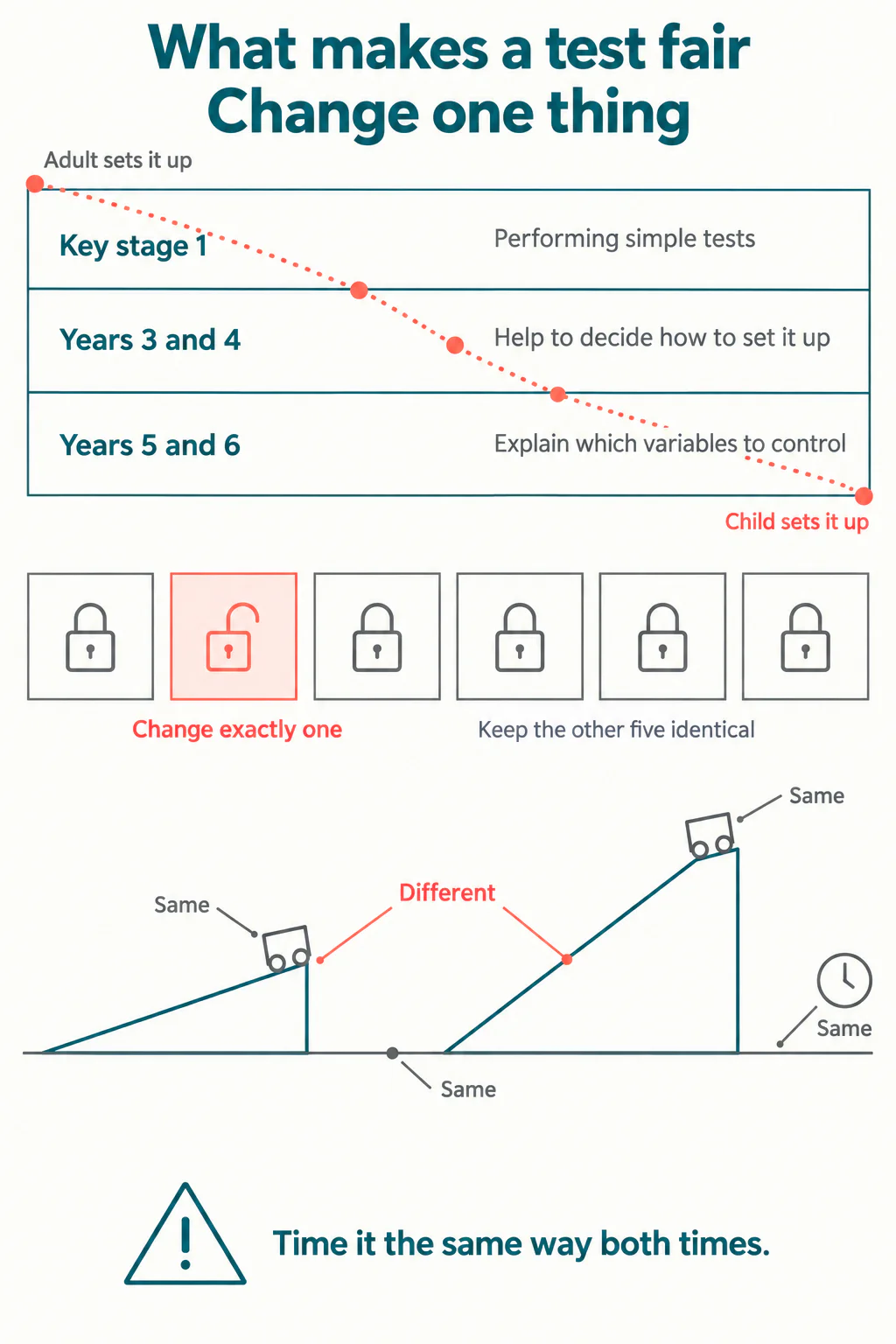
A fair test you can run in ten minutes
Two ramps, one question: does a steeper slope make the car travel further after it leaves the ramp? You need a plank or a stiff piece of card, some hardback books, one toy car and a phone timer.
- Agree the question out loud. Not "let us test ramps" but "does a steeper ramp make the car go further". A vague question cannot be unfair, because it cannot be answered either way.
- Decide the one thing you will change. The number of books under the ramp, so three and then six.
- List what stays the same, on paper. Same car, same plank, same floor, same release point on the ramp, released rather than pushed, same person doing the releasing.
- Decide how you will measure, in one sentence. "Distance from the bottom of the ramp to the front wheels where the car stops, measured with the tape."
- Run it three times at each height. Write down all six numbers, including the odd one.
- Ask what the results show, and what they do not. They may show steeper goes further. They do not show why, and they say nothing about a different car or a carpet.
Step 5 is where the real learning hides. Three runs at the same height will not give three identical numbers, and that surprises children who expect science to be tidy. The variation is the point: it shows them, concretely, why one measurement is not evidence, which is a far better lesson than being told so.
Step 6 is where a nine-year-old becomes a ten-year-old. Saying what a result does not prove is the beginning of the Year 5 and 6 expectation to explain which variables matter and why.
Not every science question is a fair test
Worth saying plainly, because children who have been taught fair tests enthusiastically start trying to force every question into that shape. The curriculum is careful here: variables should be controlled "where necessary", and Years 5 and 6 are asked to plan "different types of scientific enquiries", plural.
| Type of question | Example | Fair test? |
|---|---|---|
| Comparing two conditions | Does a steeper ramp go further | Yes |
| Observing over time | How does this bulb change over six weeks | No, nothing is being compared |
| Identifying and classifying | Which of these leaves are from the same tree | No |
| Pattern seeking | Do taller children have longer arms | No, you cannot control who is tall |
| Researching | Why do some birds migrate | No, it is a secondary-source question |
That bottom section of the table is genuinely useful at home, because it legitimises the science a family can actually do on a Tuesday. Watching a bulb on a windowsill is proper scientific work. It is not a failed fair test. A child who believes all science is a fair test will also assume the pattern-seeking question is badly designed, when the truth is that you cannot assign children their heights and nobody expects you to.
What to say when the results are messy
Say that they are supposed to be, then ask what could have varied. This is a better response than either "try again" or quietly ignoring the inconvenient number.
Messy results are the natural moment to introduce the idea of a repeat measurement, which is the thing that separates a convincing home investigation from a one-off. Three runs per condition is the usual expectation by upper primary. If one number sits far away from its two siblings, that is interesting rather than wrong: ask the child what was different about that run, and quite often they will remember the shove.
Resist the urge to tidy the data. A child who learns that scientists discard results that spoil the pattern has learned something worse than nothing. Our post on reading science diagrams and graphs covers what to do with the numbers once you have them, and passing science tests without understanding the science is about what happens when this reasoning step gets skipped for years.
If a school project is looming rather than a hallway experiment, how much a parent should help with a science fair project deals with the boundary question directly.
What to take away
A fair test changes one thing, keeps everything else the same, and measures identically every time. The curriculum introduces it in Years 3 and 4 with the child helping rather than leading, and asks for controlled variables with reasons only in Years 5 and 6. Before that, simple tests are the whole job.
At home, the thing to watch is not the apparatus but the method. Ask how the measurement will be made, write it in one sentence, repeat each condition three times, and keep the untidy number. That is more rigour than most school investigations manage, and it takes ten minutes in a hallway.
Codeyoung runs 1:1 live online classes for children aged 6 to 17, with a teacher who adapts the pace to your child rather than a fixed syllabus. The first class is free, so you can see how they respond before deciding.
Book a Free TrialOur online science classes for kids are built around investigations rather than recall, which is where this kind of reasoning actually gets practised.