
In one of the most quoted results in primary mathematics, researchers gave this problem to 145 sixth-grade students:
8 + 4 = □ + 5
Every single one of them got it wrong. The paper records it flatly: "all 145 sixth-grade students given this problem thought that either 12 or 17 should go in the box." The answer is 7. Nobody said 7.
These were not struggling children. One sixth-grade teacher told the researchers, "Sure, I will help you out and give this problem to my students, but I have no idea why this will be of interest to you," and then found that all twenty-four of her own students answered 12. She was interested enough to pass it round the rest of her department, which is how the sample reached 145.
The useful part of this story is not that children make a mistake. It is that the mistake is excellent reasoning from the evidence they have been given, and that a first and second grade class taught differently got it right at a rate their sixth-grade counterparts did not come close to.
What does the equals sign actually mean?
It means "is the same as". It is a statement that two quantities have the same value, and it works in both directions. It is not a button. It does not mean "work out what is on the left and put the answer on the right".
That distinction sounds pedantic until you watch what depends on it. A child who reads the sign as "is the same as" can handle 7 = 3 + 4, can accept 8 = 8, can see that 8 + 4 = 7 + 5 without computing either side, and years later can look at 4x + 27 = 87 and know what the task is. A child who reads it as an instruction can do none of those four things.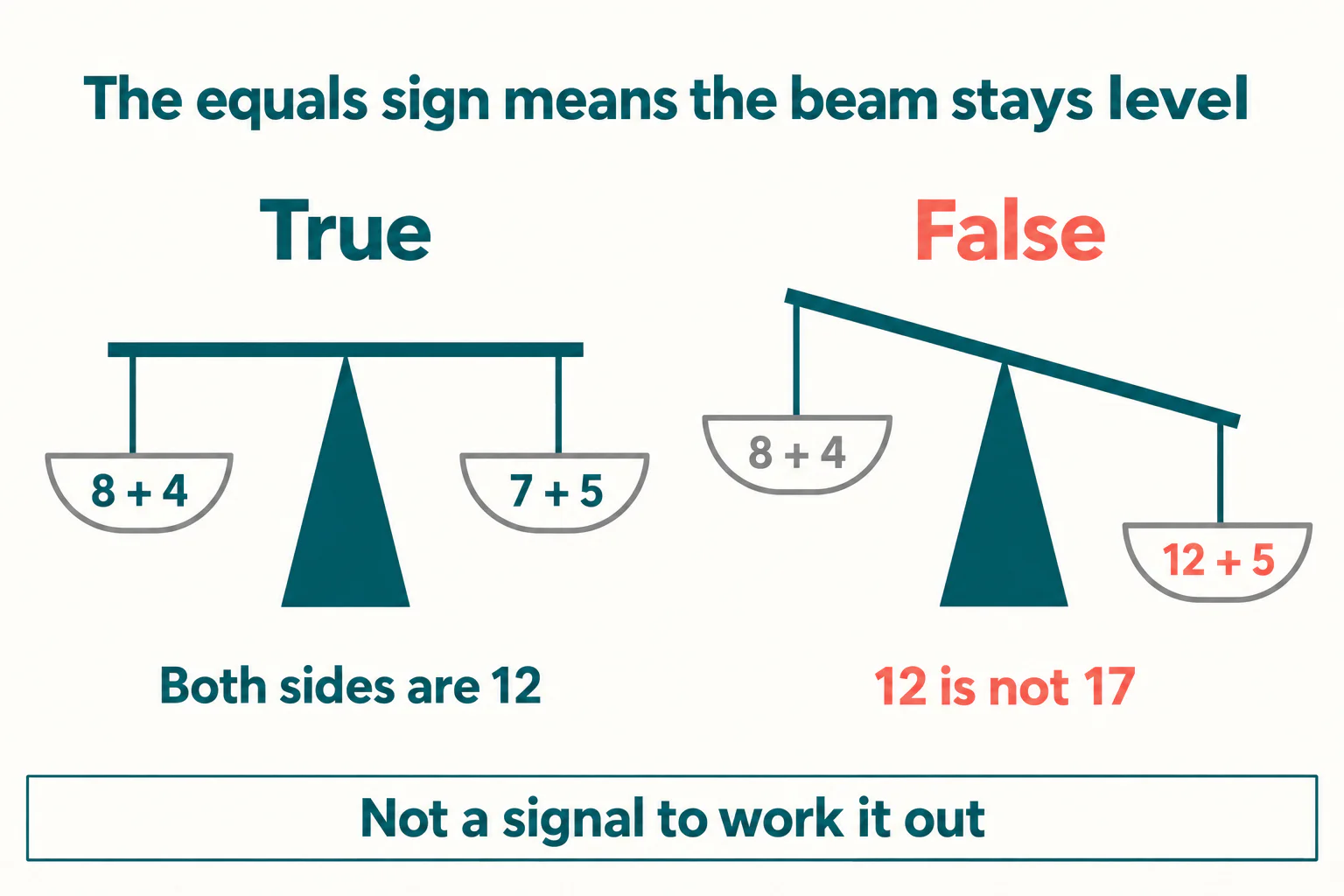
That metaphor is not ours. A first grader named Lillie produced it unprompted: "The equals sign means that it has to be even. The amount has to be the same on each side of the equals sign. It is just like a teeter-totter. It has to be level."
Why do children get this wrong?
Here is the part that should change how you react to the mistake. The researchers point at the cause, and it is not the child:
"Not much variety is evident in how the equals sign is typically used in the elementary school. Usually, the equals sign comes at the end of an equation and only one number comes after it."
Think about what a child has actually seen by the age of eight. Hundreds of sentences shaped 4 + 6 = 10. Dozens shaped 67 - 10 - 3 = 54. In every one of them, the sign is followed by exactly one number, and that number is the answer to the calculation on the left. A child who concludes that the sign means "compute, then write the answer" has formed a rule that fits every example in their experience.
The paper makes this explicit: with sentences like those, "the children are correct to think of the equals sign as a signal to compute." The rule is not sloppy. It is a sound generalisation from a biased sample, which is exactly what a good learner does. The error is in the sample.
That is also why telling a child the correct meaning rarely fixes it. The teacher in the study tried, and reports that "telling the class what the equals sign meant was not, however, sufficient for many children to be able to adopt the standard use of the sign." One correct explanation does not outweigh three years of consistent evidence.
What happened when they changed the teaching
The same project ran the experiment the other way round, with six and seven year olds taught to treat the sign as a relationship from the start. The result sits in the paper's conclusion:
"In a pilot study involving a similar first and second grade classroom in the same town, however, we found that at the end of the year, fourteen out of sixteen children correctly answered that 7 should go in the box."
Fourteen of sixteen six and seven year olds, against nought of 145 sixth graders. The younger children had five fewer years of arithmetic and beat the older ones completely, because they had been given a wider diet of examples rather than more practice on the narrow one.
This is the practical reason to care. A gap that looks like a developmental limit turns out to be a curriculum artefact, and it closes in one school year when somebody addresses it directly.
Gaps like this one are invisible on a marks sheet, because a child can score well on arithmetic while holding a wrong idea about what the symbols mean. A free trial class with a Codeyoung teacher looks at how your child reasons, not just whether the answer matched.
Book a Free Trial →Why showing it with cubes is not enough
The instinct of every good teacher and most parents is to make it physical. The study tried that, and the outcome is the most quietly important finding in it.
A kindergarten teacher gave her class 4 + 5 = □ + 6. All the children said 9. She then built it with them: a stack of four cubes and a stack of five, against a stack of nine and a stack of six. The children could see the two arrangements were not the same, could say which had more, and several children were able to tell the teacher how they could make both groupings have the same number of cubes.
Then she went back to the written equation. "Even after doing this activity, however, the children still thought that 9 should go in the box."
The researchers draw the conclusion carefully: children "may have an appropriate understanding of equality relations involving collections of objects but have difficulty relating this understanding to symbolic representations involving the equals sign." The idea was already there. The symbol is a separate thing to learn, and modelling the idea does not automatically transfer to it.
So the manipulatives are worth using, and they are not the fix on their own. The fix has to happen in the notation.
The method that works: true or false
Instead of asking for an answer, show a number sentence and ask whether it is true or false. This removes the thing that triggers the wrong habit, because there is no box to fill and nothing to compute towards. The teacher in the study used a set like this:
- 4 + 5 = 9
- 12 - 5 = 9
- 7 = 3 + 4
- 8 + 2 = 10 + 4
- 7 + 4 = 15 - 4
- 8 = 8
The first two are easy and every child handles them. Everything after that is where the work happens, and the children's objections are worth knowing in advance because yours will make the same ones.
On 7 = 3 + 4, the class agreed the arithmetic was right and the sentence was still wrong. "But the sentence is wrong.""It's backward.""Yes, but it's the wrong way." They are not disputing the maths. They are disputing the grammar, which tells you precisely what they think the symbol is for.
On 8 + 2 = 10 + 4, some children said true, because 8 + 2 does equal 10 and they stopped reading there. Children with a firm grasp explained that 8 + 2 is 10, 10 + 4 is 14, and 10 is not the same as 14.
On 8 = 8, the class was genuinely unsettled. One child spoke for all of them: "Well, yes, eight equals eight, but you just shouldn't write it that way."
Two things make this work at a kitchen table. There is no right answer to produce, so a child who is wrong is not failing at arithmetic. And the false sentences do more than the true ones, because explaining why something is false forces the child to compare both sides.
This is not an enrichment activity. It is a Grade 1 standard. Common Core 1.OA.D.7 reads: "Understand the meaning of the equal sign, and determine if equations involving addition and subtraction are true or false. For example, which of the following equations are true and which are false? 6 = 6, 7 = 8 - 1, 5 + 2 = 2 + 5, 4 + 1 = 5 + 2." Those four examples are almost exactly the study's set. The method has been the official expectation for years, and sixth graders still answer 12.
Why this decides whether algebra lands
The paper names the stake directly: a lack of this understanding "is one of the major stumbling blocks for students when they move from arithmetic to algebra."
Take 4x + 27 = 87. A child reading the sign as "compute the left and write the answer" is stuck before they start, because the left side cannot be computed. There is no number to produce. The only way in is to see the sentence as a claim that two things are the same, and then to do the same thing to both sides to keep it true. Every technique in early algebra is a variation on that one move.
The same class later met a = b + 2 and was asked which letter was larger. The answers show what the groundwork buys: "a has to be bigger because whatever b + 2 is has to be higher than b because you combine them.""Together they have to be the same; b + 2 has to be the same as a." Those are seven year olds reasoning about variables, and they can only do it because the equals sign is a relationship to them.
Worth being clear about the boundary here. This is a post about one symbol. The separate problem of words that mean different things in maths and in ordinary English is covered in the maths words that trip children up. And the skill of checking whether a result is plausible at all sits in is this answer sensible. The equals sign is upstream of both.
What to do this week
Four steps, and the first one takes thirty seconds.
- Test it. Write 8 + 4 = □ + 5 and hand it over. Say nothing. If the answer is 12 or 17, you have found the gap, and you have found it in good company.
- Do not correct it. Ask what the equals sign means. The explanation you get is the thing you are actually working on.
- Switch to true or false and use the six sentences above. Three or four minutes, a few times a week. Argue about the false ones.
- Change the shape of the sentences you write from then on. Put the total first sometimes. Leave the box in different places. Write a sentence with an operation on both sides. The narrow diet caused this, and widening it is the cure.
Once the sign is secure, the ideas that build on it become available, and bar models in particular get much easier, because a bar model is a picture of two things being the same. For a child who is finding the transition hard rather than just unfamiliar, how to tell whether a child is genuinely behind in maths is the better next read.
Putting it together
The equals sign means "is the same as", and a great many children who are perfectly good at arithmetic believe it means "work it out". They believe it because every sentence they were shown was consistent with that reading, which makes it a teaching problem rather than a learning one.
It is also a cheap problem to fix. Six number sentences, a few minutes, and an argument about whether you are allowed to write 8 = 8. The children in that study who had those arguments at six were doing better on the test problem than children five years older who had not. Start with the box, listen to the explanation, and widen the diet.
Codeyoung runs 1:1 live online classes for children aged 6 to 17, with a teacher who adapts the pace to your child rather than a fixed syllabus. The first class is free, so you can see how they respond before deciding.
Book a Free TrialSources: Karen P. Falkner, Linda Levi and Thomas P. Carpenter, "Children's Understanding of Equality: A Foundation for Algebra", Teaching Children Mathematics 6(4), December 1999, pages 232 to 236. All quotations and figures above are from that paper, read in full. The true-or-false method it describes builds on Robert Davis (1964), and the paper cites Behr, Erlwanger and Nichols (1975) and Kieran (1981) on the arithmetic-to-algebra transition. Standard 1.OA.D.7 quoted from the Common Core State Standards for Mathematics. Both sources checked 30 October 2026. Our online maths classes build reasoning before formal method.