
Three tests dominate gifted and talented screening in American schools, and parents are usually told the name of theirs about a week before the test happens. CogAT, NNAT3 and OLSAT 8 are treated as interchangeable ability tests. They are not. They sample different abilities, score on different scales, and were built to find partly different children.
That has a practical consequence worth knowing before results arrive: a child can clear the qualifying cutoff on one of these and miss it on another, without anything about the child having changed. This guide sets out what each test actually asks a child to do, what the reported numbers mean, and the two details that quietly decide who qualifies.
Which three tests are we talking about?
All three are group administered ability tests used for gifted screening, and all three cover kindergarten through grade 12. The similarity ends there.
| Test | Publisher | What it measures | Main score reported |
|---|---|---|---|
| CogAT Form 8 | Riverside Insights | Verbal, quantitative and nonverbal reasoning | Standard Age Score, age percentile rank, age stanine, Ability Profile |
| NNAT3 | Pearson | Nonverbal general ability only | Naglieri Ability Index, 40 to 160 |
| OLSAT 8 | Pearson | Verbal Scale and Nonverbal Scale | School Ability Index, percentile rank, stanine |
Sources: Riverside Insights and Pearson Assessments product documentation, checked 13 October 2026.
CogAT spans ten levels. OLSAT 8 spans seven. NNAT3 is language free by design, which is the single most important fact about it and the reason many districts added it.
What does each test actually ask a child to do?
This is where the differences stop being administrative. The item types are genuinely different kinds of thinking.
CogAT: nine subtests in three batteries
CogAT splits into three batteries, each containing three subtests. Riverside Insights describes them as follows.
- Verbal Battery.Verbal Analogies, where children examine a pair of words, work out the relationship, and apply it to a third word. Sentence Completion, where they read an incomplete sentence and choose the best ending. Verbal Classification, where they find what three words have in common and pick a fourth that belongs.
- Quantitative Battery.Number Analogies, the same reasoning as verbal analogies using quantitative concepts. Number Puzzles, where an equation has missing elements the child must supply. Number Series, where a sequence follows a rule the child has to identify first.
- Nonverbal Battery.Figure Matrices, where the child derives a rule from existing figures and applies it. Paper Folding, where they choose how a folded and punched sheet looks unfolded. Figure Classification, where they decide how three figures are alike and pick a fourth.
Two of those nine deserve a parent's attention. Paper Folding is close to pure mental rotation and is the subtest that most often surprises families, because children who are strong at school can find it genuinely hard. Number Puzzles is early algebraic thinking in disguise, which is why children who have only ever done arithmetic procedures sometimes stall on it.
NNAT3: one ability, no words at all
NNAT3 is a nonverbal measure of general ability built around progressive matrices of shapes and patterns. There is no reading, no vocabulary and no arithmetic. Pearson is explicit about why that design exists: it aids identification of gifted students with what it calls unique challenges, naming English Language Learners, students with dyslexia and twice exceptional students.
Read that the right way round. NNAT3 is not an easier test. It is a test that removes a specific barrier, so that a child whose reasoning is strong but whose English or decoding is not can still show the reasoning.
OLSAT 8: two scales, reported together
OLSAT 8 has a Verbal Scale and a Nonverbal Scale, with verbal, nonverbal and quantitative item types across seven levels. It reports a School Ability Index along with percentile rank and stanine, and it provides those by age and also by grade, which turns out to matter more than it sounds.
Not sure which level your child should start at? A free trial class with a Codeyoung teacher shows you exactly where they are and what they are ready for next, before you commit to anything.
Book a Free Trial →Why a 130 on one test is not a 130 on another
Here is the correction that almost nobody makes, and it changes how a score letter should be read.
CogAT's Standard Age Score has a mean of 100 and a standard deviation of 16. So does the Naglieri Ability Index on NNAT3, which runs from 40 to 160 and places about 68 percent of children between 84 and 116, and about 95 percent between 68 and 132.
The familiar individually administered IQ tests, the Wechsler scales among them, use a standard deviation of 15. A parent who has met one of those numbers before will read a Standard Age Score of 130 as the same thing, and it is not. On a 16 point scale, 130 is 1.88 standard deviations above the mean. On a 15 point scale, 130 is 2.00. The gap is small in the middle of the distribution and gets practically important exactly where cutoffs live, near the 95th and 98th percentiles.
So when a district policy says "a score of 130 or above", the first question is which test produced it. The number alone does not define the bar.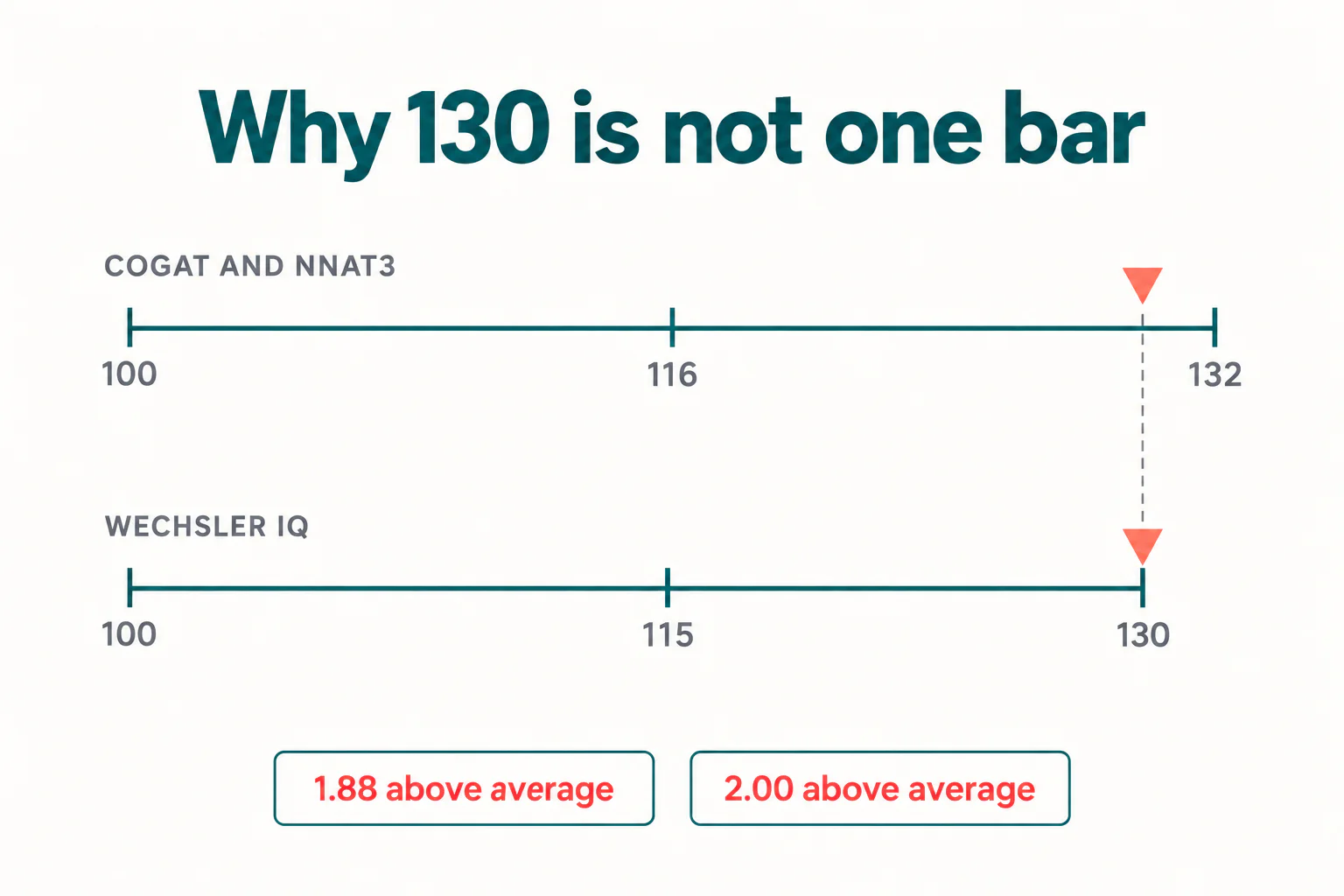
The two details that quietly decide who qualifies
Beyond the test name, two administrative choices do more to determine outcomes than most parents realise.
Composite score or single battery
CogAT reports a composite across the three batteries, and it also reports an Ability Profile, an index unique to CogAT that identifies the pattern across the batteries rather than the average of them. The profile exists because averaging hides unevenness.
Consider a child at the 99th percentile on the Quantitative Battery and the 70th on the Verbal. The composite lands somewhere in the high 80s and misses a 95th percentile cutoff. Nothing in that composite tells you a mathematically exceptional child just walked past the gate. Districts that screen on composite alone will miss that child every time, and districts that look at battery scores or the Ability Profile will not. It is worth asking which yours does.
Age norms or grade norms
CogAT's Standard Age Score compares a child to others of the same age in months from the national sample. OLSAT 8 reports percentile rank and stanine by age and by grade.
Those two comparisons produce different answers for the same child. A September born child in a year group is among the oldest in the grade but is compared only to children of the same age under age norms, which removes the maturity advantage that grade norms leave in place. For a summer born child the effect runs the other way. Neither approach is wrong; they answer different questions. But a score reported against grade norms and a score reported against age norms are not comparable, and parents are rarely told which they are holding.
What should a parent actually do with this?
Four questions, asked of the right office, will tell you more than any amount of general reading about gifted testing.
- Which test and which form? CogAT Form 8, NNAT3 and OLSAT 8 are different instruments with different item types.
- What is the cutoff, and is it a percentile or an index score? A percentile is unambiguous. An index score needs the scale attached to it.
- Composite only, or are battery scores considered? This decides whether a spiky profile is visible.
- Age norms or grade norms, and are local norms used? Local norms compare a child to their own district rather than to the national sample.
On preparation, the honest position is narrower than the practice test industry suggests. Showing a child the item formats once, so that Paper Folding is not the first time they have seen a folded sheet with a hole punched through it, removes confusion that has nothing to do with ability. That is fair. Drilling for weeks is a different proposition: it can move a score into a programme whose daily pace then does not fit the child, and the child pays for that every day afterwards.
Where the reasoning these tests measure actually comes from
None of these tests examine a syllabus. They sample reasoning: spotting a rule in a sequence, holding a transformation in mind, working out what a set of things has in common. Those are the same operations a child uses when they work out why a program loops one time too many, or why a pattern in a number series breaks at the fourth term.
That is the useful connection for a parent, and it has nothing to do with test preparation. Children who regularly reason about structure, in puzzles, in mathematics, or in code, are practising the thing being measured rather than the format it is measured in. Our collection of IQ style questions for children and our set of brain teaser riddles with answers both work on exactly these patterns, and our piece on building logical thinking for modern learning covers the longer term habit.
A gifted screening is one morning. The reasoning it samples is built over years, and 1:1 maths classes that keep asking a child why something works, rather than drilling a procedure, do more for it than any practice booklet.
What the score is, and what it is not
CogAT, NNAT3 and OLSAT 8 each give a real and useful reading of how a child reasons on one morning, with one set of item types, against one comparison group. A high score is good information. A score a point under a cutoff is also information, and it is usually information about the test and the norming choice rather than about the child.
Ask which test, which cutoff, composite or battery, and which norms. Those four answers turn a confusing letter into something you can act on. Then put the letter in a drawer and get back to the part that actually compounds, which is a child who is regularly asked to explain why.
Codeyoung runs 1:1 live online classes for children aged 6 to 17, with a teacher who adapts the pace to your child rather than a fixed syllabus. The first class is free, so you can see how they respond before deciding.
Book a Free TrialSources checked 13 October 2026: Riverside Insights CogAT test descriptions; Pearson NNAT3.