
Many parents wonder if their 6-year-old is too young for coding, yet foundational computer science frameworks show that children can grasp core computational concepts as early as kindergarten. The K-12 Computer Science Framework, supported by organizations like Code.org, highlights how concepts like sequencing and loops can be introduced through play. This makes the age 5-7 window an ideal starting point for engaging, activity-based learning.
Key Takeaways
- For children aged 5 to 7, the best first steps in coding involve engaging with play-based, visual programming tools that align with their interests.
- Parents should observe signs of readiness in their child, such as problem-solving skills and curiosity, before introducing coding.
- Introduce simple, age-appropriate coding projects and monitor screen time to ensure a balanced learning experience.
- The ideal coding path for young children depends on their individual personality, family budget, and specific learning objectives, not a universal "best" option.
What programming options are there for 5 to 7 year olds?
Choosing the right starting point depends entirely on your child's personality, your family's budget, and your learning goals. A 5-year-old who loves building with LEGOs might respond differently than a 7-year-old who enjoys creating detailed stories. There is no single "best" option, but there is a best fit for your specific situation.
Educational research consistently finds that students receiving one-on-one instruction perform significantly better than those in traditional classroom settings. Codeyoung is built on this principle, making expert 1:1 tutoring accessible and affordable so every child gets the focused attention they need to succeed.
To find the perfect fit, consider the following pathways. You can even combine them.
- If your child learns best with direct, personalized guidance: Choose a 1:1 live tutoring program. At Codeyoung, a dedicated instructor works with your child on Zoom, adapting the pace and projects to their interests in real-time. This avoids the frustration of getting stuck that often occurs with self-led apps.
- If you have a limited budget or want to test the waters first: Start with free, self-directed visual coding apps like ScratchJr. These are excellent tools for unstructured play and exploration, but they require a high degree of parent involvement to explain concepts and troubleshoot problems.
- If your child is highly social and enjoys group dynamics: A small group class, like those offered by providers such as CodeWizardsHQ, could be a good fit. The trade-off is less individual attention compared to a 1:1 model, and the class must move at a pace set for the entire group, not your individual child.
- If your primary goal is building foundational logic through storytelling: Focus on platforms that prioritize animation and narrative. Instead of abstract puzzles, your child can build projects like an interactive comic strip or a simple cartoon, making the logic of sequencing and events feel intuitive and fun.
- If you suspect your child might be gifted or advanced: A diagnostic assessment is the best first step. Codeyoung’s free trial class includes a placement diagnostic that identifies your child's current understanding and learning style, allowing us to create a truly personalized curriculum from day one.
Many families find a hybrid approach works best. Your child might use a free app for creative play during the week and then have a 1:1 session with a Codeyoung instructor to tackle bigger concepts and build more complex projects. The key is to match the format to your child's immediate needs.
What are the best play-based, visual coding tools for 5 to 7 year olds?
For children aged 5 to 7, learning to code should feel like playing. Abstract lines of text-based code are developmentally inappropriate and frustrating for this age group. Instead, the focus should be on visual, block-based environments where kids can drag and drop commands to see immediate results. This approach aligns with teaching standards from organizations like the Computer Science Teachers Association (CSTA), which advocate for using age-appropriate tools to introduce computational thinking.
At Codeyoung, we've taught over 50,000 students across more than 15 countries using this philosophy, achieving an 80%+ course completion rate because the learning is fun. Our curriculum is built around our CREATOR pedagogy, where instructors act as mentors who guide students through a process of Creation, Reflection, and Exploration. This is supported by our proprietary practice platform, Noah AI, which provides students with engaging, adaptive exercises between live sessions to reinforce concepts without feeling like homework.
The goal is to connect coding concepts to tangible, exciting outcomes. Rather than explaining what a "loop" is with a dry definition, an instructor will help a child make their favorite character dance, a visual and memorable demonstration of a repeating action.
Here are some examples of play-based visual coding in action:
- Creating an Interactive Story: A child can choose a character and a background, then use code blocks to make the character walk, talk, and react when clicked. They are learning about event-based programming and sequencing.
- Designing a Simple Game: Students can build a basic maze game where they program a character to move up, down, left, and right to reach a goal. This introduces problem-solving and algorithmic thinking.
- Animating Their Own Name: A popular first project is making the letters of their name change color, spin, or grow. It’s a personal and highly motivating way to learn about loops and properties.
- Building a Virtual Pet: Children can program a pet that needs to be "fed" (by clicking on it) and "played with" (by making it move), teaching the basics of state and variables in a relatable context.
| Tool | Type | Best for | Free or paid |
|---|---|---|---|
| ScratchJr | Block-based, Visual coding app | Unstructured play and exploration, Simple interactive stories and games, Learning sequencing and events | Free |
| Scratch | Block-based, Visual coding platform | Learning fundamental programming concepts (loops, conditionals, variables), Creating complex games and animations, Progression within block-based coding | Free |
| Block-based Visual Coding Environments | Visual, Block-based, Drag-and-drop commands | Play-based learning, Immediate results, Introducing computational thinking, Age-appropriate learning for 5-7 year olds | Free (many options) |
What is a simple first coding project for a 6 year old?
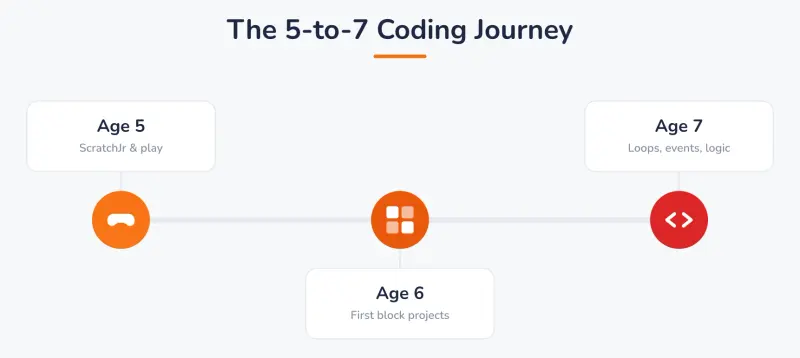
One of the best ways to introduce a young child to coding is with a project that is simple, visual, and instantly gratifying. Let’s imagine building a "Chase Game" in a block-based environment like ScratchJr. This project is perfect for a 6-year-old because it involves characters, movement, and a clear goal.
The story of the game is simple: a cat needs to chase a mouse. The first step is choosing the sprites, which are the characters. The child selects the cat and the mouse from the character library. Next, they pick a fun background, perhaps a garden or a living room. This step alone gives them creative ownership of the project.
Then, the coding begins. The child learns how to attach code blocks to the mouse sprite. They might use a "start on green flag" block, followed by a "move right" block repeated several times. When they click the green flag, they see the mouse scurry across the screen. This is a powerful moment where they see their instructions create an immediate, visible result.
Now for the cat. The child gives the cat a similar set of instructions to move across the screen. The challenge, which a Codeyoung instructor would guide them through in a live 1:1 Zoom session, is figuring out how to make the cat "catch" the mouse. This introduces a new concept: collision detection, or what ScratchJr calls "bumping." The child adds a block that says, "on bump, make mouse disappear."
When they run the program again, the cat moves, bumps into the mouse, and the mouse vanishes. They have built a complete, interactive game with a beginning, middle, and end. Every one of our sessions is recorded, so you and your child can re-watch this breakthrough moment and use the recording as a guide to build new versions of the game later, perhaps with different characters or speeds.
What are the signs that my young child is ready to start coding?
You don't need to wait for your child to ask about building websites to know they might be ready for coding. The foundational skills for programming often appear as natural play patterns and ways of thinking. If you recognize these behaviors in your 5, 6, or 7-year-old, they likely have the right mindset to enjoy and benefit from a structured introduction to computational thinking.
Look for a deep interest in cause and effect. This could be as simple as repeatedly pressing a button on a toy to see what happens or lining up dominoes to watch them fall. They are experimenting with inputs and outputs. Similarly, a love for building with blocks like LEGOs or Magna-Tiles demonstrates an intuitive grasp of sequencing and spatial reasoning, skills that are directly applicable to arranging code blocks.
A child who creates detailed rules for their own games or tells elaborate, sequential stories is already thinking like a programmer. They are designing systems and algorithms. If they enjoy puzzles, riddles, or board games that require planning ahead, they are practicing the logical thinking and problem-solving that sit at the heart of coding.
Here are a few specific signs your child might be ready:
- They enjoy sorting and categorizing. A child who meticulously organizes their toys by color, size, or type is practicing classification and data management, a key concept in computer science.
- They ask "what if" questions. If your child wonders, "What if we built the tower this way instead?" or "What if the car had six wheels?" they are exploring variables and testing different outcomes.
- They can follow multi-step instructions. A child who can successfully follow a recipe to bake cookies or assemble a multi-part toy has demonstrated the ability to execute a sequence of commands, which is the definition of an algorithm.
- They show persistence when solving a problem. If a LEGO creation falls apart, do they give up or try to rebuild it stronger? This resilience is crucial for debugging, the process of finding and fixing errors in a program.
If you see these signs, the best way to confirm their readiness is with our free trial class. It includes a placement diagnostic designed to see how your child approaches problems, allowing us to gauge not just what they know, but how they think.
How much screen time is right when kids start coding?
The conversation about screen time often misses a critical distinction: the difference between passive consumption and active creation. An hour spent watching videos on a tablet is fundamentally different from an hour spent building an interactive story or solving a coding puzzle. When a child is coding, they are not zoning out; they are engaged in a mentally stimulating activity that involves problem-solving, critical thinking, and creativity.
For a 6-year-old, a balanced approach is key. We recommend starting with focused coding sessions of 45 to 60 minutes, once or twice a week. This is long enough to make meaningful progress on a project without leading to fatigue or burnout. These sessions should be treated as dedicated learning time, just like a music lesson or sports practice.
It's also important to integrate "unplugged" activities that reinforce computational thinking away from a screen. Playing a board game like Ticket to Ride teaches strategic planning. Following a complex recipe in the kitchen is an exercise in executing an algorithm. Building a model car from a kit requires following a sequence of detailed instructions. These activities build the same mental muscles as coding.
The goal is to ensure that screen-based coding is a high-quality, interactive part of a varied intellectual diet. Instead of setting a simple, universal time limit, focus on the nature of the activity. If your child finishes a coding session feeling excited, proud of what they built, and eager to share it with you, that is a positive sign that the screen time was a valuable investment in their cognitive development.
What are the most common questions about early coding for kids?
The most common questions parents ask about early coding for kids typically center on when to start, what tools to use, how to gauge readiness, and what constitutes the "best" learning path. For children aged 5 to 7, the ideal first steps involve engaging play-based, visual programming tools that naturally align with their budding interests, fostering creativity and logical thinking through engaging play. Before diving in, observe your child for signs of readiness such as developing problem-solving skills and a natural curiosity, then introduce simple, age-appropriate projects while carefully monitoring screen time to ensure a balanced and healthy learning experience. Remember, the perfect coding journey is not a universal recommendation but a unique adventure tailored to your child’s individual personality, your family’s budget, and your specific learning objectives.