Coding Bootcamp for Kids: Worth It or Not?
With so many intensive programs promising quick results, parents often ask if a coding bootcamp for kids is really helpful or just too much pressure. It can be confusing to decide what is best for a child.
Many parents feel excited when they see children building apps and games in just a few weeks. Fast learning sounds great, but before enrolling your child, it is important to understand the benefits, drawbacks, costs, age needs, and other options. This article helps parents decide whether a boot camp is the right choice for their family.
Intensive Learning: Is a Coding Bootcamp Worth It?
A coding bootcamp is very different from regular weekly classes. These programs fit months of learning into a short time. Classes are often held daily, especially during breaks. Learning happens through projects where students solve real-world problems and create things like websites, games, or apps.
Unlike regular courses that move slowly, bootcamps place students in a fast-paced setting. The aim is to build practical skills quickly. Many bootcamps use a focused curriculum that gives more importance to hands-on learning than theory.
The biggest difference between a boot camp and weekly programming classes is intensity. A bootcamp creates an immersive learning environment where code is the main focus. This helps students learn faster, but it also needs strong commitment from students and parents.
Understanding the Accelerated Learning Model
The accelerated learning model works through full focus and practice. When students spend many hours each day on programming, they stay focused and learn faster. The intensive nature of this method helps improve coding skills through repetition and quick use of what they learn.
However, fast learning does not work for everyone. Students need readiness, attention, and interest in technology. The ability of problem solving by themself is important when learning moves quickly. Without these skills, the pace can feel stressful.
A bootcamp experience needs strong focus. Unlike traditional education, bootcamp students study only coding for six months. This helps some students learn faster, but others may find it tiring if they need variety.
The Pros and Cons of a Coding Bootcamp
Understanding coding bootcamp benefits, along with possible problems, helps parents make better choices based on their child’s learning style and needs.
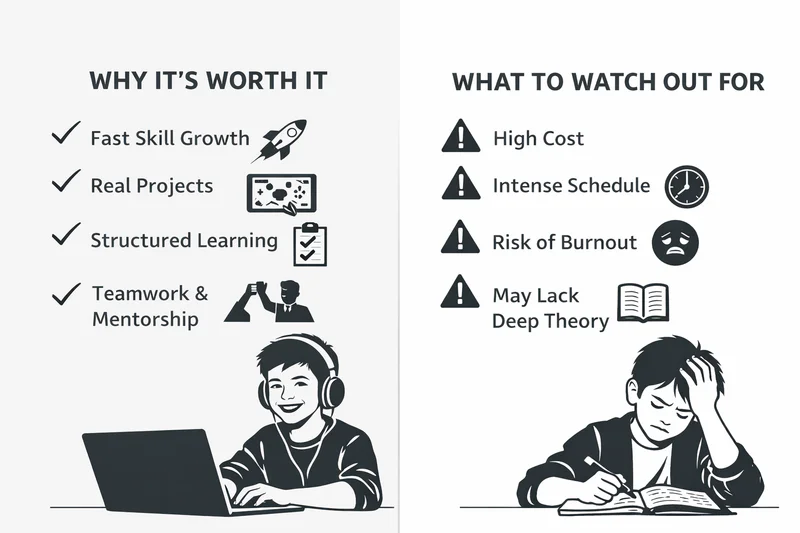
Benefits of Bootcamps:
Speed and Efficiency: Bootcamps are designed to shorten learning time. They help students gain new skills quickly and see results faster than regular classes.
Project-Based Learning: Students create real projects that they can proudly show others. This builds confidence and clearly shows their ability to potential employers or schools.
Career Support: Many bootcamps offer guidance such as resume help and connections to the tech world, which regular courses may not provide.
Structured Environment: A fixed schedule helps students build discipline, manage time better, and learn to work under deadlines.
Community and Networking: Students become part of a team with shared interests, improving teamwork and communication skills useful in software development.
Industry-Relevant Skills: Bootcamps teach in-demand skills and different programming languages needed in today’s job market.
Drawbacks to Consider:
Cost: Fees can be high, sometimes costing hundreds or even thousands of dollars.
Intensity: The fast pace can feel stressful, especially for beginners.
Depth vs. Breadth: Short programs may focus on speed, which can leave knowledge gaps in understanding.
Limited Flexibility: Fixed schedules may not suit every family.
Age Appropriateness: Not every child has the skill level for such an immersive learning environment.
Immersion vs. Burnout: Is Your Child Ready?
A child’s emotional and mental readiness is often more important than age when thinking about boot camp enrollment for future career growth or to handle the job market.
Signs your child may thrive:
Shows a strong interest in technology and asks questions about how programs work
Can work on their own and complete projects without constant help
Does not give up easily and can handle frustration when facing challenges
Warning signs of potential burnout:
Quickly loses interest when tasks become difficult or take too much time
Feels tired or stressed when schedules become busy
Has had a bad experience with accelerated programs in the past
A positive attitude toward learning and the ability to self-study are important signs of bootcamp success.
Comparing Options: Coding Bootcamp vs. Online Courses
The choice between bootcamps and online courses depends on learning style, time, and family needs.
Bootcamps work best when your child likes structure, clear deadlines, and instructor guidance. They are helpful if you want fast skill growth, portfolio projects, and career support. Bootcamps also suit families who can follow a fixed schedule and children who enjoy teamwork and group learning. Coding bootcamps offer structured pathways that can prepare students for computer science studies or early career exploration.
Online courses are better when a child prefers learning at their own pace. They are good for beginners starting their coding journey, families with busy schedules, or tight budgets.
Many families start with online courses to build foundations, then choose bootcamps to gain bootcamp benefits safely. This combination approach helps balance the opportunity cost of intensive learning with the need for solid fundamentals.
Practical Considerations: Cost and Age Requirements
When parents look at boot camps, two main concerns come up: cost and age rules.
Cost Factors: A coding bootcamp for kids cost depends on length and format. Short camps may cost a few hundred dollars, while longer programs can cost much more. Parents pay not just for lessons, but for quality programs that include expert instructors, small classes, career services, tools, and project guidance. Some programs offer financial aid to make opportunities more accessible. Choosing the right program matters because poor learning wastes time and money; understanding bootcamp tuition structures helps families budget effectively.
Age Requirements: Most bootcamps accept students around 10–12 years old, though rules differ. Younger kids need gentle learning, while teen programs are more serious and may prepare students for the tech field. Skill level matters more than age; prior experience can help children excel, while beginners may need more time to code comfortably.
Setting Realistic Expectations for Post-Bootcamp Skills
It is important to set clear expectations after a boot camp. Most students gain foundational knowledge in one or two programming languages, confidence to solve coding problems, and portfolio projects that show specific skills. They also learn basic web development, software engineering, or computer science ideas, along with soft skills like teamwork and communication. Bootcamps also give exposure to the tech world and career options.
However, students usually do not gain mastery of programming or guaranteed job placement. A bootcamp does not replace a computer science degree or deep theory. According to labor statistics, entry-level positions in software development typically require either a college degree or substantial professional experience. Bootcamps provide starting points rather than complete credentials.
Many experienced developers started with bootcamps, then kept learning through practice, courses, and real projects. Bootcamp graduates succeed when they continue learning and improving their knowledge over time. The bootcamp experience should be seen as one step in a longer education journey, not a complete solution.
Conclusion: So, Are Coding Bootcamps Worth It for Kids?
Are coding bootcamps worth it for kids? The answer depends on the child and family situation. Bootcamps are helpful when the right conditions align.
Coding bootcamps work best when your child is motivated and ready, and when expectations remain realistic. Bootcamps help create foundations, not instant experts.
Learning must continue through education, practice, and exploration. The format should match the child’s learning style, and the family can manage logistics like time and cost.
Many students benefit from boot camps that provide strong fundamentals, practical skills, and confidence for software development or computer science paths. What matters most is long-term education, regular code practice, and growing problem-solving skills, not speed or pressure.
Frequently Asked Questions
Can bootcamp graduates get a job without a college degree?
Some bootcamp graduates do enter the tech industry without computer science degrees, but it is harder for young students. Adult bootcamp students may get entry-level roles through portfolio work and professional experience. For kids, boot camps serve educational purposes and usually support higher education, though the boot camp experience strengthens future applications.
How do bootcamps compare to earning a computer science degree?
A computer science degree offers deep theory, math, and a broad education, while boot camps focus on practical, job-ready skills. For kids, bootcamps support learning but do not replace formal education. Many professionals combine both to gain hands-on skills and long-term credibility in the tech field.
Will my child be able to change careers later because of a bootcamp?
Coding education and bootcamps help build career flexibility, but they don’t guarantee specific jobs. Students with strong coding skills gain confidence and adaptability. A focused curriculum and immersive learning environment support growth, but long-term success depends on experience, continued learning, and more than just one program.