
There is a juried prize for children's mathematics books, awarded every year by a panel of mathematicians, teachers and librarians, sorted into five age bands. It has existed since 2015. Almost none of the best math books for kids lists online mention it, which is a strange thing to leave out when the work of selection has already been done properly by people qualified to do it.
This guide uses that prize as its backbone, adds the small number of older books that have genuinely survived, and then says something most book lists avoid: the research usually cited to prove that maths books raise achievement is disputed in the journal that published it. That does not make the books a bad idea. It changes what you should expect from them, and the honest reason to buy one is better than the advertised one.
Start with the prize, not the listicle
The Mathical Book Prize is awarded by the Simons Laufer Mathematical Sciences Institute, formerly MSRI, one of the largest mathematics research institutes in the United States. It is presented in partnership with the National Council of Teachers of English and the National Council of Teachers of Mathematics, and in coordination with the Children's Book Council.
Two details make it more useful than an ordinary recommendation list. The first is who judges: the selection panel is "drawn from librarians, teachers, mathematicians, early childhood experts, and others", so a book has to survive readers who know the mathematics and readers who know children. The second is the eligibility bar, which states that "both literary merit and mathematical interest must be present". That rule quietly removes the entire category of books that are really worksheets with illustrations.
The prize sorts winners into five bands: PreK, Grades K to 2, Grades 3 to 5, Grades 6 to 8, and Grades 9 to 12. That structure solves the problem with most book lists, which is that they drift towards picture books for four-year-olds and leave the 9 to 13 band, where attitudes to mathematics actually harden, almost empty.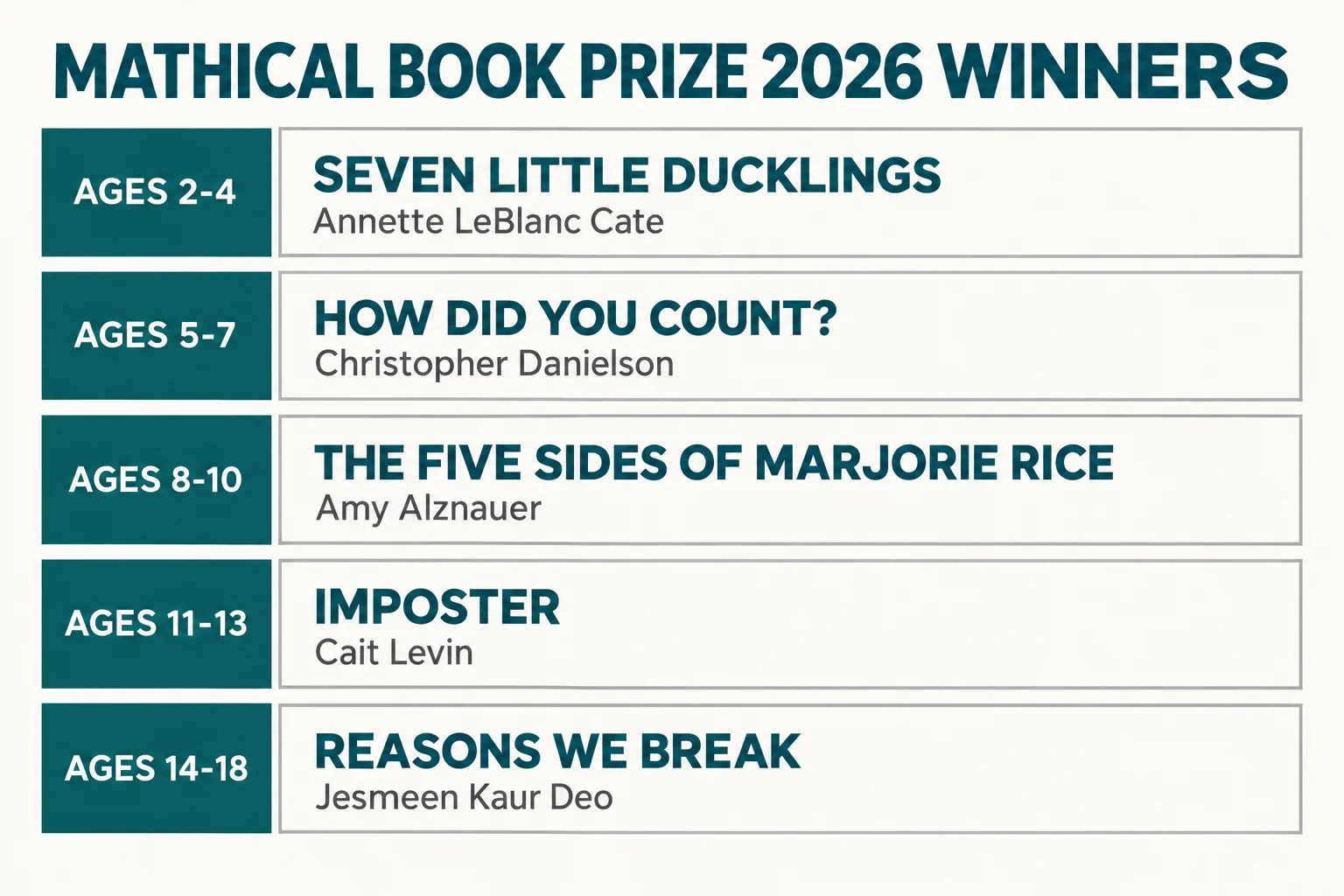
The 2026 winners, by age
The 2026 list was announced on 19 February 2026, adding 30 books for ages 2 to 18. These are the category winners.
| Age band | Winner | Author | Publisher |
|---|---|---|---|
| PreK, ages 2 to 4 | Seven Little Ducklings | Annette LeBlanc Cate | Candlewick Press |
| Grades K to 2, ages 5 to 7 | How Did You Count? | Christopher Danielson | Stenhouse Publishers |
| Grades 3 to 5, ages 8 to 10 | The Five Sides of Marjorie Rice: How to Discover a Shape | Amy Alznauer, illustrated by Anna Bron | Candlewick Press |
| Grades 6 to 8, ages 11 to 13 | Imposter | Cait Levin | Charlesbridge |
| Grades 9 to 12, ages 14 to 18 | Reasons We Break | Jesmeen Kaur Deo | Disney-Hyperion Books |
Two of these deserve a note for parents scanning the table. How Did You Count? is built on a question rather than a fact, which is unusual for the age group: it asks children how they arrived at a number, not what the number is. That is the difference between arithmetic and mathematics, introduced at five.
The Five Sides of Marjorie Rice is the story of an amateur mathematician with no university training who discovered new types of pentagon that tile the plane, working at her kitchen table. For a child who has decided that mathematics belongs to other people, a true story about somebody who was not supposed to be able to do it is worth more than another puzzle book.
Do maths books actually work?
Here is where most lists make a claim they cannot support, so it is worth setting out carefully.
The study everybody cites
In 2015 a team published "Math at home adds up to achievement in school" in Science, a randomised trial in which around 587 first-grade children and their families were given either a maths story app or a reading app. The reported result was a gain in maths achievement for the maths group, with the largest effects among children whose caregivers described themselves as anxious about mathematics. It has been quoted in parenting coverage ever since.
The reply almost nobody cites
In March 2016, Science published a Comment by Michael C. Frank reanalysing the same data. Frank found no mistakes in the original calculations, but concluded that the trial did not show a significant effect of the intervention on maths performance, with the disagreement turning on how interaction effects should be interpreted and tested. The original authors published a Response standing by their conclusions. The dispute has never been resolved, and it sits in the same journal as the headline.
What this means for a parent buying a book
Do not buy a maths book expecting a measurable jump in test scores, because that claim is contested. Buy it for the thing the research does support more consistently, which is the relationship a child has with the subject. That is not a consolation prize. For most children between 8 and 13 the binding constraint is not knowledge, it is whether they think of themselves as a person who can do mathematics, a point we come back to in maths anxiety in kids.
Not sure which level your child should start at? A free trial class with a Codeyoung teacher shows you exactly where they are and what they are ready for next, before you commit to anything.
Book a Free Trial →Why reading beats helping, if maths makes you anxious
There is a second finding that changes how a parent should use these books, and it is sturdier than the first.
A 2015 study in Psychological Science by Maloney, Ramirez, Gunderson, Levine and Beilock followed 438 first and second graders and their primary caregivers across a school year. Children of maths-anxious parents learned less mathematics over the year and were more anxious about it by the end. But the effect appeared only when those parents frequently helped with maths homework. Where anxious parents helped rarely, their children's achievement was not related to the parents' anxiety at all.
The parents' own mathematical knowledge made no difference. Their anxiety did.
Read against that, a maths book is not a weaker substitute for sitting down with homework. It is a different activity with a different risk profile. Homework help puts an anxious adult in the position of judging a child's answers in real time, which is exactly the situation that transmits the anxiety. A book puts the adult and the child on the same side of the page, with the question coming from a third party. There is nothing to mark. If you were taught to dread this subject, helping with maths homework when you hated maths covers the rest of that problem.
The older books that have actually survived
Four books predate the prize or sit outside it and still earn shelf space. All four do something the newer titles mostly do not.
- Really Big Numbers, Richard Evan Schwartz. The inaugural 2015 Mathical winner, and unusually it took the prize in both the Grades 3 to 5 and Grades 6 to 8 categories. It walks upward through magnitude until the numbers stop being imaginable, which is a genuine mathematical experience rather than a fact to learn.
- The Number Devil, Hans Magnus Enzensberger, illustrated by Rotraut Susanne Berner, first published in German in 1997 and in English in 2000. Twelve dreams, one per night, covering prime numbers, Fibonacci sequences and infinity. Reading age roughly 9 to 12, and still close to unmatched for a child who wants the real thing without a textbook.
- Math Curse, Jon Scieszka, illustrated by Lane Smith, Viking, 1995. A child wakes up seeing every ordinary situation as a maths problem. Nominally for ages 3 to 7, routinely enjoyed by children well past that, and the best short argument that mathematics is a way of looking rather than a subject.
- The Boy Who Loved Math: The Improbable Life of Paul Erdős, Deborah Heiligman, illustrated by LeUyen Pham, Roaring Brook Press, 2013, ages 4 to 8. A biography of a mathematician who could not manage ordinary life and did extraordinary mathematics. It makes the subject human, which is the hardest thing on this list to do.
If biography is what lands with your child, that lane extends well past books: mathematician movies for kids and the history of algebra both work on the same instinct, which is that mathematics was made by people and can therefore be joined.
How to read one without turning it into homework
The method matters more than the title, and it is almost entirely about restraint.
Read it as a story the first time
No pausing to check understanding, no "so what would three more be". The first read establishes that this is a book, not an assessment. A child who suspects a test is coming reads defensively, and defensive reading is where the pleasure goes.
Let the book ask the questions
Good mathematics books are built around questions already. Your job is to leave the silence after one rather than filling it. If your child answers wrongly, say what they noticed that was right and read on. The correction can wait, and often the next page does it for you.
Stop early
Close the book while the child still wants another chapter. Twenty minutes that ends with a request is worth more than forty that ends with relief, and it is the single easiest adjustment on this page.
Matching a book to a child
Age band is the starting point, not the decision. Three rough cases cover most children.
The child who thinks they are bad at maths. Go for story and biography rather than puzzles. The Five Sides of Marjorie Rice and The Boy Who Loved Math both work because the mathematics arrives attached to a person. A puzzle book here reads as another opportunity to be wrong.
The child who is quick and bored. Go for ideas that school will not reach for years. Really Big Numbers and The Number Devil both give a fast child somewhere to go upward instead of sideways into more of the same exercises.
The child who likes stories and tolerates maths. Go for fiction where the mathematics is in the plot rather than the margin, which is what the Grades 6 to 8 and 9 to 12 Mathical categories increasingly select for. Imposter sits exactly there.
What to do with this list
Pick one book from the right age band, read it as a story, and ask nothing. If your child is between 8 and 13, that band is where the prize list is strongest and where most other lists are thinnest, so start there rather than with another counting book.
Expect a change in how your child talks about mathematics before you expect a change in their marks. That is the effect the evidence actually supports, and for a child who has decided the subject is not for them it is the one that matters. Our 1:1 online maths classes are built on the same order of operations: the confidence first, the formal method once the idea has landed.
Codeyoung runs 1:1 live online classes for children aged 6 to 17, with a teacher who adapts the pace to your child rather than a fixed syllabus. The first class is free, so you can see how they respond before deciding.
Book a Free TrialSources checked 24 October 2026: Mathical Book Prize, about the award; 2026 Mathical winners announced; Berkowitz et al., "Math at home adds up to achievement in school", Science, 2015; Frank, Comment on the same, Science, 11 March 2016; Maloney et al., "Intergenerational Effects of Parents' Math Anxiety on Children's Math Achievement and Anxiety", Psychological Science, 2015.