
A child reads a word problem, spots the word "altogether", adds the two numbers, and gets it wrong. Not because the arithmetic failed, but because nobody was ever taught to work out what the problem is asking before deciding what to do with the numbers.
Bar models fix that specific failure. A bar model is a rectangle whose length stands for a quantity, and arranging those rectangles turns the relationship inside a word problem into something a child can see. Known in many US classrooms as a tape diagram or strip diagram, it is the single most useful piece of maths equipment I teach, and it is also the one most often taught backwards.
What a bar model actually is
One rule holds the whole method together: length represents amount. A bar twice as long means twice as much. That is it.
From that rule, two shapes cover the majority of primary and lower-secondary word problems.
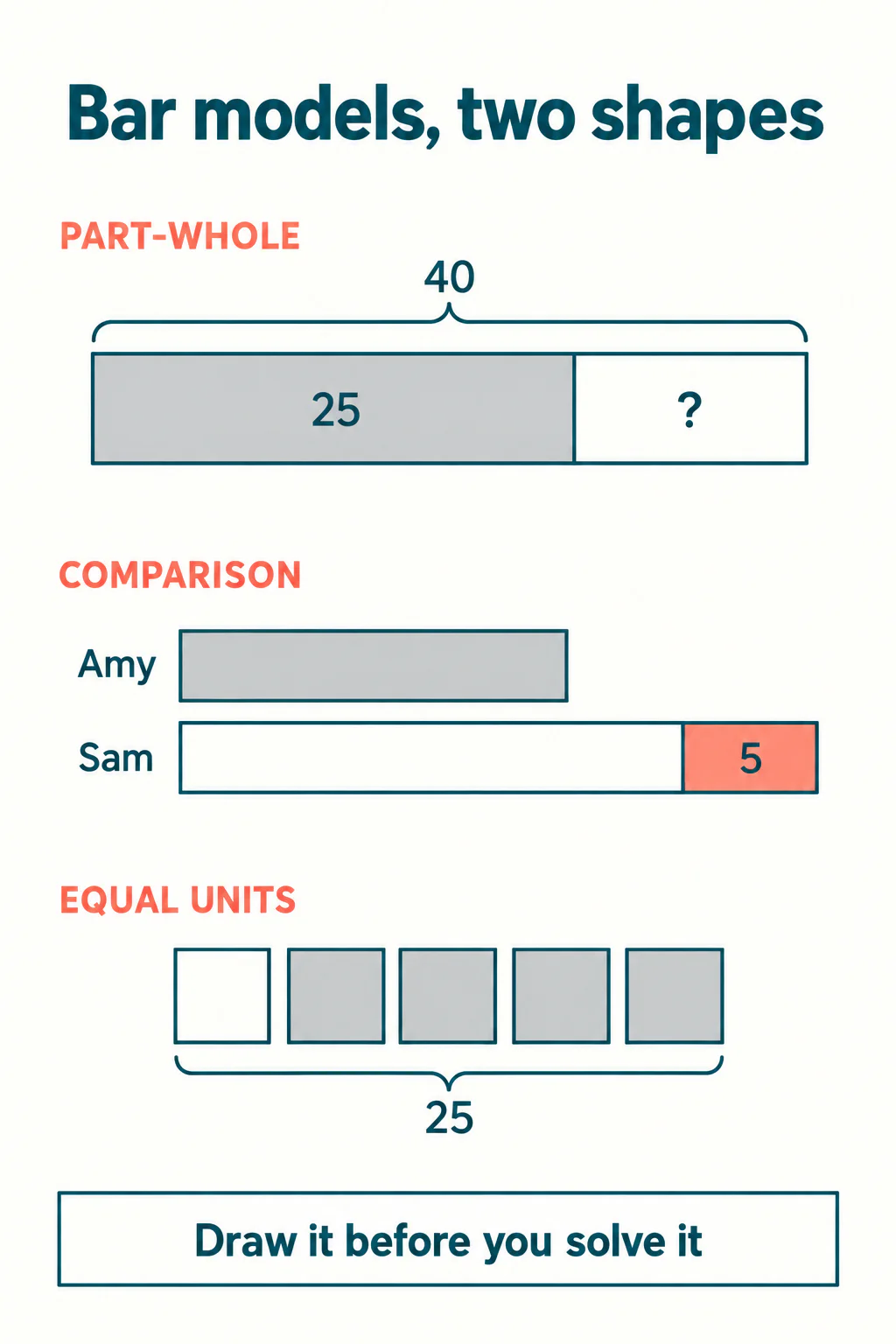
Part-whole. Pieces sit end to end and together make a total. Use it whenever quantities combine: two groups joined, one group removed from a total, a total split into parts.
Whole: 40
[------- 25 -------][--- ? ---]
Comparison. Two bars sit one above the other, aligned on the left. The overhang is the difference. Use it whenever a problem says more than, fewer than, twice as many, or the difference between.
Amy   [---------- 12 ----------]
Sam   [---------- 12 ----------][-- 5 --]
Before solving anything, a child only has to answer one question: is this a stacking problem or a comparing problem. Getting that right is most of the work, and it is precisely the judgement that keyword-spotting destroys.
Does drawing pictures actually raise attainment?
This is worth being careful about, because plenty of classroom techniques feel useful and do nothing measurable.
The US Institute of Education Sciences published a What Works Clearinghouse practice guide, Improving Mathematical Problem Solving in Grades 4 Through 8, which makes five recommendations and rates the evidence behind each one. "Teach students how to use visual representations" carries the guide's top rating, Strong Evidence. Only two of the five recommendations reached that level.
That is a considered claim rather than an enthusiastic one, and it comes with a condition attached that matters more than the headline. The representation has to be used as part of solving the problem. A picture drawn after the answer is already known teaches nothing, and children are extremely good at producing exactly that when a teacher asks for working.
The English national curriculum lands in the same place from a different direction, asking that pupils "become fluent in the fundamentals of mathematics, including through varied and frequent practice with increasingly complex problems over time", and that pupils who are not sufficiently fluent should "consolidate their understanding, including through additional practice, before moving on". Bar models are a consolidation tool as much as a problem-solving one.
Five problems, five models
1. Part-whole, missing part. A class of 40 children, 25 have school lunch, how many bring a packed lunch. Draw the whole bar as 40, mark 25, and the missing piece is visibly a subtraction. A child who wrote 40 + 25 has now seen why that cannot be right, which is worth more than being told.
2. Comparison. Sam has 5 more marbles than Amy. Together they have 29. How many does each have. Two bars, Sam's longer by 5. Remove the 5 from the total and what remains is two equal bars: 24 ÷ 2 = 12. Amy has 12, Sam has 17. Most ten-year-olds cannot set this up algebraically and almost all of them can draw it.
3. Multiplication as equal units. A book costs 4 times as much as a pen, and together they cost £25. Draw the pen as one unit and the book as four identical units. Five units in total, so one unit is 5. The phrase "4 times as much" has become four boxes, which is the same idea with the abstraction removed.
4. Fractions of a quantity. Three fifths of the 35 children in a club are girls. Split the bar into five equal parts, each worth 7, shade three of them. The answer is 21 and the structure of the fraction is now visible: the denominator says how many pieces, the numerator says how many you take. Our guide to fractions uses the same picture for comparing and adding them.
5. Ratio. Money is shared between two children in the ratio 3:2, and there is £40 altogether. Five units, one unit is 8, so the shares are 24 and 16. Ratio problems collapse the moment a child sees that a ratio is an instruction about how many boxes to draw.
Not sure which level your child should start at? A free trial class with a Codeyoung teacher shows you exactly where they are and what they are ready for next, before you commit to anything.
Book a Free Trial →The problem type where bar models beat everything else
Here is the class of problem that makes the method worth the effort of learning.
Ravi had three times as much money as Leena. After Ravi spent £60, they had the same amount. How much did Ravi start with?
An adult writes 3x − 60 = x and solves it. An eleven-year-old who has not met algebra usually stops here entirely.
With bars: draw Ravi as three units and Leena as one. Ravi spends £60 and the two are now equal, so the £60 removed exactly two of Ravi's units. One unit is 30. Ravi started with 90.
No equation, no rearranging, and no loss of rigour. Two-step and multi-step problems are where children most often stall, and the reason is usually that they lose track of the relationship halfway through rather than that they cannot calculate. We wrote about that specific stall in why children stop halfway through a two-step word problem.
What to expect at each age
| Age | Model | Typical problem |
|---|---|---|
| 6 to 7 | Part-whole with numbers to 20 | 7 red counters and some blue ones, 15 altogether |
| 7 to 8 | Comparison | Sam has 5 more than Amy |
| 9 to 10 | Equal units, multiplication and division | A book costs 4 times as much as a pen |
| 10 to 11 | Fractions and percentages of amounts | Three fifths of the club are girls |
| 11 to 13 | Ratio, before and after, then the bridge to algebra | Shared in the ratio 3:2; Ravi spends £60 |
Treat that as a sequence rather than a timetable. A child who has never drawn a bar model can start at the top of the list at any age, and usually should, because the comparison model is much harder to understand if the part-whole model is not already automatic.
Four mistakes that stop bar models working
Drawing after solving. The most common one, and it turns a thinking tool into handwriting practice. If your child can tell you the answer before the pencil moves, the problem was too easy for the method, not a sign the method is unnecessary.
Bars not to scale. A bar representing 30 drawn shorter than one representing 12 breaks the only rule the method has. It does not need to be accurate to the millimetre. It needs to be obviously longer.
Unlabelled bars. A picture of three rectangles with no words is not a model of anything. Each bar gets a name, and the thing being asked for gets a question mark. This sounds fussy and it is the difference between a model that survives to the second step and one that does not.
Reading half the question. Children draw the first sentence, then discover the second sentence changes the picture. Read the whole problem, then draw. It is a habit worth being strict about, and it pairs with the habit of asking whether the final answer is sensible, which we covered in checking whether an answer makes sense.
How to use this at home in five minutes
You do not need to know the method better than your child does. You need three questions, asked in this order, before any numbers are written.
- What do we know? Every number in the problem, and what each one counts.
- What are we asked to find? One thing, usually. Mark it with a question mark on the drawing.
- Is this stacking or comparing? Parts making a whole, or two amounts set against each other.
Then hand the pencil over. The temptation to draw it yourself is strong and the drawing is the part that does the teaching, so resist it. If a child draws it wrong, that is the most useful thing that can happen in the whole exercise, because now there is something specific to talk about.
One more thing worth knowing: some of what looks like a maths problem is really a reading problem. Words such as difference, product, share and of carry technical meanings that collide with everyday ones, and a child who mishears "the difference between" as ordinary English will draw the wrong picture with perfect confidence. We wrote about that collision in the maths words that trip children up, and it pairs closely with everything above.
Where it leads
The reason to invest in bar models at nine is what happens at thirteen. A bar split into equal units, with one unit unknown, is already an equation. Rename the unit as x and the picture becomes 3x − 60 = x without anything new being learned.
Children who arrive at algebra having drawn hundreds of these tend to treat the letter as standing for a quantity they could point to. Children who arrive without them often treat x as a mysterious symbol with its own rules. That difference shows up years later, in how willing a student is to attempt an unfamiliar problem.
Build the reasoning first and the formal method lands on top of something solid. Teach the formal method first and you get a student who can follow steps and cannot start.
What to do with this
Pick one word problem from this week's homework and draw it before solving it. Ask the three questions, decide whether it stacks or compares, label the bars, and only then calculate. Do that for a fortnight and you will see whether your child's difficulty is arithmetic or comprehension, which are two very different problems with two very different fixes. Our wider piece on strategies for solving maths word problems sits alongside this one.
If the drawings keep coming out wrong in the same way each time, that pattern is diagnostic and worth a second pair of eyes. A teacher watching a child draw learns more in ten minutes than a marked worksheet reveals in a term, which is the case for working through it with someone rather than around it.
Codeyoung runs 1:1 live online classes for children aged 6 to 17, with a teacher who adapts the pace to your child rather than a fixed syllabus. The first class is free, so you can see how they respond before deciding.
Book a Free TrialOur online maths classes teach the reasoning first and the formal method once the concept has landed, which is exactly the order this method assumes.
Sources: Institute of Education Sciences, What Works Clearinghouse, Improving Mathematical Problem Solving in Grades 4 Through 8 (2012, revised 2018); Department for Education, national curriculum in England: mathematics programmes of study. Both checked 24 September 2026.