
The AMC 8 runs from 21 to 27 January 2027, and the cheapest registration deadline for the schools that host it is 28 October 2026. If your child's school is not already a competition site, the window to fix that quietly closes over the next two weeks, and most parents do not find out until January.
There is a second problem, and it catches almost everyone. You cannot register your own child. The Mathematical Association of America registers institutions, not families, and a great deal of parent-facing writing about the AMC gets this wrong in a way that costs families an entire competition cycle.
What the AMC 8 actually is
The AMC 8 is a 25-question, 40-minute competition for students in grade 8 and below, run by the Mathematical Association of America. Over 300,000 students across all 50 states and more than 30 countries take some level of the AMC each year.
The syllabus is middle school mathematics used in unfamiliar ways: counting and probability, estimation, proportional reasoning, elementary geometry including the Pythagorean theorem, spatial visualisation, and reading graphs and tables. Later questions can touch beginning algebra, such as linear or quadratic functions and coordinate geometry. Nothing on it requires content your child has not met. The difficulty is in recognising which idea applies.
The 2026-27 dates and deadlines
Every deadline below falls at 11:59 pm Eastern on the date shown. These are the dates a site must meet, not your child.
| Milestone | AMC 8 | AMC 10 and AMC 12 |
|---|---|---|
| Early bird registration | 28 October 2026 | 30 September 2026 (passed) |
| Regular registration, last chance for a new site | 5 January 2027 | 15 October 2026 |
| Late registration, returning managers only | 14 January 2027 | 28 October 2026 |
| Competition date | 21 to 27 January 2027 | 5 November and 13 November 2026 |
| Grade limit | Grade 8 and below | Grade 10 or grade 12 and below |
| Age limit on competition day | Under 15.5 years | Under 17.5 or under 19.5 years |
| Length | 25 questions, 40 minutes | 25 questions, 75 minutes |
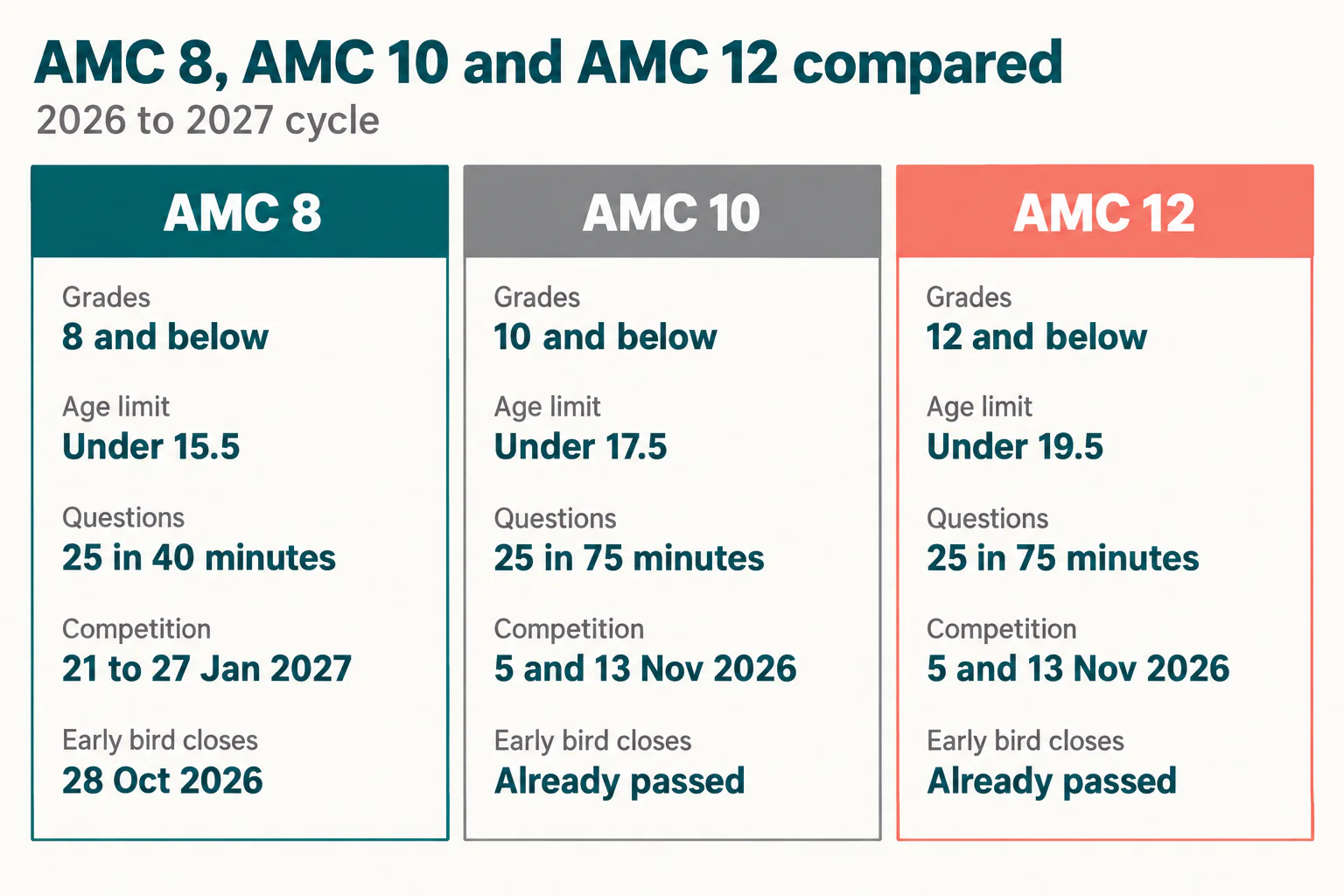
Two things in that table are easy to miss. The AMC 8 is a week, not a day, and each site chooses its own date inside it, so ask your school which day it has picked. And the row that actually binds is the second one: after 5 January 2027 a school that has never hosted the AMC 8 cannot register at all, no matter what it is willing to pay.
Why you cannot register your own child
This is the part that costs families a year. The MAA licenses the competition to competition sites, and each site appoints a Competition Manager who registers it, orders student licences, proctors the exam and distributes results. Only then does that manager send parents a link to register their own students.
The eligibility rules for a site are specific. Schools, universities, learning centres and math circles may host. Home schools are not eligible to be competition sites, and the policy states plainly that the AMC may not be administered at a personal residence. A competition manager must be an adult affiliated with the site who is not related to, and not the legal guardian of, any student competing there, which rules out a parent proctoring their own child.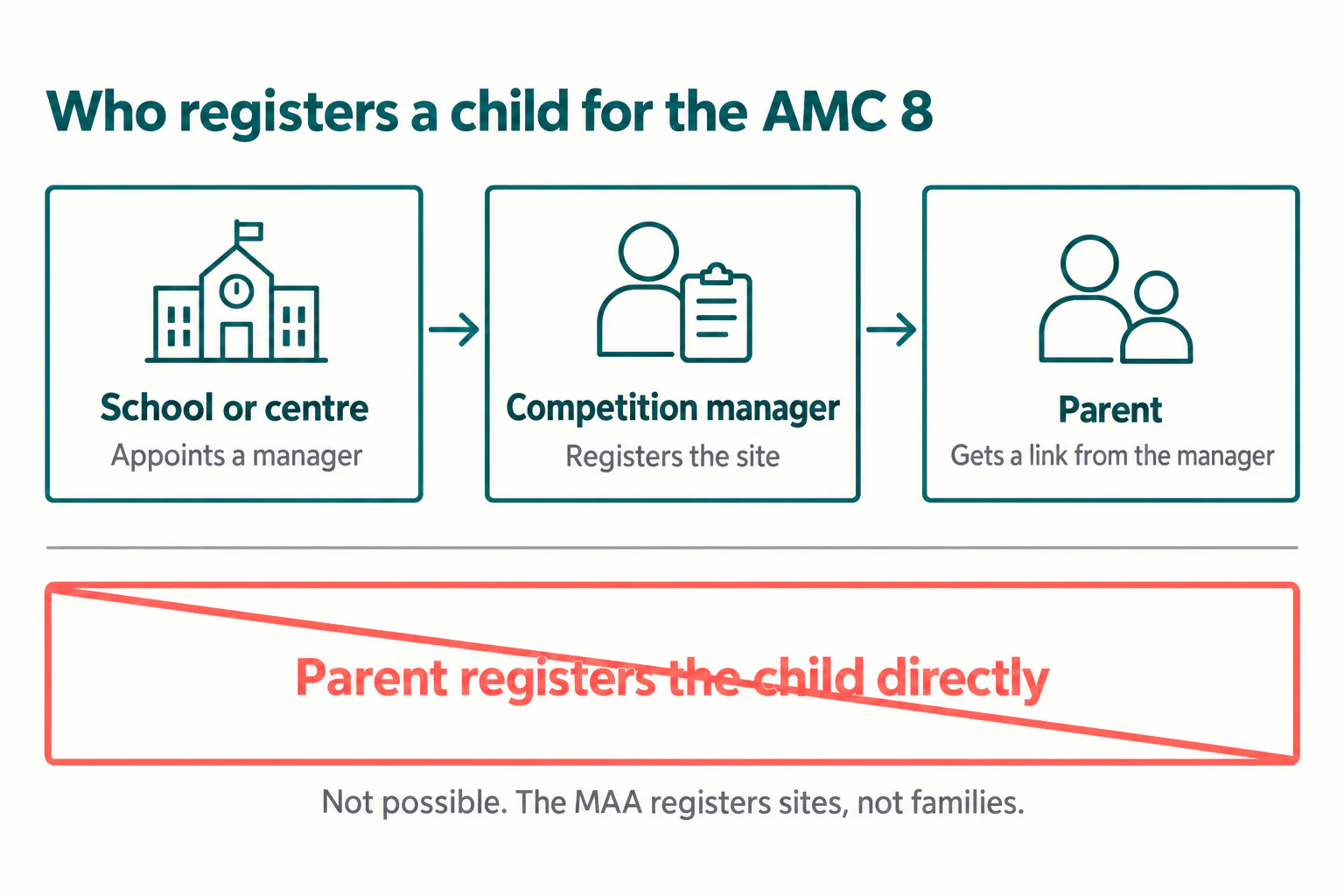
What to do if your school does not host it
Ask a maths teacher to consider registering, and give them the deadline rather than the idea. If that does not work, the MAA publishes a public list of sites registered for the current cycle, so you can search for a university, math circle or learning centre near you and ask whether they will take outside students. The MAA also says that families unable to find a local site may contact it for help finding one nearby. Do that in October, not January.
The fees are not what you think
You will read that the AMC 8 costs a fixed amount per student. That figure is what the site pays the MAA: a registration fee for the site plus bundles that licence ten students at a time.
What your family pays is a separate matter entirely. The MAA states it is not involved in financial transactions between participants and competition sites, that some sites charge students to cover their costs, and that others offer the competition free of charge as a service to their community. So the right question for a school is not "how much is the AMC 8", it is "what will you be charging students". The answers vary enormously, and plenty of schools charge nothing.
Not sure whether your child is ready for competition maths, or which level to aim at? A free trial class with a Codeyoung teacher shows you exactly where they are and what they are ready for next, before you commit to anything.
Book a Free Trial →What your child may and may not bring
The permitted list is short and the prohibited list surprises people, because the AMC is a pencil-and-paper test in a world where school maths assumes a calculator.
Permitted: writing utensils, erasers, rulers including triangular rulers, and blank scratch paper provided by the competition manager, which the policy specifies must not be graph paper. A student learning English as a second language may use a hard-copy, nontechnical translation dictionary, handed to the manager 24 hours before the competition, with no extra time granted.
Prohibited: formula sheets and calculators, phones and similar devices, smartwatches, headphones, and smart eyewear such as camera glasses. Where a site runs the digital version, the computer or tablet must have exactly one browser window open with one tab, and every other application closed.
The practical consequence is worth rehearsing at home. A child who has done every multiplication by calculator for two years will lose minutes to arithmetic they should not be spending. Our guide to mental maths techniques that actually work is a better use of October than more past papers.
Scoring, and the one strategy rule that follows from it
The AMC 8 score is simply the number of questions answered correctly, out of 25, with no penalty for guessing. That single fact decides your child's entire approach to the last five minutes.
Because a blank and a wrong answer are worth exactly the same thing, zero, there is never a reason to leave a question unanswered. A child who runs out of time with four questions untouched should fill all four in rather than leaving them. Children often need to be told this explicitly, because school tests have trained them that a wrong answer looks worse than no answer.
This rule does not carry forward. The AMC 10 and AMC 12 use a different scheme in which an unanswered question earns partial credit and a wrong one earns nothing, out of a 150-point maximum, so blanket guessing there is a genuine mistake. Read the instructions printed on those exams rather than assuming the AMC 8 habit transfers.
Accommodations have the same deadline
If your child has an IEP, a 504 plan or other documented need, the MAA allows reasonable testing accommodations, and approved additional time is limited to time and a half or double time. The request must be submitted by the competition manager by the registration deadline, and the policy warns that requests submitted after it may not be accommodated.
That makes the accommodations conversation an October conversation, not a January one. Give the school the documentation now so the manager can file it with the registration.
Is your child ready, and how to tell
The honest answer for most families is that readiness is not the point. The AMC 8 is designed as an introduction to problem solving beyond the school curriculum, and a child who answers eight questions and enjoys four of them has had a good morning. Treating a first AMC 8 as a performance to be optimised is the quickest way to put a child off competition maths for good.
A reasonable way to check fit: sit down with a past AMC 8 paper and work the first ten questions together, untimed. If your child can follow the reasoning once it is explained, even without finding it alone, the competition is appropriate. If the first five are opaque, spend this year building the reasoning and enter next January instead. The grade and age limits leave most children several attempts.
For children who take to it, the next steps are the AMC 10 in grade 9 or 10, then the AIME by invitation on 5 or 6 February 2027. If you are weighing competition maths against other enrichment routes, our comparison of how gifted tests differ covers the assessment side, and how to enter maths competitions covers the wider landscape beyond the AMC.
Your October checklist
- Ask the school this week whether it is a registered AMC 8 site for 2026-27, and if not, who would need to approve becoming one.
- Give them the date, not the idea. Early bird closes 28 October 2026; a brand new site has until 5 January 2027 and not a day longer.
- If the school says no, search the MAA's public list of registered sites for a nearby university, learning centre or math circle, and ask whether they accept outside students.
- Ask what students will be charged, separately from what the site pays the MAA. Some sites charge nothing.
- File accommodation documentation now if your child needs it, because the request goes in with the registration.
- Practise without a calculator, and tell your child that on this paper a guess is always better than a blank.
What to take away
The AMC 8 is one of the few genuinely worthwhile things a middle schooler can do with maths outside the classroom, and the barrier to entry is almost never the child. It is an administrative deadline that falls three months before the competition, in a month when nobody is thinking about January, at a school that has to act rather than a parent.
So the useful move this week is a short email to a maths teacher with one date in it. Everything else, including whether your child is ready, can be worked out in December.
Codeyoung runs 1:1 live online classes for children aged 6 to 17, with a teacher who adapts the pace to your child rather than a fixed syllabus. The first class is free, so you can see how they respond before deciding.
Book a Free TrialSources checked 14 October 2026: MAA AMC Registration and Information; MAA American Mathematics Competitions; MAA Official Rules and Policies, AMC 8, AMC 10 and AMC 12, 2026-2027, updated 21 August 2026. See also Codeyoung online maths classes.