
The after school routine you set up in the first week of term is probably already gone. Not dramatically. Homework drifted later, screens crept earlier, bedtime moved by twenty minutes and then by forty, and the evening that ran smoothly on the fifth of September now ends in an argument at nine.
That is normal and it is fixable in a single evening. What it is not is a discipline problem, which is how most families treat it. The routine that worked in week one was built for week one, and the term has since got heavier.
Why late September is when it goes
Three things arrive at once and none of them were in the original plan.
Novelty runs out. The first week of a new school year carries a child through on interest alone. New teacher, new classroom, new stationery. By week four that is gone and the same evening requires actual effort rather than momentum.
The work gets real. Early term homework is light. By late September it is properly underway, and a schedule that allocated twenty minutes to homework is now trying to absorb fifty.
Tiredness accumulates. A child who lost twenty minutes of sleep a night for three weeks is carrying a real deficit by now, and tired children are slower at everything, which makes the evening longer, which costs more sleep. That loop is the actual mechanism, and it runs quietly for weeks before anyone names it.
So the routine did not fail. It expired. Rebuilding it in late September is not a sign that something went wrong in September; it is the normal maintenance nobody schedules.
Build it backwards from bedtime
This is the change that does most of the work, and almost nobody makes it.
Families build the evening forwards: school ends, then a snack, then homework, then whatever is left. Everything variable sits at the front and bedtime absorbs all the overrun, which is why bedtime is the thing that moves. Build it backwards instead and the overrun has to land somewhere you can see.
Start from the number. The US Centers for Disease Control and Prevention recommends 9 to 12 hours of sleep a day for children aged 6 to 12, and 8 to 10 hours for teenagers aged 13 to 17.
| Age | Sleep needed | If they wake at 7am |
|---|---|---|
| 6 to 12 | 9 to 12 hours | Asleep by 8pm to 10pm |
| 13 to 17 | 8 to 10 hours | Asleep by 9pm to 11pm |
Note the column heading: asleep, not in bed. A ten-year-old who needs to be asleep at 8.30 needs to be in bed nearer 8.10 and off screens well before that. Work those two gaps in and the bedtime you actually have to enforce is considerably earlier than the one most families name.
Not sure which level your child should start at? A free trial class with a Codeyoung teacher shows you exactly where they are and what they are ready for next, before you commit to anything.
Book a Free Trial →The four blocks, in order
The hours between the school gate and lights out divide fairly naturally into four. The order matters more than the exact lengths.
- Move and eat. Twenty to thirty minutes, non-negotiable, before anything is asked of them. A child coming out of school has been sitting still and concentrating for six hours and is running on empty.
- One hard thing. The most demanding task of the evening, done first while there is still fuel. Usually homework, sometimes an instrument or a class.
- Free time. Genuinely theirs, chosen by them. This is the part families cut when the evening runs late, and cutting it is what makes the next day worse.
- Wind down. Twenty to thirty minutes of something quiet and screen-free before bed.
Block one is the one parents resist. It looks like wasted time when there is homework to get through, and the instinct is to get the work done while the school day is still fresh. In practice a tired, hungry child does forty minutes of work in an hour and a half, and complains throughout. The snack and the twenty minutes outside are not a reward for finishing. They are what makes finishing possible.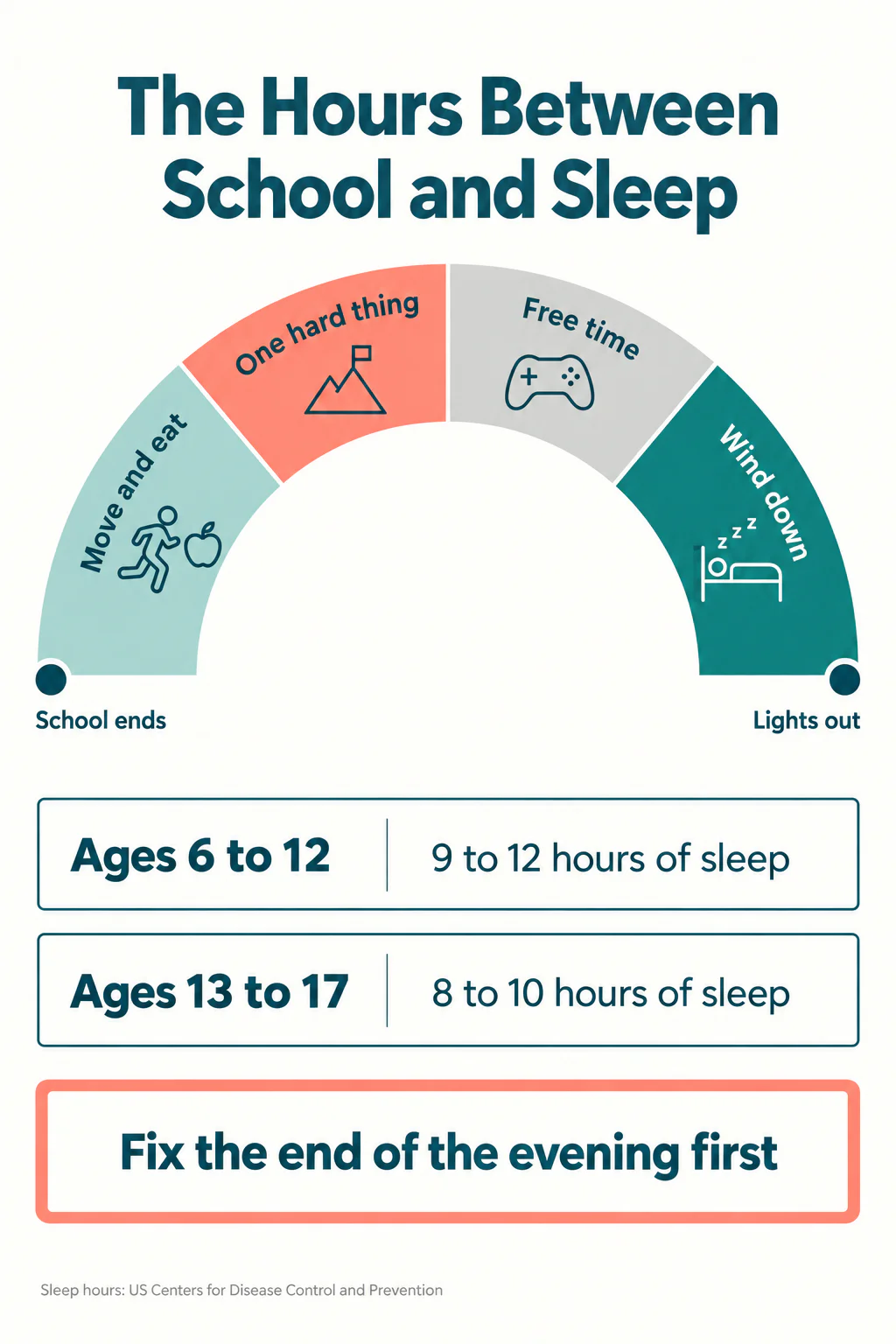
Homework: how long is too long
Worth being honest about, because a lot of evening chaos is a homework problem wearing a routine problem's clothes.
Harris Cooper's synthesis of homework research, published in the Review of Educational Research, found that the relationship between homework and achievement is considerably weaker for younger students than for older ones. That is the most-cited work in the area and it is worth knowing before you spend an hour of a seven-year-old's evening on a task that was meant to take fifteen minutes.
The practical rule we give parents: if a task regularly runs far beyond what the teacher intended, stop and send a note. Not a complaint, a data point. "This took Maya fifty minutes" is useful information for a teacher and it is the only way the mismatch ever gets corrected. Silently absorbing it at home protects nobody, least of all the child, who concludes they are slow.
Stopping also teaches something worth teaching: that effort has a sensible ceiling, and that a task which is not working after a reasonable attempt should be flagged rather than ground through. The alternative lesson is that evenings belong to whoever set the work.
Where the difficulty usually hides
Before you redesign the evening, check whether the bottleneck is one subject. Very often the routine is fine and one type of task is swallowing it: the maths that takes forty minutes, the reading that never starts, the writing that produces a fight every time.
That is a different problem and a routine will not solve it. If maths is the block, our guide to helping with maths homework when you hated maths yourself is more use than a new timetable. Fix the subject, and the evening frequently fixes itself.
Screens: set the time, not the total
Most families argue about how much. The more useful lever is when.
A fixed screens-off time, the same every school night, removes the negotiation entirely because there is nothing to negotiate about. A daily total invites a running argument about what counts, whether the maths game counts, whether it counts if a sibling was also watching. The clock does not care and neither does the child, after about a week.
Put screens-off at least half an hour before the child needs to be asleep, and make the wind-down block genuinely different in kind: a book, a bath, drawing, talking. A child who shuts a laptop and gets straight into bed is still running at task speed. The wind-down is not an old-fashioned nicety, it is the deceleration.
Where screens are also where the learning happens, which is increasingly the case, the distinction is worth making explicit with the child rather than assumed. We worked through that in building screen time balance for digital learners.
How to actually do the reset
One conversation, fifteen minutes, with the child in the room. Not a rota posted on the fridge by a parent on a Sunday night.
- Agree the wake-up time and count backwards using the sleep figures above. Write the bedtime down.
- Subtract half an hour for wind-down and screens-off. That is your real cut-off.
- Ask the child what the hardest part of the evening is. Their answer is usually accurate and frequently not what you assumed.
- Place the one hard thing after food and movement, not before.
- Protect the free block. Write it down like the others so it is visibly not the overflow buffer.
- Review it in two weeks, out loud, and change one thing. Not five.
Step three is where the useful information is. Children know exactly which twenty minutes of the evening they dread and will tell you if asked directly, and it is very often something small and fixable: the transition from playing to working, not the working itself.
Step six matters because a routine set once and never reviewed will expire again in November, when it gets dark at four and everyone's energy changes again. Two reviews a term is about right, and a child who has been consulted will comply with a routine they helped build in a way they will not with one that appeared on the fridge.
What to let go of
The reset fails when it is too ambitious, which is the other common failure mode and the one that feels most virtuous.
A routine with six blocks, a reading target, an instrument, a chore rota and a screen allowance is not a routine. It is a wish list, and it collapses in four days, after which everybody concludes routines do not work in this house. Pick the two things that matter most this term and let the rest be uneven.
For most families those two are the bedtime and the position of the hard thing. Get those right and a surprising amount organises itself, because a rested child works faster, which ends the evening earlier, which protects the bedtime. The same loop that made things worse runs in the other direction just as reliably.
The short version
A routine that has slipped by late September has not failed, it has expired, and rebuilding it is ordinary maintenance rather than a response to bad behaviour. Build the evening backwards from the time your child needs to be asleep, not forwards from the school gate, because whatever sits last in the sequence is what absorbs every overrun.
Put food and movement before the hardest task, protect the free block instead of treating it as slack, and set a fixed screens-off time rather than arguing about totals. Then change one thing in a fortnight and one thing again in November.
The sleep figures above are the current recommendations published by the US Centers for Disease Control and Prevention, and the homework research is Harris Cooper and colleagues' synthesis in the Review of Educational Research. If the evening is being swallowed by one subject rather than by the schedule, our online maths classes for kids and the rest of our 1:1 programmes are built to shorten that hour rather than to add another one.
Codeyoung runs 1:1 live online classes for children aged 6 to 17, with a teacher who adapts the pace to your child rather than a fixed syllabus. The first class is free, so you can see how they respond before deciding.
Book a Free Trial