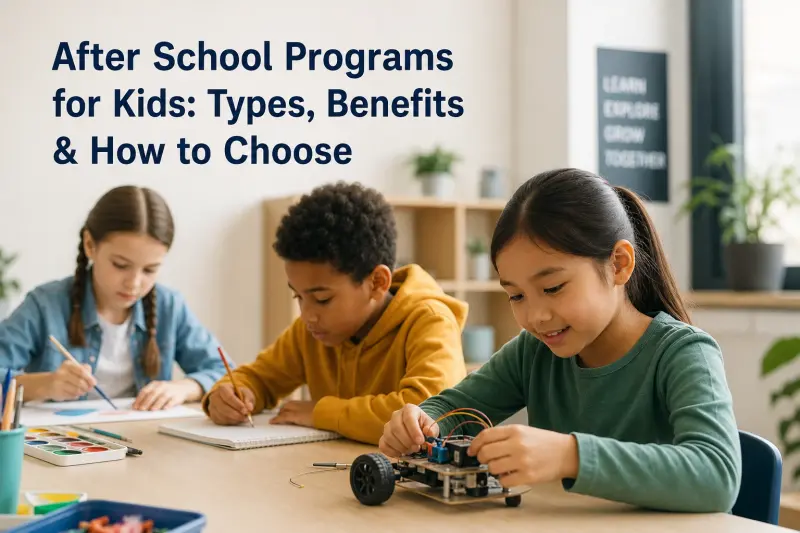
The hours between 3 and 6 PM are the riskiest part of a child's day, and the most underutilized. According to the Afterschool Alliance's 2025 America After 3PM report, parents of nearly 30 million U.S. children want after school programs, yet only 7 million kids are currently enrolled.
This guide covers everything you need to make a confident decision: the different types of programs available, what the research says about benefits, and a practical framework for choosing the right fit for your child.
What Are After School Programs for Kids?
After school programs are structured activities that take place outside regular school hours — typically running from school dismissal until around 6 PM. They provide a supervised environment where kids can learn, explore interests, get homework support, or develop new skills.
There are two broad categories worth distinguishing early:
General after school care is supervision-focused. Think school district programs, YMCA, Boys & Girls Club, and similar organizations. These typically offer a mix of free play, homework time, and light activities. The primary goal is a safe, structured place to be.
Enrichment programs are skill- and subject-focused. These are led by trained instructors, follow a structured curriculum, and target measurable progress in a specific area — coding, math, music, athletics, or language, for example.
Many families use both: general care most days, with one or two enrichment sessions per week layered on top. Understanding which category you're shopping for makes the search much more efficient.
Types of After School Programs

STEM and Coding Programs
These programs give kids hands-on experience with science, technology, engineering, and math through projects, experiments, and real code. They're particularly well-suited for online delivery — platforms like Codeyoung offer live 1:1 online classes in Coding, Math, Science, and Robotics for children ages 5–18, with sessions that fit around any schedule.
Academic Enrichment and Tutoring
Subject-specific support for math, reading, writing, or test preparation. The goal is reinforcing what's being taught during the school day rather than introducing entirely new material. Most valuable for kids who need extra practice time or are working ahead.
Creative Arts
Visual art, music, drama, and dance give children expressive outlets that standard curricula often don't prioritize. These programs build creativity, emotional intelligence, and performance confidence — benefits that transfer across every subject.
Sports and Physical Activity
Team sports, martial arts, and fitness-based programs develop coordination, discipline, and the ability to work within a team. Physical activity after school also helps kids reset mentally before evening homework time.
Life Skills Programs
Cooking, leadership development, and financial literacy fall into this category. These are practical, real-world skills that build independence. Codeyoung's Financial Literacy course is a good example of subject-matter that most school curricula skip entirely.
Online Enrichment Programs
This is the category most competitors underserve — and one of the most practical options available today. Online programs eliminate geography and transportation barriers entirely. Classes can be scheduled around existing commitments, weather, or family travel. For families in suburban or rural areas without nearby enrichment options, or for parents managing tight pickup logistics, online programs have become the default rather than the exception.
Benefits of After School Programs for Kids
The research case for after school programs is strong and consistent across multiple studies.
Academic gains are measurable. Research from the U.S. Department of Education on 21st Century Community Learning Centers — a federal after school initiative — links consistent program participation to improvements in math scores, reading performance, and classroom behavior. Kids who attend regularly show up better prepared and more engaged.
Problem-solving skills develop differently outside the classroom. STEM and project-based programs use iterative thinking: build something, see what breaks, fix it. Because grades aren't attached to after school projects, kids take more creative risks and develop stronger resilience to failure.
Social skills and belonging improve. The less formal structure of after school settings gives children more opportunity to practice communication, negotiate conflict, and build friendships. Research from Understood.org notes that kids in these programs are more likely to feel a sense of belonging and social connection.
The 3–6 PM window carries real risk. This time period is statistically peak for juvenile risk behaviors including substance use and involvement in crime. Structured after school programs directly reduce this exposure by keeping kids engaged and supervised during the hours that matter most.
Confidence grows in lower-stakes environments. With no grades on the line, kids — especially those with learning differences — are more willing to try unfamiliar things. That willingness to attempt and fail safely is a foundational confidence-builder.
Group Programs vs. 1:1 Enrichment: Why Format Matters
This is the decision variable that most parents overlook, and it has the biggest impact on outcomes.
Most after school programs use a group format — anywhere from 10 to 30 kids with one or two instructors. Group settings are valuable for social development, but they limit individual pacing. A child who grasps a concept quickly sits idle. A child who needs more time often gets left behind.
Educational psychologist Benjamin Bloom addressed this directly in his landmark 2 Sigma research, published in Educational Researcher. Bloom found that students receiving one-to-one, mastery-based instruction performed two standard deviations better than their peers in traditional group settings — meaning the average tutored student outperformed 98% of students in conventional classrooms. The research, later hosted in MIT's academic library, has been widely replicated and remains one of the most cited findings in educational psychology.
This is why format matters when the goal is measurable academic progress. A 1:1 program like live online classes assigns each child a dedicated mentor who adapts lessons to the child's exact pace, provides immediate feedback, and ensures mastery before moving forward. That structure is what makes the difference between an activity and genuine learning acceleration.
If you're choosing a program primarily for supervision, a group setting is perfectly appropriate. If academic growth is the primary goal, the 1:1 format deserves serious weight in your decision.
How to Choose the Right After School Program for Your Child
Start with your child's input. A child who chose the program is far more likely to stay engaged than one who was enrolled without input. Ask what they're curious about, what they find boring at school, or what they'd want to try if they could learn anything.
Clarify your primary goal. Supervision, academic support, and skill development are three different goals that often point to three different types of programs. Getting clear on your priority before browsing options saves significant time.
Evaluate logistics honestly. In-person programs require reliable transportation and consistent pickup windows. If your schedule doesn't allow for that, don't force it — an online program with flexible scheduling will serve your family better and get used more consistently.
Check instructor quality. Ask about training requirements, background checks, and student-to-instructor ratios. For 1:1 programs, ask specifically about how mentors are selected — Codeyoung, for instance, accepts fewer than 1% of mentor applicants through a rigorous vetting process.
Ask these five questions before enrolling:
What does a typical session look like, start to finish?
How is my child's progress tracked, and how will you communicate it to me?
What is the cancellation policy and trial session option?
How are absences and makeup sessions handled?
What happens if my child needs to move faster — or slower — than the standard curriculum?
Take advantage of free trials whenever they're available. A single session will tell you more than any website. Codeyoung offers a free trial class with no commitment required, which lets you test fit before making any financial decision.
How Much Do After School Programs Cost?
Costs vary significantly based on program type, format, and provider.
Free and low-cost options do exist. State-funded programs like California's ELOP (Expanded Learning Opportunities Program) serve millions of students. Boys & Girls Club, the Salvation Army, and many school districts offer subsidized or free care — it's worth asking providers directly about scholarship or sliding-scale pricing.
On the cost management side, most after school program costs qualify for reimbursement through a Dependent Care Flexible Spending Account (FSA). If your employer offers a Dependent Care FSA, you can pay for after school programs with pre-tax dollars — effectively reducing your out-of-pocket cost by your marginal tax rate. Note that after school programs are generally not directly tax deductible, but FSA reimbursement is the practical equivalent for most working families.
Frequently Asked Questions
What is the difference between after school care and an enrichment program?
After school care is primarily about supervision — providing a safe, structured environment between school dismissal and the end of the workday. Enrichment programs focus on skill development in a specific subject area, led by trained instructors with a defined curriculum. Many families use both simultaneously.
What are the best after school programs for kids who struggle academically?
Look for 1:1 tutoring or subject-specific enrichment programs rather than group settings. Individual attention allows instructors to identify exactly where a child is struggling and address those gaps directly, rather than keeping pace with a class. Programs that use mastery-based progression — where a child moves forward only when they've demonstrated understanding — are especially effective.
How do I find after school programs near me?
Start with your child's school — many districts maintain a list of approved programs. Childcare.gov's provider search tool is a useful national resource. For online programs, geography isn't a constraint, and most reputable providers offer trial sessions.
Are after school programs worth it?
For most families, yes — both the research and the practical evidence support it. Kids in structured after school programs show stronger academic outcomes, better social development, and lower rates of risk behavior during the 3–6 PM window. The value depends heavily on choosing a program that aligns with your child's interests and your family's primary goal.
Can after school programs be done online?
Absolutely, and increasingly they are. Online programs eliminate transportation barriers, offer more flexible scheduling, and for 1:1 formats, often deliver better instructional quality than group in-person alternatives. They're especially practical for families in areas without nearby enrichment options.
Are after school program costs tax deductible?
Most after school program costs are not directly tax deductible. However, they typically qualify for reimbursement through a Dependent Care FSA, which achieves a similar financial benefit using pre-tax dollars. Check with your employer's benefits administrator to confirm eligibility.
Conclusion
The right after school program comes down to three things: your child's genuine interests, your family's scheduling reality, and a clear sense of what you're trying to achieve. Match those three factors to a program type and format, and you'll get far better results than choosing based on convenience alone.
For families focused on academic enrichment, the 1:1 online format offers meaningful advantages that group programs simply can't replicate — and the barrier to trying is low. Codeyoung's free trial class requires no commitment, costs nothing, and takes one hour. It's the most efficient way to find out whether structured, mentor-led learning is the right fit for your child.