
Most parents start looking for advanced math classes for kids after the same moment: a child finishes the homework in nine minutes, says it was easy, and goes back to whatever they were doing. The instinct is to find something harder. The difficulty is that three quite different products are sold under one label, and buying the wrong one is how an able child ends up bored in a more expensive room.
This site has around seventy articles aimed at children who are struggling with maths. This one is for the opposite situation, which gets written about far less and is in some ways harder to get right. A struggling child gives you clear signals. A child who is ahead mostly gives you silence.
Three things sold as advanced maths, and they are not interchangeable
Before comparing providers, work out which of these you are actually buying. Most programme pages will not tell you, because the vaguer word sells to all three parents at once.
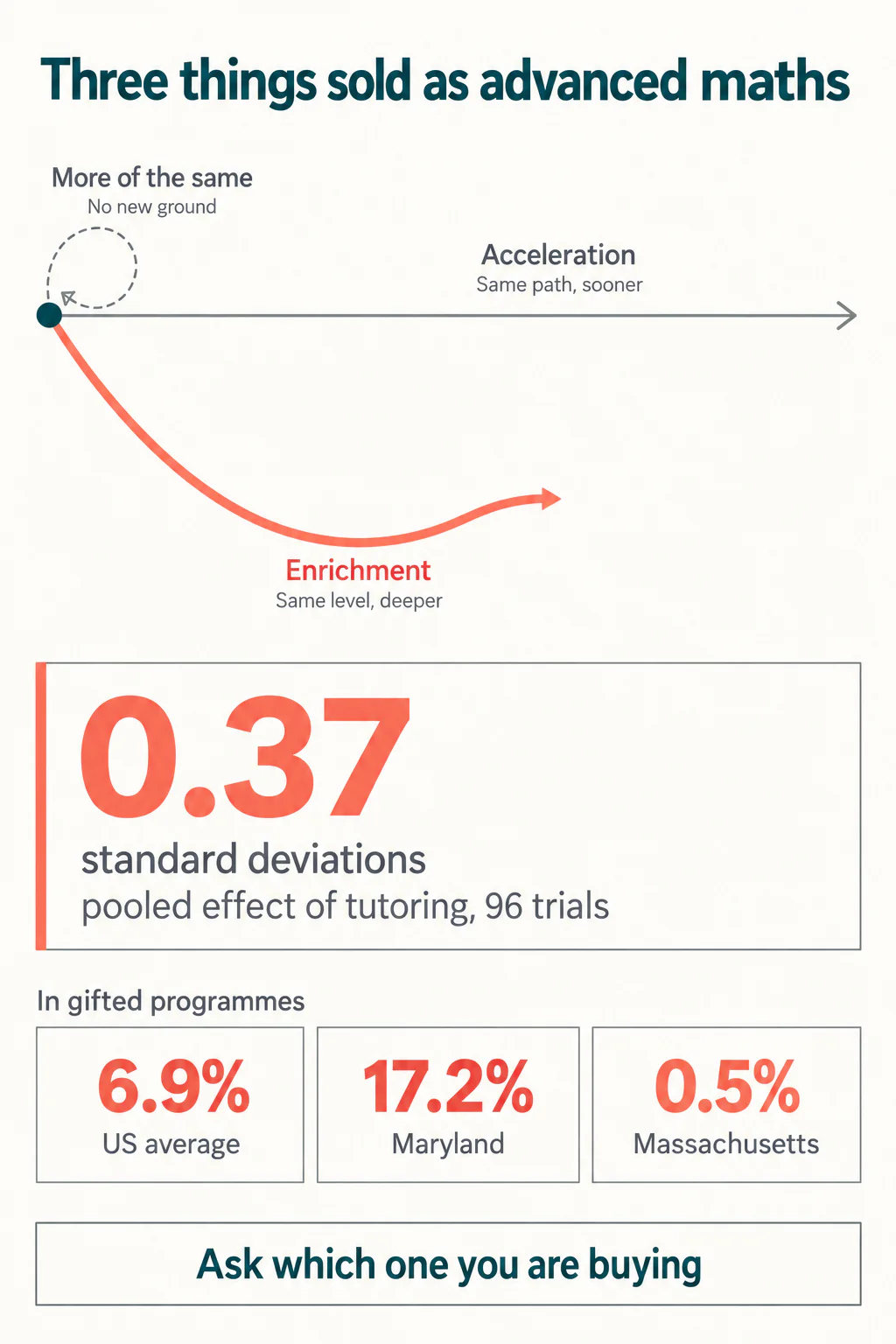
Acceleration moves your child through the standard curriculum earlier than their year group. A ten-year-old works on material written for thirteen-year-olds. The content is ordinary; the timing is not. This suits a child with genuinely secure foundations who is being held at a pace that no longer teaches them anything.
Enrichment holds the year level and goes sideways and down instead. Number theory, combinatorics, proof, problems with no taught method attached. A ten-year-old doing enrichment might spend forty minutes on a single question that a thirteen-year-old could not answer either. This suits a child who is fast but whose reasoning has not yet caught up with their fluency, which is more common than the acceleration case.
More of the same, faster. The third category is the one nobody advertises. Extra worksheets at the same difficulty, delivered more intensively, marketed as advancement because the child covers more pages. For a child who is genuinely ahead this is the worst option available, and it is frequently the cheapest, which is why it sells.
There is a quick test that separates them before you pay. Ask the provider to send one question a class would set for your child, and then ask yourself whether that question could have appeared in their school textbook. If yes, it is acceleration. If no, it is enrichment. If it could have appeared in their textbook this term, it is the third thing.
Is your child ahead, or just quick?
Speed is the most over-read signal in primary maths. Finishing early measures fluency with material already mastered. It does not measure readiness for material that is harder, and the two come apart constantly.
Three sharper signals, in rough order of usefulness:
- They can explain why a method works, not only run it. A child who can say why you line up decimal points is in a different position from one who simply does.
- They notice when an answer is unreasonable before checking it. That is estimation and number sense doing their job, and it is the single best predictor that harder content will land.
- They change the question. Asking what happens if the rule is reversed, or whether it still works with negatives, is the behaviour that enrichment is built for.
A child showing all three is ready for real difficulty. A child who is only fast is usually better served by depth at their current level first, which is the honest answer even though it sells a smaller package. If you are not yet sure which situation you are in, working out whether a child is bored or struggling is the prior question, and this article assumes you have already answered it.
Not sure which level your child should start at? A free trial class with a Codeyoung teacher shows you exactly where they are and what they are ready for next, before you commit to anything.
Book a Free Trial →What the evidence actually says about one-to-one teaching
Almost every tutoring company eventually quotes the same number. In 1984 Benjamin Bloom published a paper in Educational Researcher reporting that students taught one-to-one performed around two standard deviations better than students in conventional classrooms. It is a striking figure and it has been repeated in sales copy for forty years.
It is also not what the modern evidence shows, and a provider who quotes it without saying so is telling you something about themselves. A systematic review and meta-analysis of 96 randomised evaluations of PreK-12 tutoring, published by Nickow, Oreopoulos and Quan through the National Bureau of Economic Research, found a pooled effect of about 0.37 standard deviations.
That is still a large effect. Very little in education research clears 0.3, and 0.37 across ninety-six trials is about as solid as evidence in this field gets. It is simply not two. The same review found that effects are stronger for teacher and paraprofessional tutors than for non-professional or parent tutors, and that maths tutoring tends to produce larger effects in the later grades while reading tutoring does better in the earlier ones.
Two practical conclusions follow. One-to-one is worth paying for, and who teaches it matters more than the format does. A cheap 1:1 class with an untrained tutor is not buying you the thing the research measured.
Why school gifted programmes are mostly a postcode question
Parents often assume that if their child needed something more, school would have offered it. The provision data does not support that assumption.
In the most recent state-by-state table published by the US National Center for Education Statistics, covering 2013-14, 6.9% of public school students were enrolled in gifted and talented programmes. The range behind that average is the striking part: 17.2% in Maryland and 0.5% in Massachusetts. Two states, both with strong school systems, differing by a factor of more than thirty.
Able children are not distributed thirty times more densely in one state than another. What differs is policy, funding and identification practice. So the absence of a school programme is weak evidence about your particular child, and its presence does not guarantee the programme does anything beyond the third category above. Ask what the programme actually teaches, not whether it exists.
What advanced looks like at each stage
Advanced is a moving target, and useful enrichment at seven looks nothing like useful enrichment at fourteen. A rough map, with the caveat that children arrive at these points at very different ages:
| Age | Secure foundation looks like | Useful next step |
|---|---|---|
| 6–8 | Fluent number bonds, confident counting in steps, sees patterns in a times table | Pattern and shape puzzles, early logic, open problems with several right answers |
| 8–10 | Confident with fractions and place value, can estimate before calculating | Bar models, multi-step word problems, introductory number theory such as factors and primes |
| 10–12 | Comfortable with ratio, negative numbers and the order of operations | Pre-algebra reasoning, proof by example and counterexample, first competition-style problems |
| 12–14 | Fluent with algebraic manipulation and linear relationships | Formal proof, combinatorics, modular arithmetic, structured competition preparation |
The pattern worth noticing is that the next step is almost never the next chapter. At every stage the productive move is sideways into reasoning, and only then forward into new content. A child pushed forward without that sideways step tends to stall somewhere around algebra, having accumulated methods without the understanding that holds them together.
For a child already working at the top of this table and enjoying unfamiliar problems, entering a maths competition is a reasonable destination. It is not a requirement, and it suits some advanced learners badly.
Seven questions to ask before you pay
- Which of the three categories is this, in your own words?
- What does the first lesson do, specifically, and what will my child be able to do afterwards?
- Who teaches it, and what is their maths background rather than their teaching platform experience?
- How do you decide the starting point, and what happens if that placement turns out to be wrong?
- Show me a question from a lesson two months in.
- What happens when my child gets stuck for a whole session, and is that treated as a problem or as the point?
- How would you know this was not working, and what would you change?
The sixth question is the one that separates providers. A programme built around depth expects a child to be stuck, because being stuck productively is the skill it is teaching. A programme built around coverage treats a stuck session as a scheduling failure. Both answers are legitimate businesses. Only one of them is the thing an advanced learner needs.
If the answers point to tutoring rather than a class, the practical considerations are covered in our guide to choosing online maths classes, and the diagnostic signals are in the signs a child needs a maths tutor, which covers the mirror image of this situation.
Where this leaves you
Decide which of the three things you are buying before you compare prices, because the cheapest option is reliably the one that does the least. Judge readiness on reasoning rather than on speed. Expect a real effect from good one-to-one teaching, around a third of a standard deviation rather than the two that gets quoted, and understand that the figure depends on the teacher more than the format. Treat the absence of a school programme as information about your district, not about your child.
An advanced learner who is given depth instead of more pages tends to stay interested in maths for years longer. That is the actual return, and it is slower and less measurable than a grade jump.
Codeyoung runs 1:1 live online classes for children aged 6 to 17, with a teacher who adapts the pace to your child rather than a fixed syllabus. The first class is free, so you can see how they respond before deciding.
Book a Free TrialCodeyoung's online maths classes run one to one and start from a placement conversation rather than a year group.