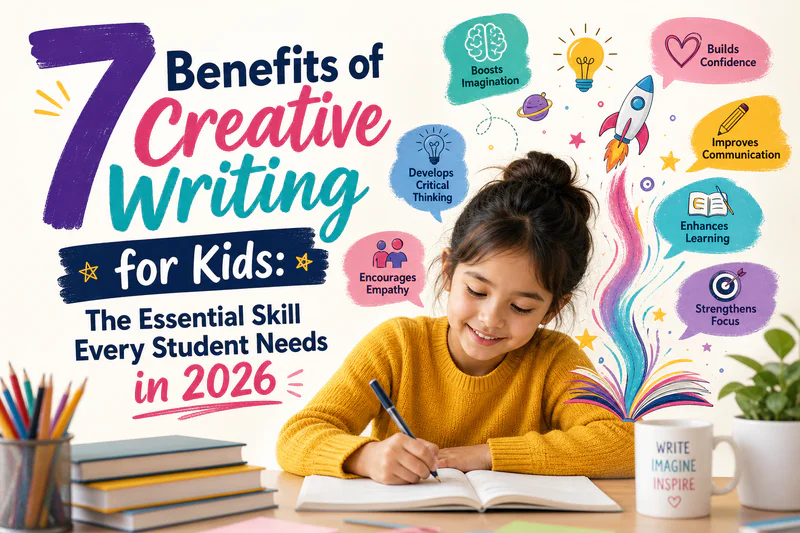
Parents today are investing heavily in after-school education, enrolling their children in online coding classes for kids, math tutoring for kids, and STEM enrichment programs. But one discipline consistently gets underestimated: creative writing. And in 2026, that's a costly oversight.
Creative writing for kids isn't just about storytelling. It builds the communication, critical thinking, and emotional intelligence that make every other subject, including coding and math, click faster and stick longer.
What Is Creative Writing for Kids?
Creative writing for kids spans a wide range of formats: short stories, poetry, journaling, comic scripts, screenplays, and even interactive narratives. What unites all of them is the emphasis on imagination, individual voice, and structured expression.
When a child writes a story, they're not just practicing grammar. They're learning to organize complex thoughts, anticipate an audience's reaction, and communicate ideas with clarity and precision. These are the exact same cognitive skills measured in academic assessments, and increasingly, the skills that determine long-term career success in every field from software engineering to business.
Research published on ScienceDirect confirms that daily creative writing practice produces significant advantages in verbal divergent thinking, imagination, and emotional stability compared to students who don't practice regularly. In other words, the benefits are measurable, not anecdotal.
Why Creative Writing Matters More Than Ever in 2026

The rise of AI has sparked a genuine concern among educators: if machines can generate content, write code, and solve problems, what should students actually be learning? The answer, increasingly, is human creativity.
AI can produce words, but it cannot replace authentic voice, nuanced empathy, or original perspective. Children who practice creative writing for kids develop a distinctly human competitive advantage, the ability to communicate ideas that resonate, persuade, and inspire.
Beyond that, academic research consistently links strong writing habits to improved performance across all subjects, including mathematics and science. And as online English classes for kids become a mainstream part of after-school education, parents are beginning to recognize that language fluency is the foundation everything else is built on.
The 7 Key Benefits of Creative Writing for Kids {#benefits-table}

The table below summarizes how each benefit maps to academic growth and real-world STEM applications. This matters because creative writing for kids doesn't exist in isolation, it actively amplifies what children learn in online coding classes for kids, online math programs for kids, and other structured disciplines.
Deep Dive: Each Benefit Explained for Parents
1. Enhanced Communication Skills
The most immediate payoff from creative writing for kids is stronger communication. Children who write regularly develop a richer vocabulary, a more confident sentence structure, and the ability to tailor their language to different audiences. Enrolling a child in quality online English classes for kids that incorporate creative writing accelerates this development significantly.
This matters for STEM too. In app development classes for kids, students must write user-facing copy, button labels, error messages, onboarding text. A child with strong writing skills produces cleaner, more intuitive interfaces. Communication is a technical skill, not just an artistic one.
2. Critical Thinking & Reasoning
Building a plot isn't as simple as it sounds. A child writing a story must establish cause and effect, manage multiple variables (characters, settings, timelines), and resolve problems in a way that's internally consistent. That's structured reasoning, the same cognitive process used in Python for kids when debugging a program or tracing why a loop isn't returning the expected output.
In fact, the grammar and syntax rules of English share a compelling parallel with the syntax rules of text-based coding languages like Python for kids. Both demand precision: a misplaced comma in an essay and a misplaced colon in a Python script both break the intended meaning. Creative writing trains that instinct for exactness.
3. Boosted Creativity & Imagination
Creativity is the currency of innovation, and creative writing for kids is one of the most reliable ways to build it. When children invent worlds, design characters, and plot out narratives, they're practicing the same imaginative thinking required to design a compelling game or app.
This is why Scratch programming for kids and creative writing are natural partners. In Scratch programming for kids, students build interactive stories and games by combining code blocks, but the most engaging projects come from children who already understand narrative structure. Great game design for teens starts with a great story concept, not just technical execution.
4. Emotional Intelligence & Expression
Creative writing gives children a safe space to explore complex feelings, fear, joy, conflict, loss, through fictional characters and scenarios. This emotional processing builds self-awareness and empathy over time.
These aren't soft skills. Research shows that emotional intelligence directly impacts academic performance, peer collaboration, and resilience in the face of challenge. Coding projects, in particular, require sustained effort through frustration, a quality that's much easier to maintain in children who teaches emotional regulation through regular reflective and creative practice.
5. Increased Confidence & Self-Esteem
Finishing a story, from a blank page to a completed piece, gives kids a concrete, tangible sense of accomplishment. Reading it aloud, sharing it with peers, or publishing it on a class platform adds an element of performance and pride that quietly builds real confidence.
That confidence transfers directly into academic contexts: the child who confidently shares their story in class is the same child who will present their Scratch programming for kids project without hesitation or pitch their app concept during a development showcase.
6. Improved Focus & Discipline
Creative writing is slow, deliberate work. It requires sustained concentration, planning, drafting, revising, and editing. Children who practice creative writing for kids regularly develop a tolerance for deep focus that benefits every academic subject.
This discipline is particularly valuable when children are enrolled in structured programs like online math programs for kids or math tutoring for kids, where persistence through difficult problems is the difference between progress and frustration. The habit of sitting with a challenge and working through it starts at the writing desk.
7. Cognitive Flexibility & Logic
Perhaps the least obvious benefit is cognitive flexibility, the brain's ability to shift between different types of thinking and adapt to new information. Creative writing demands this constantly: a writer must think analytically (does this plot make sense?), creatively (what's an unexpected twist?), and empathetically (will a reader connect with this character?) all at once.
This mental agility mirrors the multi-modal thinking cultivated in vedic math classes, where students solve problems using multiple mental strategies rather than a single rote method. Both disciplines train the brain to see problems from different angles, an irreplaceable asset in academics and professional life alike.
How Creative Writing Connects to STEM, Coding & Math {#stem-connection}
The conventional view separates arts and sciences into opposite ends of a spectrum. In practice, the most capable technologists are strong communicators who can think creatively. Understanding this connection is what separates a well-rounded educational strategy from a narrow one.
Consider Python for kids. Learning Python requires a student to understand syntax rules, logical structure, conditional reasoning, and sequential thinking. Creative writing builds all of these same cognitive muscles. A child who has spent time writing structured narratives with clear beginnings, midpoints, and resolutions has already internalized the concept of programmatic flow, they just haven't applied it to code yet.
The same parallel holds for Scratch programming for kids. When a child uses Scratch programming for kids to build an interactive story game, they are simultaneously a programmer, a game designer, and a writer. The story quality determines whether the game is engaging. The code quality determines whether it works. Both skill sets are essential, and neither replaces the other.
For parents exploring coding and math for kids, it's worth noting that strong communication skills improve a child's ability to grasp abstract mathematical concepts. When children can articulate why a solution works, in writing or verbally, they demonstrate deeper comprehension than children who simply produce the correct answer.
App development classes for kids offer another compelling example. Building an app is as much a communication challenge as a technical one. Developers must write clear button labels, intuitive instructions, and concise onboarding flows. Children who have practiced creative writing for kids approach these UX writing challenges with a significant head start over those who haven't.
Online coding classes for kids that incorporate project-based learning, where students must plan, document, and present their work, reward the student who can write and speak clearly about what they've built. In competitive environments like hackathons or science fairs, strong communication is often what separates good from exceptional.
How to Choose the Right Online English Classes for Kids {#choose-classes}

Not all English programs are created equal. When evaluating online English classes for kids with a creative writing focus, parents should prioritize a few key factors.
Look for live, instructor-led sessions. Asynchronous content has its place, but live instruction is where real fluency development happens. A skilled teacher can provide immediate feedback, ask follow-up questions, and model the thinking process behind good writing, something a pre-recorded video simply cannot replicate. Quality online English classes for kids should feel like a conversation, not a lecture.
Ensure the curriculum includes structured writing projects. Creative writing for kids is most effective when it's scaffolded: students learn a skill (descriptive language, dialogue, plot structure), apply it in a short exercise, and then build toward a longer project. Programs that jump straight to open-ended assignments without providing structural frameworks often frustrate young learners rather than inspiring them.
Consider programs that actively support English language learners. For multilingual families, creative writing in English can be a powerful bridge between languages and cultures. Look for online English classes for kids that acknowledge diverse linguistic backgrounds and use creative expression as a tool for building confidence alongside fluency.
Pair English programs with complementary STEM learning. The most effective after-school education combines language arts with analytical disciplines. Pairing online English classes for kids with online coding classes for kids or online math programs for kids creates a genuinely well-rounded learner, one who can think logically, communicate clearly, and approach problems from multiple directions.
At Codeyoung, families can explore online math programs for kids alongside English and coding tracks to build exactly this kind of balanced academic foundation.
Conclusion
Creative writing for kids is not a supplementary luxury, it is a foundational skill that makes everything else in a child's education work better. It sharpens the logic needed for Python for kids, fuels the imagination behind Scratch programming for kids, builds the focus that powers math tutoring for kids, and develops the emotional intelligence that sustains success in collaborative STEM environments.
The smartest educational investment parents can make in 2026 is a balanced one: pair quality online English classes for kids with structured online coding classes for kids and online math programs for kids to develop children who can think deeply, communicate clearly, and create confidently. That's not just good academic preparation, it's future-proofing. Explore Codeyoung's full suite of after-school programs to build the well-rounded learner your child deserves.
Frequently Asked Questions
How do online English classes for kids improve STEM learning?
Online English classes for kids build the communication and critical thinking skills that underpin every STEM discipline. When students practice articulating complex ideas clearly, through creative writing, debate, or structured discussion, they develop the same logical sequencing and precision required in coding and mathematics. Children enrolled in online English classes for kids alongside STEM programs consistently demonstrate stronger problem-solving comprehension because they can reason through challenges in structured language.
What is the role of creative writing in developing Python programming skills for kids?
Creative writing and Python for kids share more in common than most parents realize. Both require adherence to precise syntax rules, logical sequencing, and structured thinking. When children practice creative writing for kids, building plots with clear cause and effect, managing narrative consistency, they develop the same mental discipline required to write clean, functional Python for kids code. The habit of proofreading a story for errors directly translates to debugging a Python script.
How does creative writing complement Scratch programming for kids?
Scratch programming for kids is fundamentally a storytelling platform. Students use code blocks to build interactive narratives, animations, and games, all of which require strong narrative instincts. Children with a background in creative writing for kids approach Scratch programming for kids with a clearer vision of character, conflict, and resolution. The result is projects that are not only technically functional but genuinely engaging for an audience.
Can creative writing help with math tutoring for kids or online math programs for kids?
Absolutely. Creative writing builds focus, discipline, and the cognitive flexibility needed to approach unfamiliar problems without giving up. These qualities are directly applicable when children work through complex math problems in math tutoring for kids sessions or structured online math programs for kids. Additionally, the ability to write out a solution process in clear language, a technique called "math journaling", is proven to deepen conceptual understanding in mathematics.
How do app development classes for kids benefit from creative writing skills?
In app development classes for kids, students must think like designers as well as programmers. They need to write button labels, error messages, help text, and onboarding copy that real users will read and understand. Children who have practiced creative writing for kids bring a user-empathy and linguistic clarity to this process that their peers often lack. Strong writing in app development classes for kids translates directly into more polished, professional-quality products.
How does creative writing teach emotional regulation in kids?
Creative writing provides children with a structured outlet for processing complex emotions, giving names to feelings, exploring scenarios through fictional characters, and building narratives around conflict and resolution. This emotional processing builds self-awareness and regulation over time. The same internal discipline that helps a child manage narrative tension in a story helps them manage frustration during a difficult coding project or a challenging math assessment.
Why are vedic math classes and creative writing both important for cognitive development?
Both vedic math classes and creative writing for kids train the brain to think flexibly and approach problems from multiple angles. Vedic math classes use alternative calculation methods to strengthen number sense and mental agility; creative writing uses narrative problem-solving to strengthen verbal reasoning and imagination. Together, they build a cognitively robust learner who can shift between analytical and creative thinking with ease, a skill that's invaluable across every academic discipline.
What should parents look for in online coding classes for kids that also emphasize communication?
The best online coding classes for kids incorporate project presentation, documentation, and peer collaboration alongside technical instruction. Look for programs where students are expected to explain their code, write project summaries, or present their work to a group. This integration of communication into online coding classes for kids ensures that technical skills develop alongside the verbal and written fluency that employers and academic programs increasingly prioritize.
How does creative writing for kids support confidence and presentation skills?
Every completed piece of creative writing is a small victory. Over time, children who engage regularly in creative writing for kids develop a genuine confidence in their ability to produce, share, and defend their ideas. This translates directly into stronger presentation skills, whether that means standing up in front of a class, recording a video demo of a coding project, or pitching a concept to a panel of judges at a school competition.
Are there proven academic gains from combining online English classes for kids with coding and math?
Yes. Children who develop strong language skills alongside analytical disciplines demonstrate measurably better academic outcomes across the board. Online English classes for kids build the vocabulary, reasoning, and communication abilities that help students read math problems accurately, write clear scientific observations, and articulate coding logic precisely. The combination of online English classes for kids with structured online math programs for kids or online coding classes for kids represents one of the most effective holistic after-school education investments a parent can make in 2026.