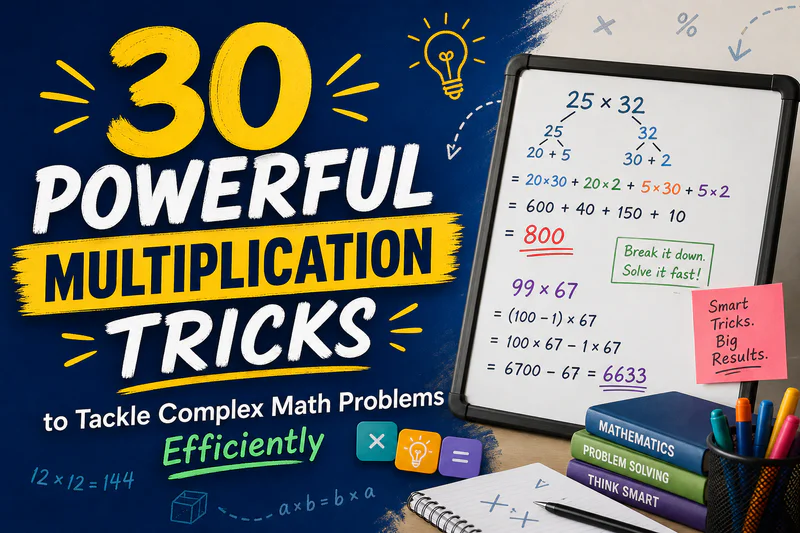
Math anxiety affects an estimated 20–30% of students, according to Education Week, and multiplication is often where that anxiety first takes hold. The good news? There is a smarter way to learn. Strategic multiplication tricks build genuine number sense, boost mental speed, and make math feel less like a chore and more like a superpower.
This guide walks through 30 of the most effective multiplication tricks, organized by difficulty, complete with a master reference table optimized for quick review. Whether your child is struggling with the 7s or ready to tackle two-digit mental math, these techniques, combined with the right online math programs for kids, can turn multiplication from a stumbling block into a genuine strength.
Why Multiplication Tricks Matter More Than Memorization
Drilling times tables until they stick is one approach. Understanding why and how numbers work together is a far more powerful one. Research consistently shows that students who learn strategic thinking alongside math facts retain those skills longer and transfer them to new problems more readily.
Automatic recall of math facts frees up working memory, the brain's short-term processing space, for higher-level reasoning. When a child doesn't have to stop and count on their fingers, they can focus on the actual problem at hand. This is precisely the cognitive foundation that quality math tutoring for kids aims to build.
There's another dimension worth considering: multiplication tricks are, at their core, algorithms. They are step-by-step logical procedures that produce a reliable result. This is exactly the kind of thinking that coding for kids develops. A child who has mastered multiplication shortcuts is already thinking computationally, and that's a significant head start. Ancient traditions recognized this too; vedic math classes have formalized rapid calculation techniques for thousands of years, proving that smart math shortcuts are timeless.
The Master Multiplication Tricks Table

Use this table as a quick-reference guide. It is structured to help parents, students, and educators identify the right trick for the right problem, fast.
Single-Digit Multiplication Tricks

Mastering the ×9 Table
The ×9 table intimidates most kids, but it has two elegant shortcuts. The Multiply by 10, Subtract method works for every case: to find 8×9, calculate 8×10 (= 80), then subtract 8 to get 72. Simple, reliable, and fast.
For visual learners, the finger trick is even more immediate. Hold both hands flat, fingers spread. To multiply 6×9, lower your sixth finger. The five fingers to its left represent 50; the four to its right represent 4. Answer: 54. No memorization required.
The ×5 Shortcut
Multiplying by 5 is secretly the same as multiplying by 10 and cutting in half. For even numbers, this is instant: 8×5 = 40 (half of 80). For odd numbers, subtract 1 first, apply the trick, then add 5. So 7×5 = (6×5) + 5 = 35. This connects directly to mental math tricks for kids that build number fluency across all operations, explore more techniques in our guide on mental math tricks for kids.
The ×4 and ×8 Tricks
Both of these are built on one simple skill: doubling. To multiply by 4, double the number twice. To multiply by 8, double it three times. A child who knows 6×2 = 12 can find 6×4 = 24 and 6×8 = 48 in seconds. This is the kind of pattern recognition that excellent online math programs for kids actively reinforce.
The ×6 and ×11 Tricks
For ×6, always start with ×5 and add the original number. Seven times 6 = (7×5) + 7 = 42. Fast, logical, and impossible to forget once the pattern clicks.
For ×11 with single digits, the answer is simply the digit repeated: 8×11 = 88. For two-digit numbers, the "split and sum" method applies. Take 35×11: keep the 3 and the 5 on the outside, place their sum (8) in the middle. Answer: 385. When the middle sum exceeds 9, carry the one, so 57×11 = 5_(5+7)_7 → 5_12_7 → 627.
Two-Digit and Large Number Tricks
Large multiplication problems look frightening on paper. Broken into steps, they become manageable, and this decomposition habit is one of the most transferable cognitive skills a child can develop.
The distributive property trick is the workhorse. Break one number into tens and ones, multiply each part separately, then add: 17×8 = (10×8) + (7×8) = 80 + 56 = 136. Every quality math tutoring for kids program teaches this approach because it mirrors how multiplication actually works, not as a memorized fact, but as a logical process.
Rounding and compensating is the other go-to method. To find 19×7, round 19 up to 20, calculate 20×7 = 140, then subtract 7 (one extra group). Answer: 133. This approach is particularly useful for numbers ending in 8 or 9. For numbers ending in 1 or 2, round down and add the difference back. These strategies feed directly into how online math programs for kids structure mental math challenges, building speed through reasoning, not repetition.
Mental math tricks for multiplication and where to start
Mental multiplication is not one skill, it's three, and they stack in a fixed order.
Doubling first. Every child who can double can already multiply by 2, 4 and 8, because ×4 is doubling twice and ×8 is doubling three times. Nothing else needs memorising.
Then decomposition. Break the harder number into parts you already know. 7×8 is 5×8 plus 2×8, which is 40 plus 16. This one habit handles the whole times table.
Then compensation. Round to something easy, multiply, then correct. 19×7 becomes 20×7 minus 7. Anything ending in 8 or 9 collapses to a single subtraction.
Work them in that order. A child who tries the Vedic base method before they can double reliably will stall, because every mental math strategy for multiplication assumes the one below it is automatic.
Vedic Math Inspired Tricks for Kids

Vedic math classes draw from an ancient Indian mathematical system that dates back thousands of years. Far from outdated, these techniques are remarkably aligned with what modern neuroscience recommends: pattern recognition over rote repetition.
The most celebrated Vedic technique for large number multiplication is the Base Method. To multiply two numbers close to 100 (say, 96×97), find each number's distance from 100 (4 and 3). Cross-subtract one distance from the other number: 96−3 = 93. Then multiply the distances: 4×3 = 12. The answer is 9312. Problems that look like calculator territory become 5-second mental calculations with this method.
The Criss-Cross (Urdhva-Tiryak) method extends this to any two 2-digit numbers. Multiply the ones digits, then cross-multiply (ones of one number by tens of the other, summed), then multiply the tens. Stack and carry. It sounds complex in description but becomes fluid with practice. For a deep dive into these ancient techniques, explore this comprehensive guide on Vedic math for kids.
Vedic math classes are increasingly incorporated into modern online math programs for kids because they offer something rare: they make kids feel like mathematical geniuses. And that confidence effect is just as valuable as the speed gains.
Connecting Multiplication Tricks to Coding Concepts
Here's something most parents don't realize: multiplication tricks are essentially algorithms. They are precise, step-by-step procedures that transform an input (two numbers) into an output (their product). This is exactly what programming does.
When a child works through the distributive property, breaking 17×8 into (10×8)+(7×8), they are decomposing a problem, a core skill in software development. When they apply the ×9 rounding trick, they are using an approximation-and-correction strategy, something programmers rely on constantly. Coding for kids programs explicitly build on this kind of structured thinking.
The connection becomes even more tangible with Python for kids. Python, one of the world's most widely used programming languages, handles mathematical operations directly. A child who understands multiplication shortcuts will understand why result = num * 10 - num computes a ×9 product, and that insight accelerates their coding progress significantly.
Strong online math programs for kids are increasingly designed with this STEM integration in mind. They don't just teach multiplication; they build the logical framework that makes coding feel natural. And coding for kids courses that incorporate math fluency see students advance faster across both disciplines.
How Parents Can Implement These Tricks at Home
Introducing multiplication tricks at home doesn't require a formal curriculum, but a consistent, structured approach makes all the difference. Here is a practical action plan:
Week 1–2: Start with one table. Pick the ×5 or ×9 trick first. Practice for 5 minutes daily, not 30. Short, frequent sessions build retention far more effectively than marathon drilling.
Week 3–4: Layer a second trick. Once the first is automatic, add the ×4 double-double method. Encourage your child to explain the trick back to you. Teaching reinforces understanding.
Ongoing: Mix tricks and application. Use real-life scenarios. "If apples cost 7 dollars each and we need 8, what's the total?" Real contexts make abstract tricks feel purposeful.
Pair this home practice with professional math tutoring for kids to ensure misconceptions get caught early. A skilled tutor can identify which tricks resonate with your child's learning style and adapt accordingly. For more strategies, this guide on how to improve your child's math skills at home offers a detailed, parent-friendly roadmap.
Enrolling in online math programs for kids provides the scaffolding that makes home practice sustainable. These platforms track progress, adapt to skill level, and keep children engaged with game-like challenges, which means they actually want to practice.
Conclusion
Multiplication tricks are more than time-savers, they are confidence builders. Every time a child solves what looks like a hard problem in seconds, they rewire their relationship with math. The anxiety fades. The curiosity grows.
The 30 techniques in this guide are a strong starting point, but sustainable progress requires the right support structure. Pair these tricks with quality online math programs for kids to keep learning consistent and adaptive. Add math tutoring for kids when a child needs more personalized guidance. And when your child is ready for the next challenge, introduce them to coding for kids, because a mind that has mastered multiplication tricks is already thinking like a programmer.
Frequently Asked Questions
What are online math programs for kids and why are they effective?
Online math programs for kids are structured, digital learning platforms that teach math concepts through adaptive lessons, interactive exercises, and real-time feedback. They are effective because they personalize the learning pace to each child, ensuring no one is left behind or held back. Programs like those at Codeyoung combine conceptual teaching with mental math fluency to build genuine number sense, not just test-ready recall.
How do vedic math classes help kids multiply faster?
Vedic math classes teach ancient calculation techniques, such as the Base Method and Criss-Cross multiplication, that reduce complex problems to simple, pattern-based steps. These methods train children to see relationships between numbers rather than treating each calculation as an isolated fact to memorize. Students who complete vedic math classes consistently report faster mental calculation speeds and greater confidence in math overall.
Can math tutoring for kids improve multiplication skills quickly?
Yes, targeted math tutoring for kids can accelerate multiplication mastery significantly, especially when the tutor identifies the specific tricks and strategies that match a child's learning style. Most children who receive structured math tutoring for kids alongside regular practice at home show measurable improvement within four to six weeks. The key is combining conceptual understanding with strategic repetition, which quality online math programs for kids also provide.
How does coding for kids relate to learning multiplication?
Multiplication tricks are fundamentally algorithmic, they are step-by-step procedures for solving problems efficiently. This is the exact mental model that coding for kids programs develop. A child who practices breaking multiplication problems into smaller parts (distributive property) is already practicing the decomposition and abstraction that are central to programming. Enrolling in coding for kids courses alongside math instruction creates a powerful, mutually reinforcing skill set.
When should children start learning multiplication tricks?
Most children are ready to begin multiplication tricks around ages 7–8, once they have a solid foundation in addition and basic multiplication concepts. However, online math programs for kids can introduce pattern-based thinking, like doubling, even earlier. Vedic math classes often introduce foundational concepts to children as young as 6, using visual and tactile methods that make abstract patterns tangible.
What is the best way to learn times tables without drilling?
The most effective approach combines strategic tricks with meaningful context. Instead of drilling 7×8 until it sticks through sheer repetition, teach the trick (7×8 = 5×8 + 2×8 = 40+16 = 56) and then apply it in a word problem. Online math programs for kids use this method by design, embedding facts within puzzles and real-world scenarios so the brain forms associations that stick long-term.
Are multiplication tricks better than traditional memorization?
Tricks are not a replacement for eventual fluency, they are the path to it. Understanding why 7×9 = 63 through a logical process builds far more durable memory than reciting it 50 times. Once a child has used the trick enough times, the answer becomes automatic anyway. Math tutoring for kids programs that teach tricks first, fluency second, consistently outperform drill-only approaches in long-term retention assessments.
How does Python for kids benefit from early multiplication mastery?
Python for kids relies heavily on mathematical operations from the very first lessons, calculating loop iterations, working with arrays, building functions that process numerical data. A child who is fluent in multiplication and understands how numbers relate to one another will progress through Python for kids curricula significantly faster. The mental math habits built by tricks like the distributive property translate directly into writing efficient code and understanding what that code is computing.
How do mental math tricks complement online math programs for kids?
Mental math tricks fill the gap between understanding a concept and executing it fluently under pressure. Online math programs for kids provide the structured curriculum and adaptive practice; mental math tricks give students the rapid-fire tools to apply that knowledge instantly. Together, they create a complete learning system, one that builds both deep understanding and practical speed.
Can combining vedic math and coding accelerate math learning?
Absolutely. Vedic math classes develop non-linear, pattern-based thinking that makes calculations faster and more intuitive. Coding for kids programs develop sequential, logical thinking that makes problem decomposition natural. When children are exposed to both, they develop a rare cognitive flexibility, the ability to see a problem from multiple angles and choose the most efficient path. Online math programs for kids that integrate elements of both vedic math and computational thinking represent the most comprehensive approach to STEM preparation available today.