Every child who uses an app today has the potential to build one tomorrow. In 2026, that shift, from passive screen consumer to active digital creator, is not just possible. It's the most future-proof skill set a young person can develop.
This guide breaks down the 12 best programming languages for app development, why structured app development classes for kids matter more than ever, and how mathematics and coding work together to unlock genuine tech leadership.
Why Kids Should Start App Development in 2026
The global coding for kids market was valued at $2.8 billion in 2025 and is projected to reach $9.1 billion by 2034, according to data from Dataintelo. That growth reflects a simple truth: the world is being built by people who know how to write software, and the best time to start learning is during childhood.
Here's why 2026 is the ideal year to enroll your child in app development classes for kids:
Creativity on demand: Building an app forces kids to design, iterate, and solve problems in ways no other medium can replicate.
STEM readiness: Coding for kids develops logical thinking, sequencing, and pattern recognition, all foundational STEM competencies.
AI literacy: In 2026, AI is embedded in almost every consumer app. Kids who understand how apps are built can also understand, and eventually direct, AI systems.
Digital literacy beyond usage: Knowing how software works transforms a child's relationship with technology from dependency to mastery.
Career preparation: From mobile development to machine learning engineering, the career paths unlocked by early app development classes for kids are among the most lucrative in the global economy.
For a broader look at where these skills lead professionally, explore STEM careers for kids, the opportunities available to today's young coders are extraordinary.
The Role of an Application Programmer
Before choosing a language, it helps to understand what an application programmer actually does. At its core, an app developer takes an idea and turns it into a working piece of software that solves a real problem or creates an experience.
For kids enrolled in app development classes for kids, this translates into concrete, learnable responsibilities:
Designing user interfaces (UI): How an app looks and feels to the person using it.
Writing backend logic: The invisible rules that make an app function, calculations, data storage, conditional responses.
Debugging and testing: Identifying what's broken and fixing it systematically.
Integrating APIs and tools: Connecting an app to external services, including AI tools, maps, or databases.
Iterating based on feedback: Updating and improving code as user needs evolve.
Every one of these skills is teachable. The right programming language, matched to a child's age and goals, is the gateway. Structured online coding classes for kids provide the scaffolding that makes the journey from idea to working app both achievable and genuinely exciting.
12 Programming Languages for App Development for Kids, Comparison Table

Deep Dive: Why Each Language Matters for Kids in 2026
Scratch, The Creative Starting Point
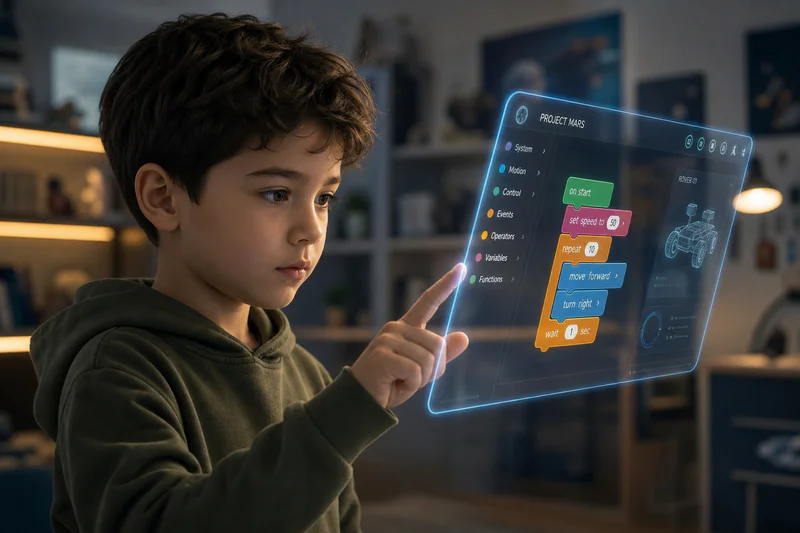
Scratch programming for kids remains the gold standard introduction to app logic for children aged 5 to 10. Developed by MIT, Scratch uses drag-and-drop blocks to represent code, eliminating syntax barriers while teaching loops, conditionals, and event-driven logic. Kids who start with Scratch programming for kids build an intuitive mental model of how software thinks before they ever type a line of text.
Curious about what young learners can actually create? Read more about app development for kids, the results consistently surprise even skeptical parents.
Python, The Language of AI-Powered Apps
Python for kids is the single most important language in the 2026 app development landscape. Its readable, near-English syntax makes it accessible to beginners, while its libraries (Pygame, Flask, TensorFlow Lite) make it powerful enough to build AI-integrated applications. In structured app development classes for kids, Python is typically introduced around age 10 and used to create everything from quiz apps to machine learning projects.
Python projects for kids offer a fantastic roadmap for what's achievable at every skill level, from simple calculators to data-driven apps.
JavaScript, The Language of the Web
JavaScript runs in every browser on earth. For kids interested in building web-based apps and interactive experiences, it's non-negotiable. Combined with HTML/CSS (which handles the visual layer), JavaScript gives young developers a complete toolkit for creating apps that work on any device without installation.
Java and Kotlin, Building for Android
Java has powered Android development for over a decade. It's verbose but teaches rigorous object-oriented programming (OOP) principles that underpin most enterprise software. Kotlin, now Google's officially preferred Android language, is more concise and modern, making it the better choice for kids starting app development classes for kids in 2026. Both languages are deeply relevant for building apps on the world's most popular mobile operating system.
C# and Unity, From Games to Apps
C# within the Unity engine is a remarkable entry point because it feels like game-making before it feels like coding. This matters enormously for engagement. Kids working on game design for teens through Unity frequently discover they're also learning the exact development principles used to build commercial mobile apps.
Lua, Swift, C++, Ruby, Blockly, HTML/CSS
Lua's dominance on Roblox makes it a natural motivator for millions of young creators, they're already playing games built with it. Swift, with Apple's dedicated Swift Playgrounds app, gives iOS-focused kids a structured, game-like environment to build real apps for iPhone and iPad. C++ demands more maturity but produces developers with an exceptional understanding of how computers actually work. Ruby's elegant syntax makes it a surprisingly effective teaching language for web app prototyping. Blockly, like Scratch, serves as a visual foundation. And HTML/CSS, though sometimes underestimated, is the direct language of visual app design, making it essential foundational knowledge in any serious app development classes for kids curriculum.
How App Development Classes For Kids Accelerate Learning
Self-teaching has its place, but structured app development classes for kids produce dramatically faster progress. Here's why the learning environment matters as much as the language itself.
In a well-designed program, children don't just watch tutorials, they build projects, receive real-time feedback, and work through debugging challenges with an expert mentor. Online coding classes for kids at platforms like Codeyoung are structured precisely this way: live, instructor-led sessions with personalized guidance tailored to each child's pace and goals.
This matters most when kids hit the inevitable learning walls, the moments when a loop doesn't work as expected, or a function returns an error they can't parse. A skilled mentor in online coding classes for kids converts those moments of frustration into breakthrough learning experiences, rather than letting them become reasons to quit.
Personalized math tutoring for kids plays a complementary role here. Languages like Java and C++ require students to manage data types, memory allocation, and computational logic, all of which become significantly easier when a child has strong mathematical reasoning skills. The relationship between coding and math for kids is not incidental; it's structural. One discipline directly accelerates the other.
The Math Behind App Development: Why Online Math Programs and Vedic Math Classes Matter
App development is, at its core, applied mathematics. This is not an abstraction, it shows up constantly in practical development work.
Consider UI design: positioning elements on a screen requires coordinate geometry. Calculating in-game scores demands arithmetic and conditional logic. Building a recommendation algorithm (even a simple one) involves statistical thinking. Every child in app development classes for kids who also has strong numeracy skills will progress faster, debug more efficiently, and build more sophisticated projects.
This is where online math programs for kids become a strategic complement to coding education. Platforms like Codeyoung's math program pair rigorous math skill-building with the practical context of technology, helping kids see why fractions, algebra, and geometry matter beyond the classroom.
Vedic math classes offer something particularly relevant to young app developers: speed and pattern recognition. The structured, high-speed mental arithmetic techniques taught in vedic math classes mirror the algorithmic efficiency that makes great code great. When a child learns to solve a multi-digit multiplication problem mentally in seconds using Vedic techniques, they're developing the same cognitive muscles that help them optimize a sorting algorithm or evaluate the most efficient way to structure a loop.
Math tutoring for kids provides the 1:1 mentorship dimension that makes all of this click. Complex logical hurdles in languages like Java or C++ often aren't really programming problems, they're mathematical reasoning gaps. Targeted math tutoring for kids through online math programs for kids closes those gaps systematically, making advanced app development classes for kids far more accessible.
Conclusion
The 12 programming languages covered in this guide represent a complete toolkit for young creators ready to move from using technology to building it. Whether your child starts with Scratch programming for kids at age 6 or dives into Python for kids at 12, the path to becoming a capable app developer is structured, learnable, and genuinely exciting.
The smartest move any parent can make right now is to pair structured online coding classes for kids with strong math foundations through dedicated online math programs for kids. Together, these two disciplines form the complete foundation for app development mastery, and for the technology careers that will define the next generation of innovation.
Frequently Asked Questions
What is the best programming language for app development classes for kids?
Python for kids is the top recommendation for most learners aged 10 and above. Its clean syntax, vast library ecosystem, and direct relevance to AI-powered app development in 2026 make it the most versatile starting point. For younger children (ages 5–10), Scratch programming for kids is the definitive best first language, it builds visual logic and creative thinking before any text-based syntax is introduced. In structured app development classes for kids, the typical pathway is Scratch → Python → JavaScript or Kotlin, depending on the child's platform focus.
At what age should kids start app development classes for kids?
Children as young as 5 can begin app development classes for kids using block-based environments like Scratch programming for kids or Blockly. Text-based app development with languages like Python or JavaScript is typically introduced around ages 10–12. Online coding classes for kids at Codeyoung are structured to meet learners exactly where they are, regardless of starting age.
Can kids really build their own apps with Scratch programming for kids?
Absolutely. Scratch programming for kids enables children to build interactive stories, games, and simple apps entirely through visual blocks, no text syntax required. MIT's Scratch platform hosts millions of student-created projects. It is a genuine app-building tool, not just a toy, and forms the core of many serious app development classes for kids curricula for the 5–10 age group.
How do online coding classes for kids transition learners from Scratch to Python for kids?
Well-designed online coding classes for kids use a project-based bridge approach. A child who has built games in Scratch programming for kids already understands loops, events, and conditionals conceptually. The transition to Python for kids then focuses on translating those understood concepts into text-based syntax, which feels far less intimidating when the logic is already familiar. Coding for kids programs that rush this transition tend to lose learners; those that bridge it carefully produce confident Python developers.
What is the easiest language for kids to build mobile apps?
For iOS, Swift with Apple's Swift Playgrounds is remarkably accessible. For Android, Kotlin is the most modern and readable option. For cross-platform web apps, HTML/CSS + JavaScript is the lowest-friction entry point. All of these are taught in quality app development classes for kids programs, with the right choice depending on the child's device preference and age.
How does math tutoring for kids help with learning complex languages like Java and C++?
Java and C++ require learners to reason about data types, memory, recursion, and algorithmic complexity, all of which draw directly on mathematical thinking. Math tutoring for kids that covers algebra, logic, and number theory builds exactly the cognitive frameworks needed to understand these languages deeply. Children who receive targeted math tutoring for kids alongside their app development classes for kids consistently progress faster and with greater conceptual clarity than those who treat the two subjects as separate.
Are online math programs for kids important for app development?
Yes, and significantly so. Online math programs for kids develop spatial reasoning (critical for UI design), arithmetic precision (essential for game score calculations and data handling), and logical sequencing (the foundation of all algorithmic thinking). Vedic math classes add a dimension of rapid, pattern-based mental computation that directly parallels algorithmic efficiency in code. Pairing online math programs for kids with app development classes for kids creates a compounding effect on STEM capability.
How are Python projects for kids relevant for AI-powered apps in 2026?
Python for kids is the gateway to AI development because Python hosts virtually every major machine learning library in use today, TensorFlow, PyTorch, and scikit-learn among them. Python projects for kids at the intermediate and advanced level now regularly include sentiment analysis tools, image classifiers, and chatbot integrations. In 2026, app development classes for kids that incorporate Python for kids are directly preparing young learners to build the AI-integrated apps that define the current tech landscape.
What careers can kids aim for after learning app development classes for kids?
The career pathways are broad and consistently well-compensated. App development classes for kids build foundational skills for mobile app development, full-stack web engineering, AI/ML engineering, game development, UX/UI design, and cybersecurity. As coding for kids education matures into higher education and professional experience, early starters have a measurable advantage, both in technical depth and in the portfolio of real projects they've already built. Explore STEM careers for kids for a detailed breakdown of where these skills lead.
How does game design for teens relate to app development classes for kids?
Game design and app development share the same foundational skills: programming logic, UI/UX thinking, user testing, and iterative improvement. Game design for teens is often the most motivating entry point into serious app development classes for kids because it harnesses existing passion for an immediately tangible creative goal. Many professional app developers built their first "app" as a game, and the technical skills transferred completely.